

In Japan there are many opportunities to explore and experience the history and culture of ninjas, Some of them are serious and authentic replications of the ninja life, and others are more playful, and only loosely based on tradition. During our stay in Japan this time, we were able to have a ninja adventure that mostly fell into the latter category, though it certainly had touches of the former. This was at a place called Ninja Station; to get there required a drive that, we were delighted to see, gave us a good view of Mount Fuji.


Modern Day Ninja Training 101
There are several components to the ninja experience at Ninja Station. First, of course, you have to get into the proper frame of mind and show the world you mean business by donning a ninja costume and posing for a photo. There’s a pretty good selection of garb to choose from, all looking ninja authentic — well, at least authentic enough for a theatrical production or some such.


Then you get to try your hand at throwing a ninja star, those pointed-blade metal projectiles that could do some damage if hurled by a skilled warrior. At a distance of about 10 feet, we tried firing these off at a target, and on several attempts, actually hit the bullseye or at least got amazingly close. Run away in terror, evil villains.


But this facility isn’t content to offer a practice of traditional ninja arts; it also extends the concept to the possibilities afforded by modern technology. In one section, we enacted a sort of laser tag battle against each other, rather like gunslingers in a showdown of the Wild West. In another, we donned virtual reality helmets and took on an imaginary warrior on horseback, with our virtual sword, a challenge more daunting that it appears — a virtual warrior is a more formidable foe than a flesh-and-blood spouse.


There was also a chamber where we practiced ninja-esque maneuvers by dodging laser beams, crawling over, under, around and between them as required. This was reminiscent of a similar feature at 5 Wits, a franchise of puzzle-solving attractions back in the U.S. (We’re quite familiar with it because our son Zephyr is Director Of Guest Experience for the company.) At Ninja Station, however, you can adjust the level of difficulty to continue providing a challenge when you reach the smarty-pants stage and think you have the skills all conquered.


Ninja Museum Artifacts
To cap off our ninja escapade, we toured the adjacent ninja museum, which houses artifacts of actual ninjas from long ago, not wannabe ninjas like us. Some of the items on display were put into use three or so centuries ago. These include not only weapons and tools like real ninja stars, swords, and axes, but also shoes and other items of clothing and gear.


Having satisfied our ninja cravings for the time being, we went to lunch at another one of those superb traditional-style Japanese restaurants that our hosts have a habit of finding and taking us to.


Shima Onsen
Then we drove up into Gunma Mountains, into a resort village called Shima Onsen, which was crusted with snow and not very busy at this time of year; which was great, because its timely sleepiness made it more tranquil and ethereal than it would have been had it been bustling with tourists.


Spirited Away Inspiration
That mood of enchantment was quite appropriate, since one of our main reasons for being here was that this location inspired some of the scenery in the animated film Spirited Away (which we’d seen a time or two), directed by Hayao Miyazaki, who very well might be characterized as the Japanese Disney. (On our previous trip to Japan, we toured the Tokyo-area museum of Miyazaki’s Studio Ghibli; and Zephyr went with his Japanese friends to a cinema to watch a newly released Ghibli film.)


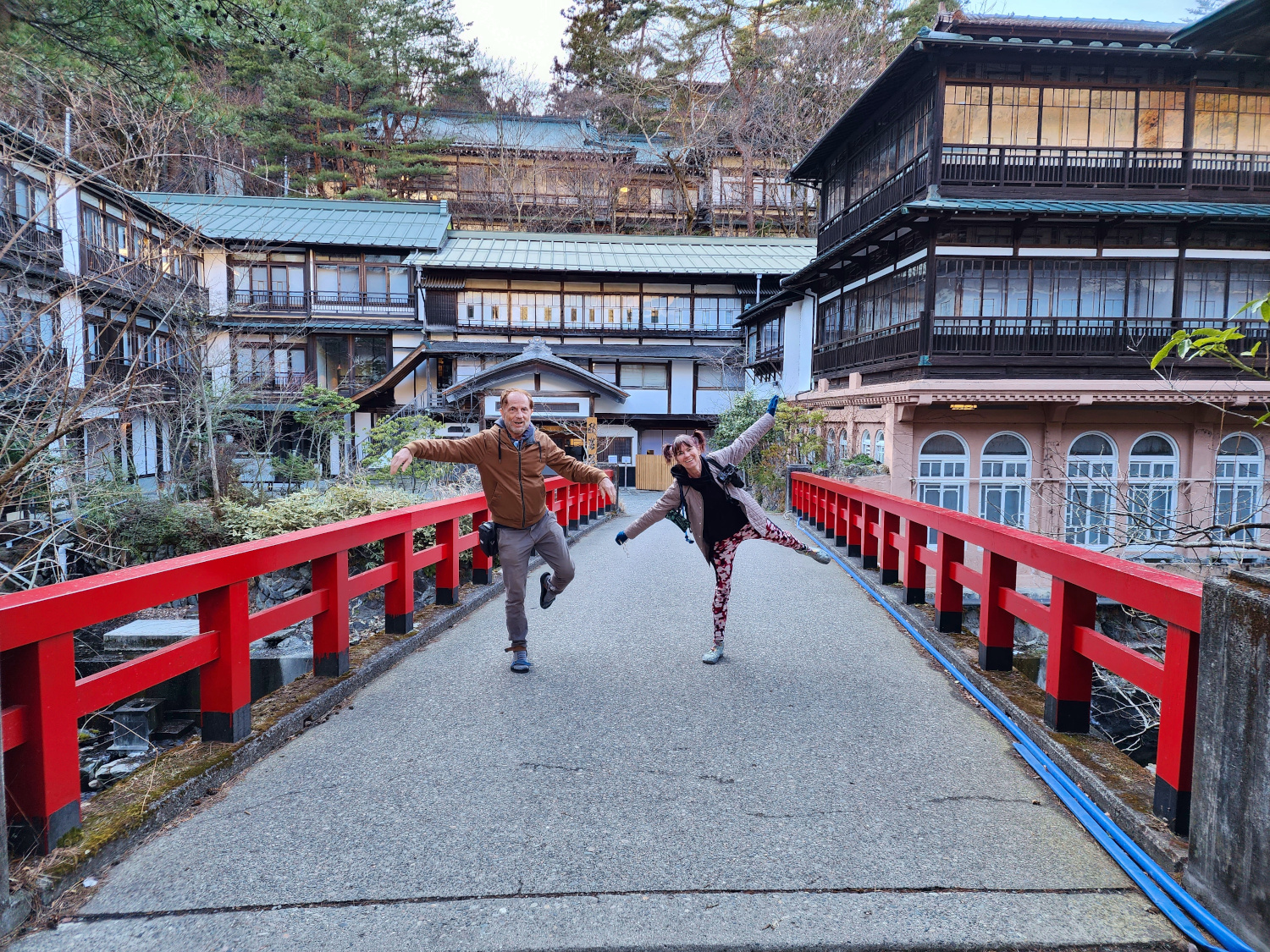
In particular, there’s the landmark red bridge, a pedestrian bridge leading to the 300-year-old Sekizenkan resort hotel, where Miyazaki reportedly has stayed several times. Seeing that distinctive red bridge, he apparently couldn’t resist making use of it. When you walk or stand on that bridge, it’s easy to imagine yourself being transported into another dimension, at least if you’ve seen the movie.


An onsen, by the way, is a spring-fed thermal mineral bath. It’s a popular Japanese attraction, at many places in the country that we’ve been wanting to avail ourselves of for some time. (Nudity is required to bathe in one, and in the good old days, genders were mixed; nowadays, it’s more common to have them segregated.) Well, we weren’t able to do it this time, but we did get a taste of it by partaking of a foot bath. It was free for public use; we just walked in, sat down, and plopped our feet into the water.


Back at home in the evening, we got a demonstration of a Hinamatsuri celebration. You may recall from a previous post that Hinamatsuri is the festival honoring young girls with, among other things, an elaborate display of dolls and accessories — and in this case, we helped assemble the display.
Tea Party for the Dolls


The daughter of the family, Ayaka, is long past Hinatsmuri age; but what the heck, we had the celebration anyway. It consisted basically of the family just having a bunch of sweets and snacks while seated in front of the doll display. And the Japanese know how to make some very interesting snacks. So we enjoyed them, but we were careful not to overindulge; a ninja must stay fit, you know.
Getting There
- Ninja Station “Ninpaku” 624-4 Haramachi, Higashiagatsuma, Agatsuma District, Gunma 377-0801, Japan
- Red Bridge from Spirited Away “Keiun-bashi” Sekizenkan in Shima Onsen, Gunma Prefecture, Japan
3/3/2023

Leave a Reply