

Dennis’s Rishikesh Rummage
DENNIS: During Kimberly’s stint studying yoga in Rishikesh, I made another excursion to Rishikesh myself. But I did not have a chance to meet up with her, because she was too busy, and my business was in another part of town. I was going to see a dermatologist, to take care of an infection I’d had between two of my toes for several weeks.
Fortunately, appointments are usually not necessary to see the doctor in India. Generally, you can just drop in. But I have a very hard time finding the doctor’s office. It simply is not in the location where Google Maps tells me it is. Finally, I locate it on a little side street (not the street it’s supposed to be on) that I’ve already walked down a couple of times. The entrance is upstairs, and the stairs leading to the upstairs are rather inconspicuous. Furthermore, the sign advertising the business is partially concealed behind some poles and a mess of electrical wiring.
After I get upstairs and sign in with the receptionist, I pay the fee in advance of 300 rupees – about $3.50. (Just try getting an office visit or even to an office visit for that in the U.S.) And I only have to wait about 10 minutes before the doctor sees me. I show him my infection, and he confirms, as I suspected, that it is a fungus somewhat like athlete’s foot. When I show him the medication I’ve been putting on it for the past couple of weeks, he says, “No, don’t use that. That actually could make it worse. This product has been banned by the Supreme Court of India, but a few local pharmacies still sell it.”
So he prescribes some new medicine, which I am able to obtain at a little pharmaceutical booth conveniently located right out front. I take home two tubes of it, plus some oral medicine. The total cost for everything is about 1000 rupees (12 bucks). Back in the States, we think of doctors as owning two homes, four cars, and a stake in a golf course. In India, it seems amazing that they can even stay alive on what they get paid.
From there, I’m off on an errand to track down a pocket datebook for the upcoming year’s appointments and reminders. Yes, I’m one of the Stone Age Luddites who still prefer to do this on paper rather than digitally. And it’s become increasingly hard to find the old-fashioned pocket datebooks to do it with. I’ve already searched in several office supply stores to no avail.
Today, acting purely on a hunch, I turn down a little pedestrian thoroughfare, and walk about a block, and there’s a little bookstore. I go inside, and on a little shelf near the front there is, wonder of wonders, a packet of two, yes two such datebooks, very compact. I don’t know exactly why anyone would need two for the same year. But here they are, ripe for the purchasing. They set me back 44 rupees, or about 25 cents each.
Before heading back home to Raiwala, I start looking for some place to grab some lunch. Vegetarian food is not hard to find in Rishikesh. In fact, that’s all that’s available. What I stumble upon is a little cafeteria type of establishment, where you select food at a counter, pay for it there, and then either take it with you or sit at a table to eat it.

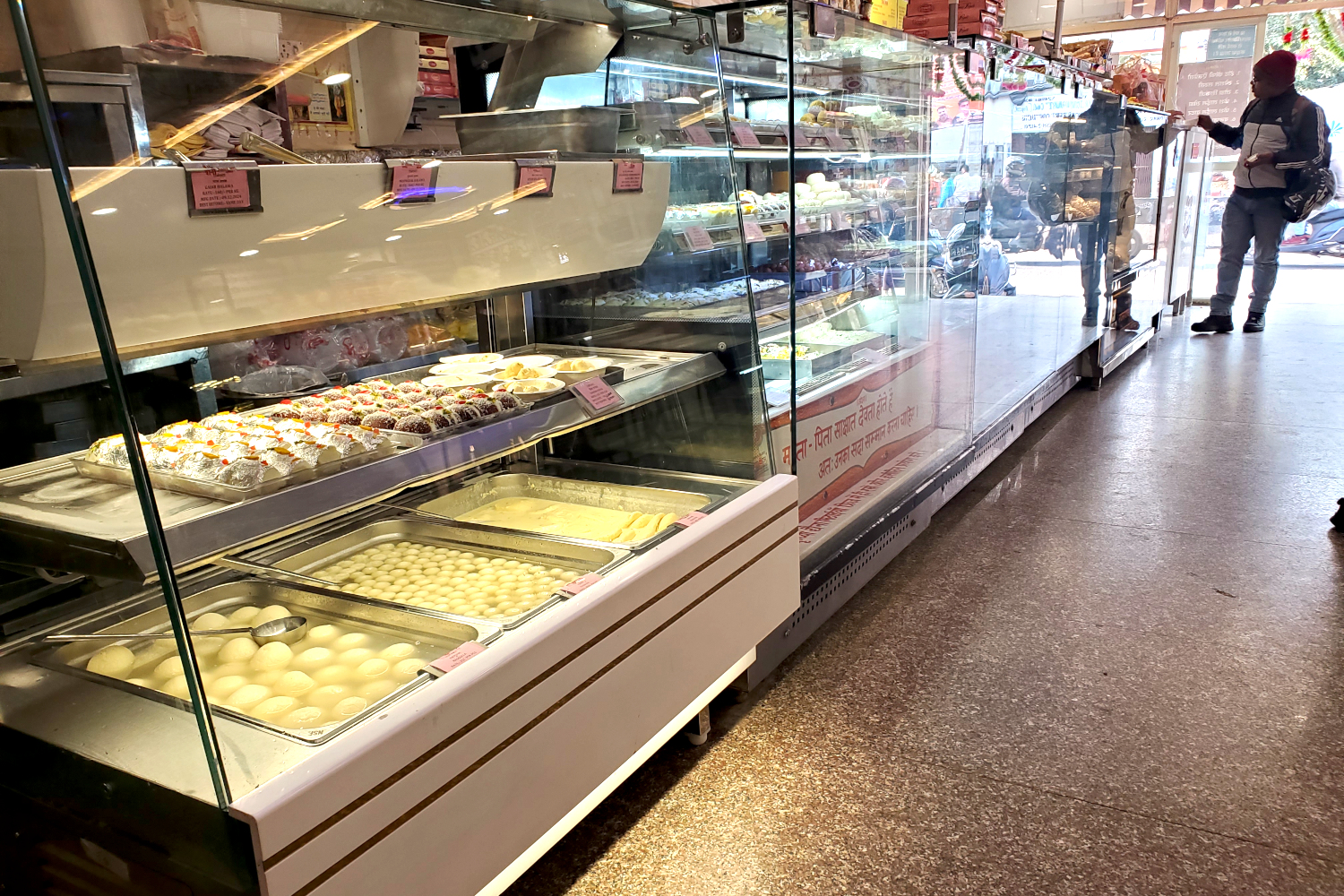

What catches my eye is a paneer wrap (paneer is Indian cheese), but I’m confused about the ordering procedure. A fellow who seems to be the manager of the place happens to be standing nearby, and he comes to my rescue. The wrap costs less than a dollar, and is every bit as delicious as it looks.
This expedition into Rishikesh has been both successful and economical – the biggest expense has been getting there and back. India is definitely a good place to find a bargain. But that’s because it’s a nation with a great deal of poverty and squalor. And when you see the conditions in which many of the people live, it’s hard to feel elated about saving a few bucks on goods and services, as the money saved could considerably improve the lives of the locals.
If you enjoy reading about our adventures and impact, consider supporting us on Patreon.
Kimberly’s Journey: Yoga, Rapids, and Reverence
KIMBERLY: In Yoga Teacher Training we’ve been learning how the 5 elements of Water, Fire, Earth, Air, Ether keep showing up all around us. It’s a fascinating concept, especially when you start to see it woven into everything, from the human body to the natural world. In our bodies, these elements are represented by blood (water), digestion (fire), bones (earth), breath (air), and the subtle space between the cells (ether). This connection between the macrocosm and microcosm is a core principle in yoga philosophy, and seeing it manifested in our daily experiences here in Rishikesh has been truly profound.
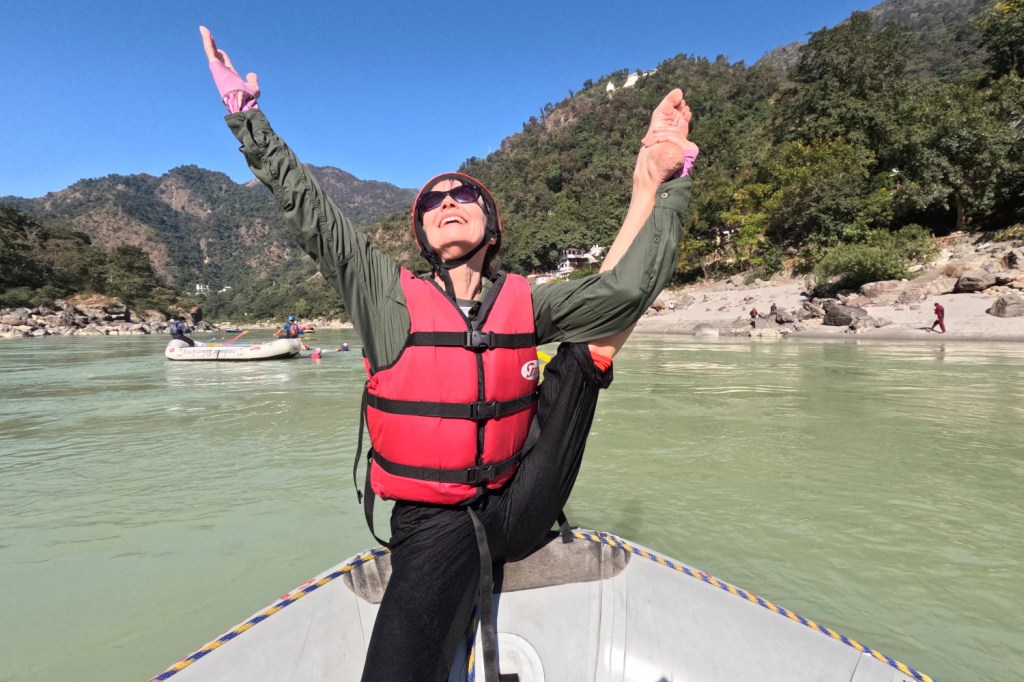
So it was fitting that, on one of the days, we paid a visit to the legendary Ganga “Ganges” River, a powerful symbol of water and purification. After two early morning classes, which really set the tone for the day – we have the option of rafting down the Ganga. An opportunity I can not to pass up! The thought of navigating the revered waters, feeling their energy, is too compelling. They load us into vans with rafts strapped on the roof and head up the river to drop us off at the launching point.
Rafting on the Ganga River

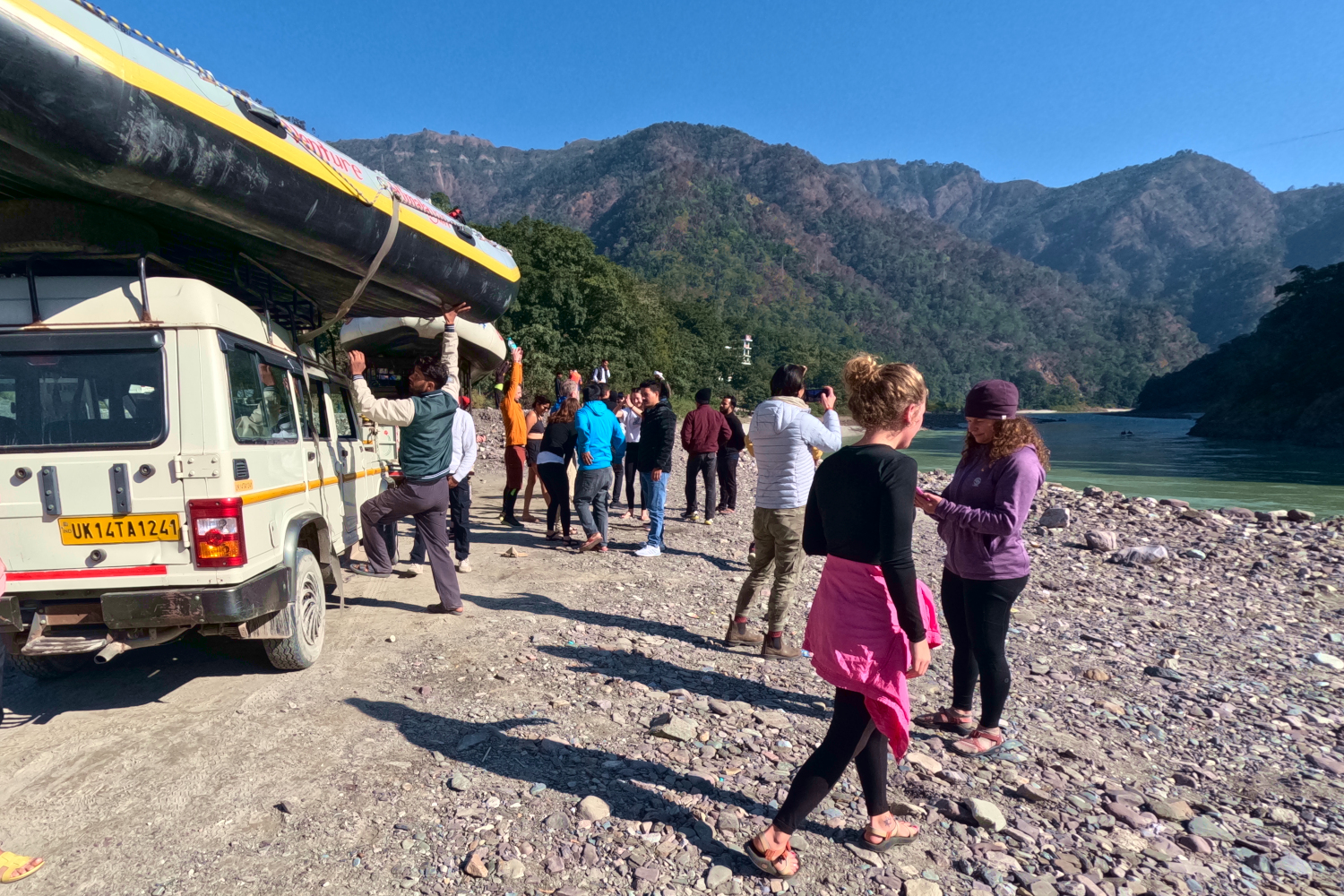

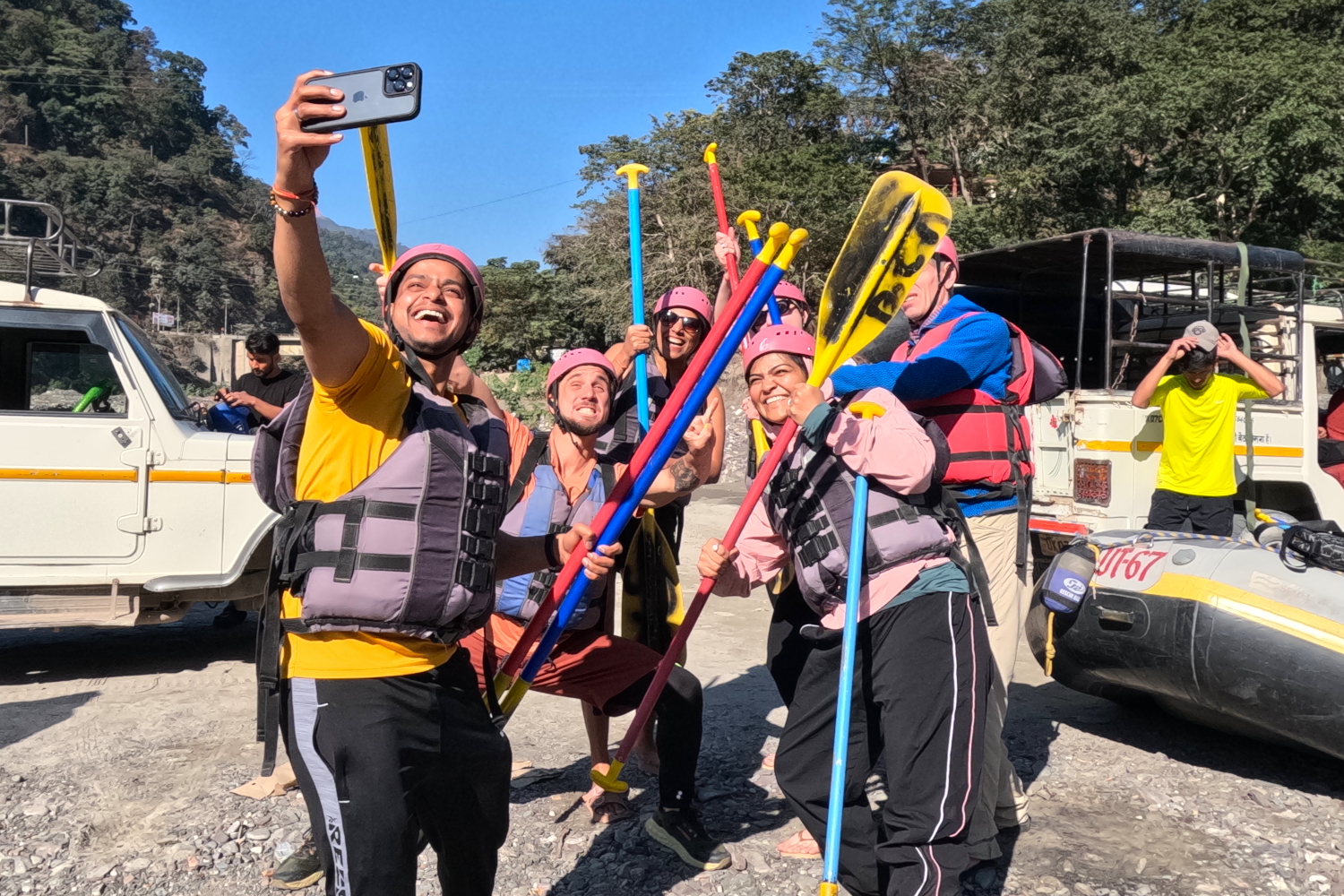

The drive upriver is most scenic, offering glimpses of the lush Himalayan foothills and the winding, emerald-green Ganga below. When we finally arrive at the banks of the Ganga, we are issued paddles and given a quick orientation on using them. In true Indian fashion, there are a few comical moments. One of the guides unexpectedly takes my paddle away – I still have no idea why! And then, I am instructed to load into three different rafts, but since there is only one of me, I eventually manage to settle into a single raft. I even have to actively request a paddle back! It’s moments like these that have taught me to embrace the unexpected and to take things in stride here; not everything in India will make immediate sense, and that’s part of its charm.
I also get told three times that I need to leave my GoPro in the van. But feeling quite confident that it’s secured properly to my life vest, ready to capture the adventure, I override the order and tote it along. The guides eventually relent, feeling they’ve done their best to warn me that it might fall off and get lost. I do, however, follow their advice to leave my extra clothing behind.

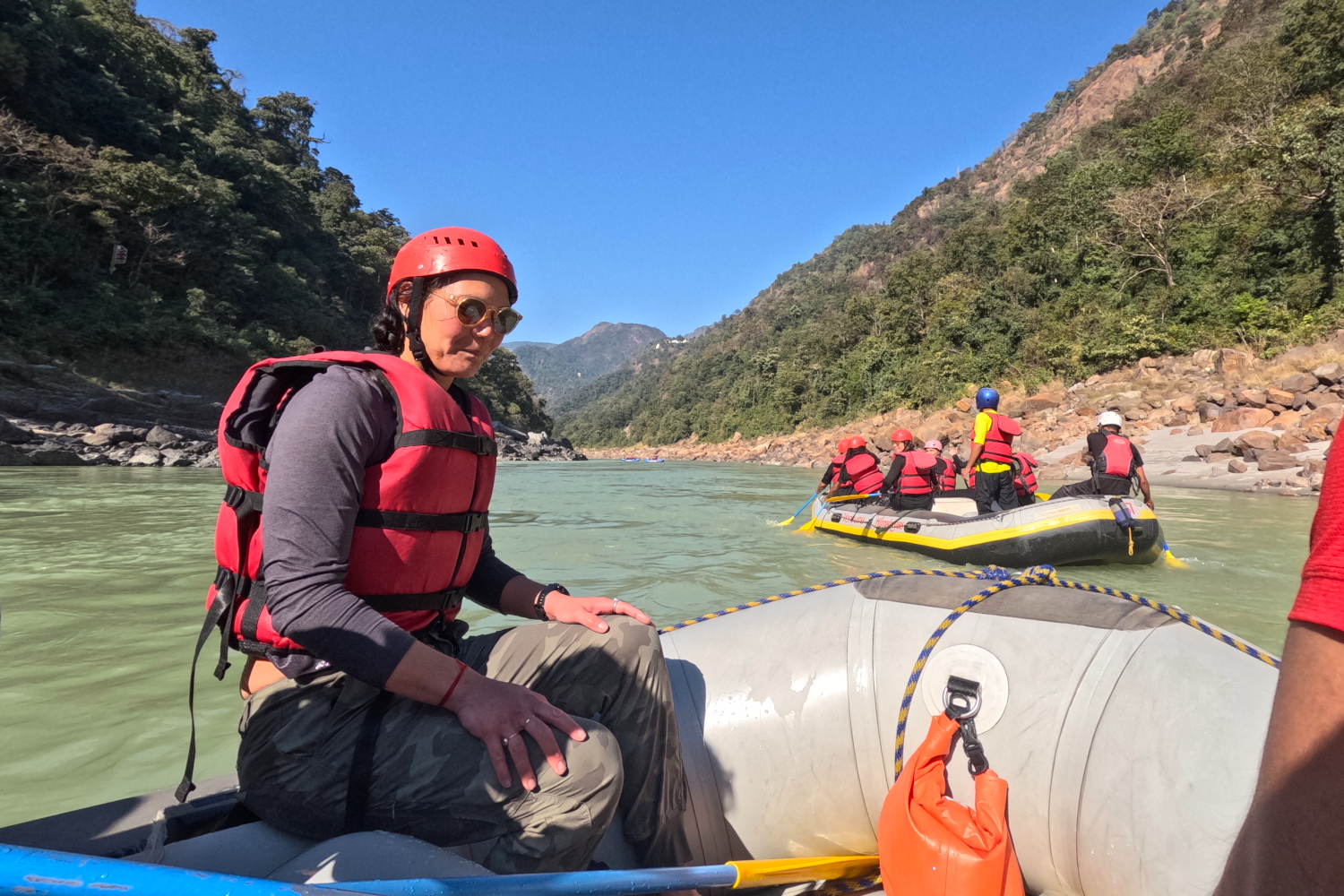

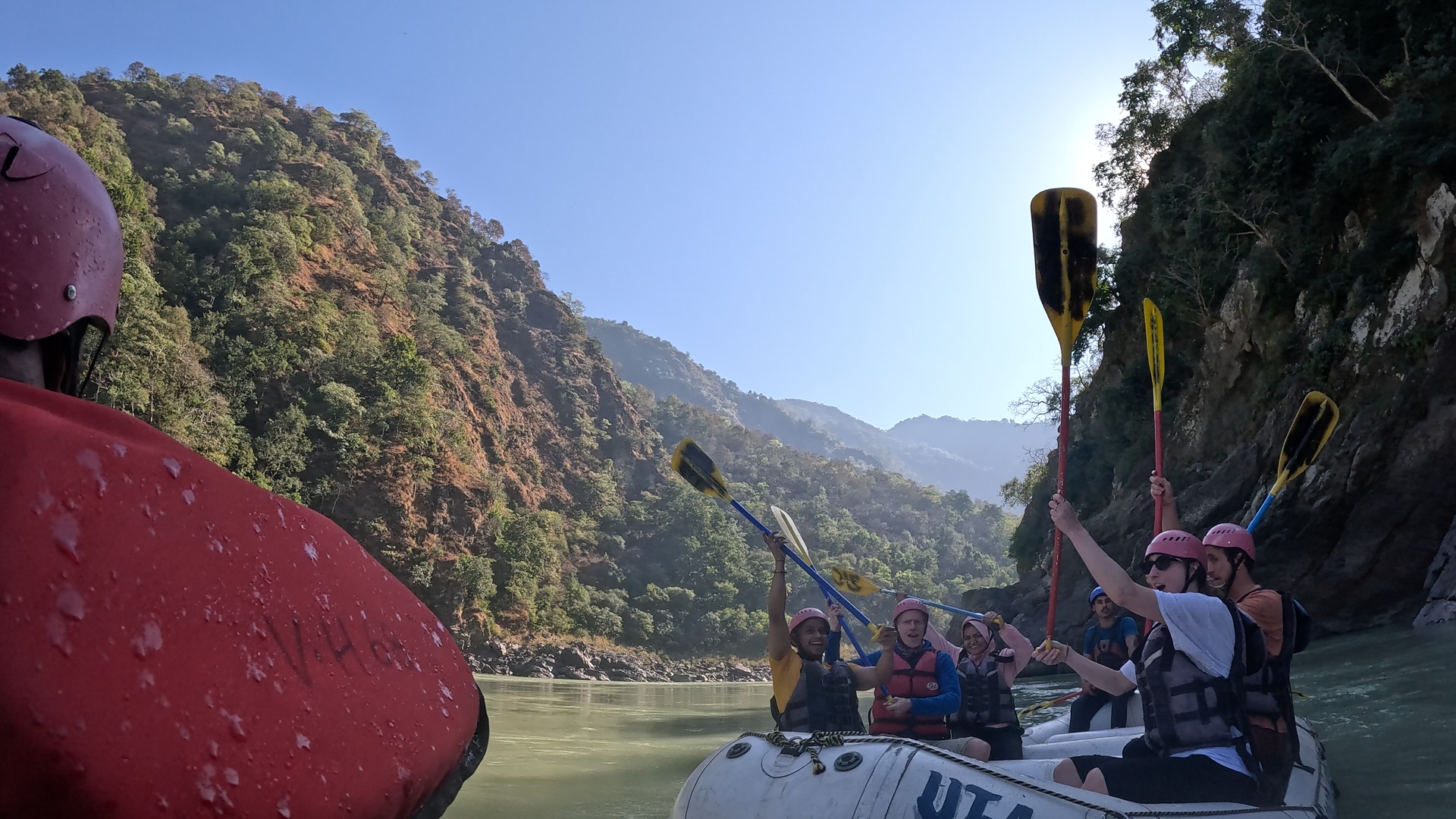
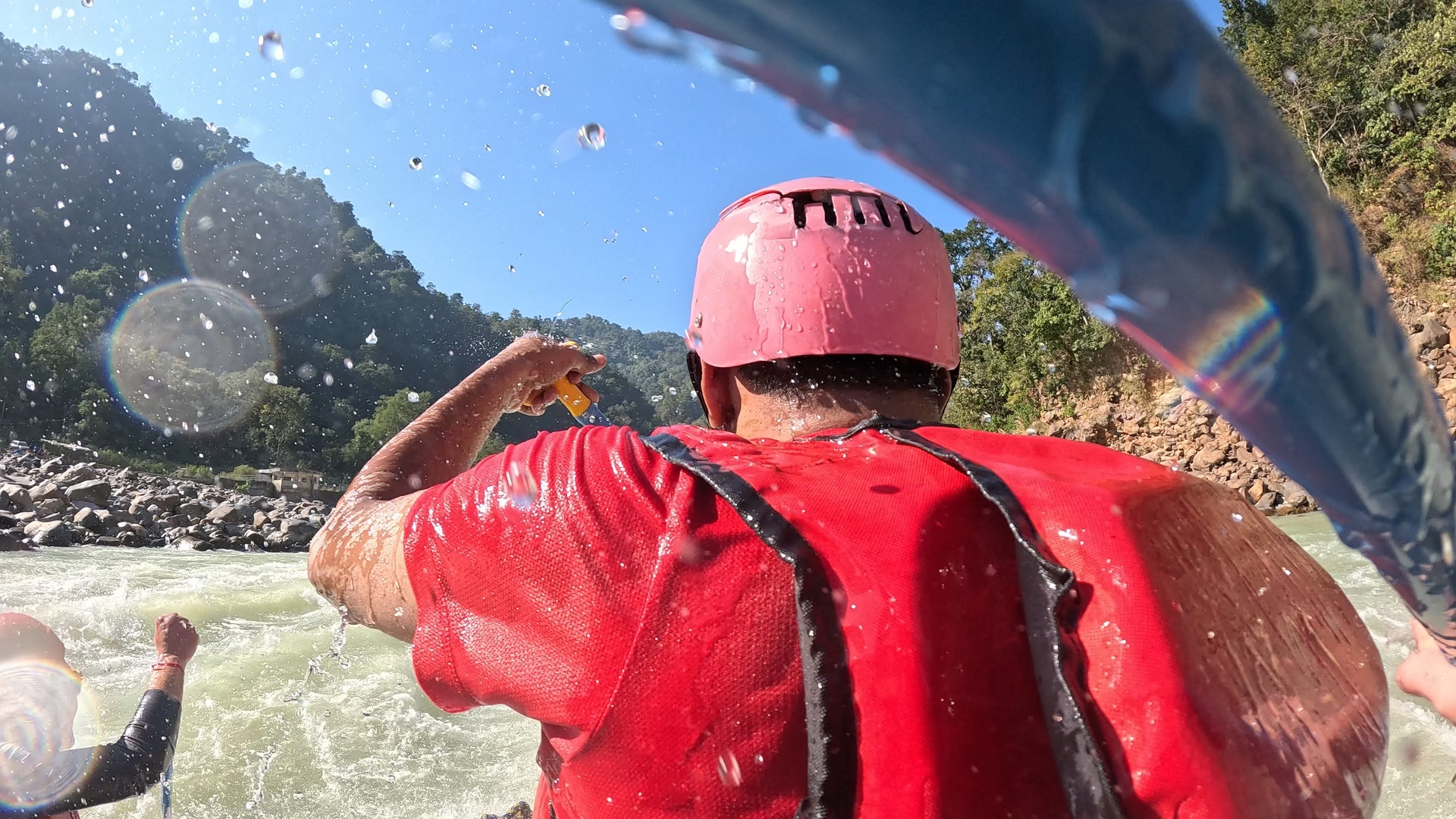
We indulge in some initial paddling to get a feel for the rhythm of the river and our team. I’m not sure who the guy is sitting directly in front of me; none of us have ever seen him in a yoga class before. All I know is it’s incredibly difficult to paddle in sync behind him as he is not keen on listening to directions and paddles unevenly, throwing off our collective rhythm. He especially makes me nervous when we come to the rapids. The Ganga in Rishikesh is famous for its exhilarating white-water rapids, ranging from Grade I to Grade IV. Our section likely includes some exciting Grade II and III rapids, which provides a mild rush, nothing too challenging. Every surge of water, every plunge, feels like a powerful embrace from the river itself, a true test of balance and trust in the raft and our guides.
When the waters are calmer we have the option to jump into the river. I pass on the full plunge and let the freezing water come to me instead. Probably would not have made any difference as I still get soaked just as thoroughly. I get a kick out of watching my classmates bravely jump in and float along.
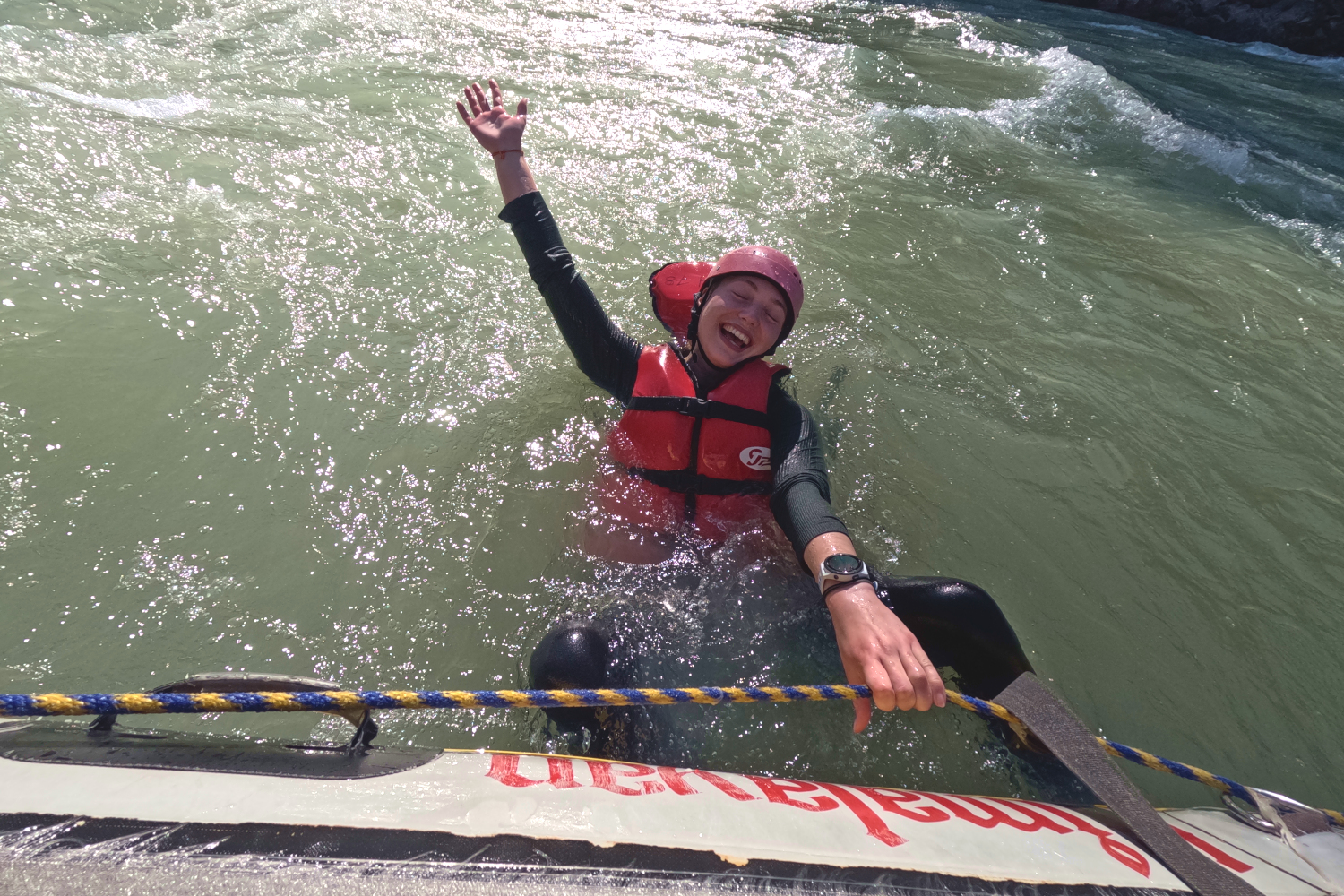
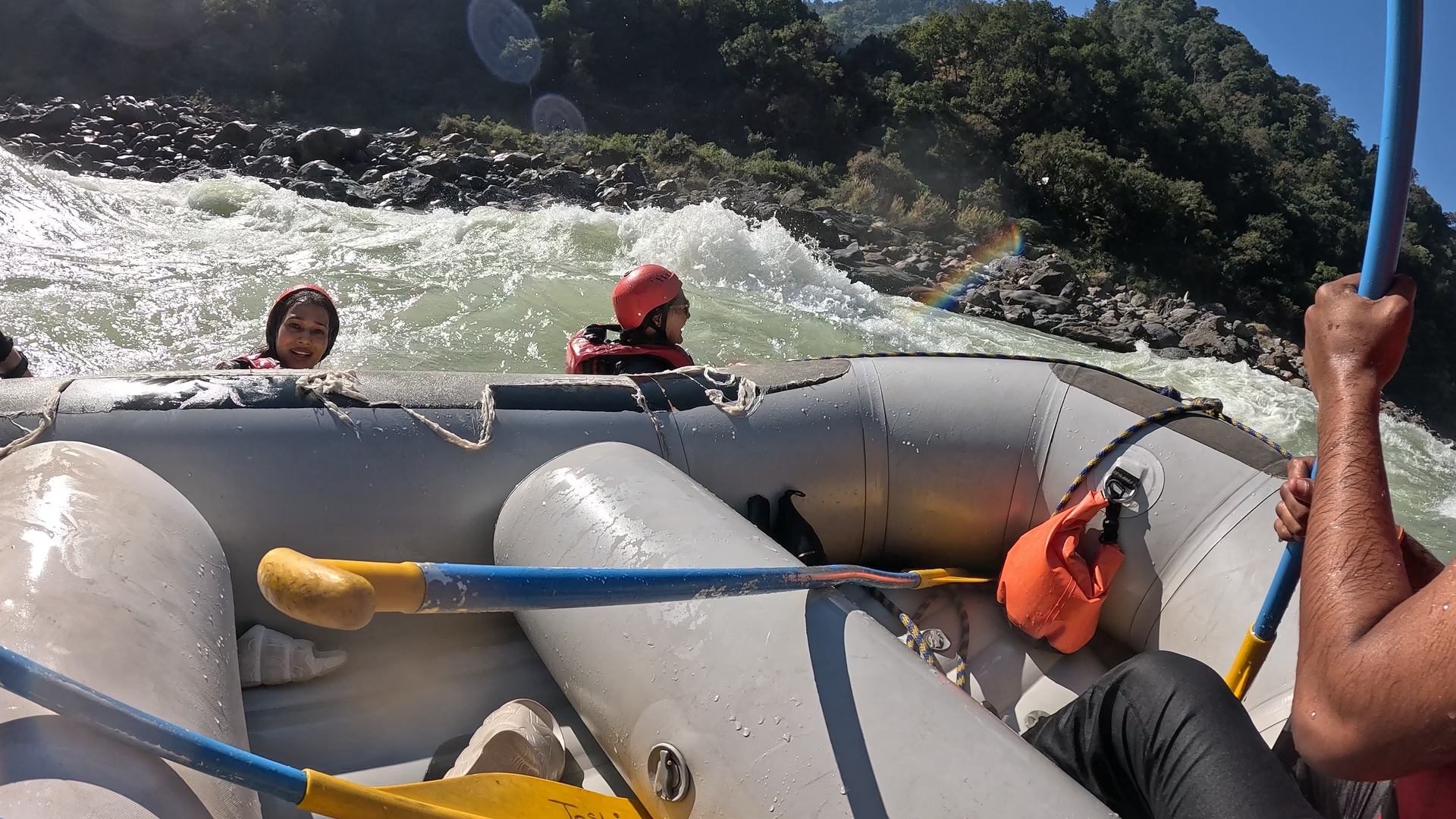
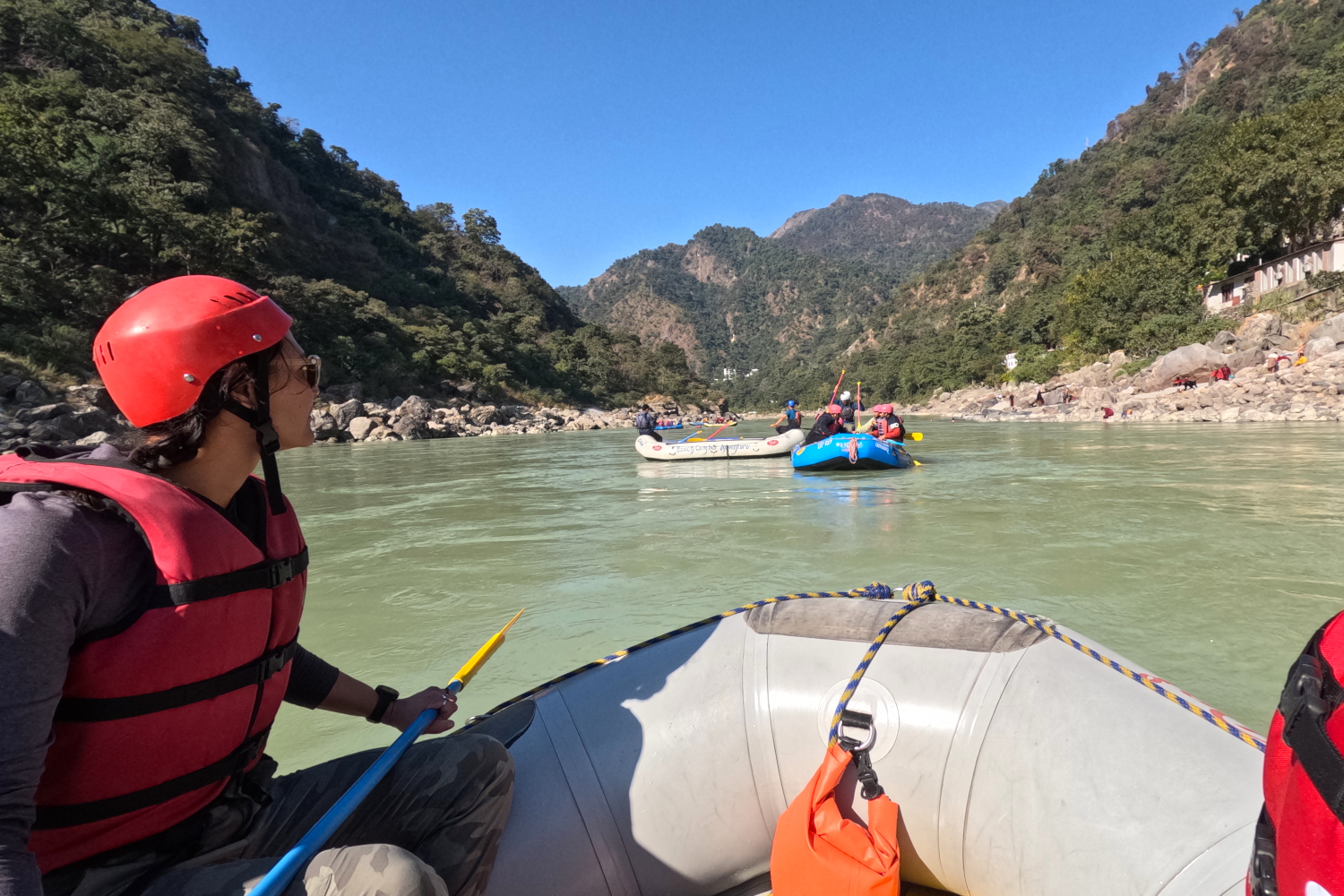
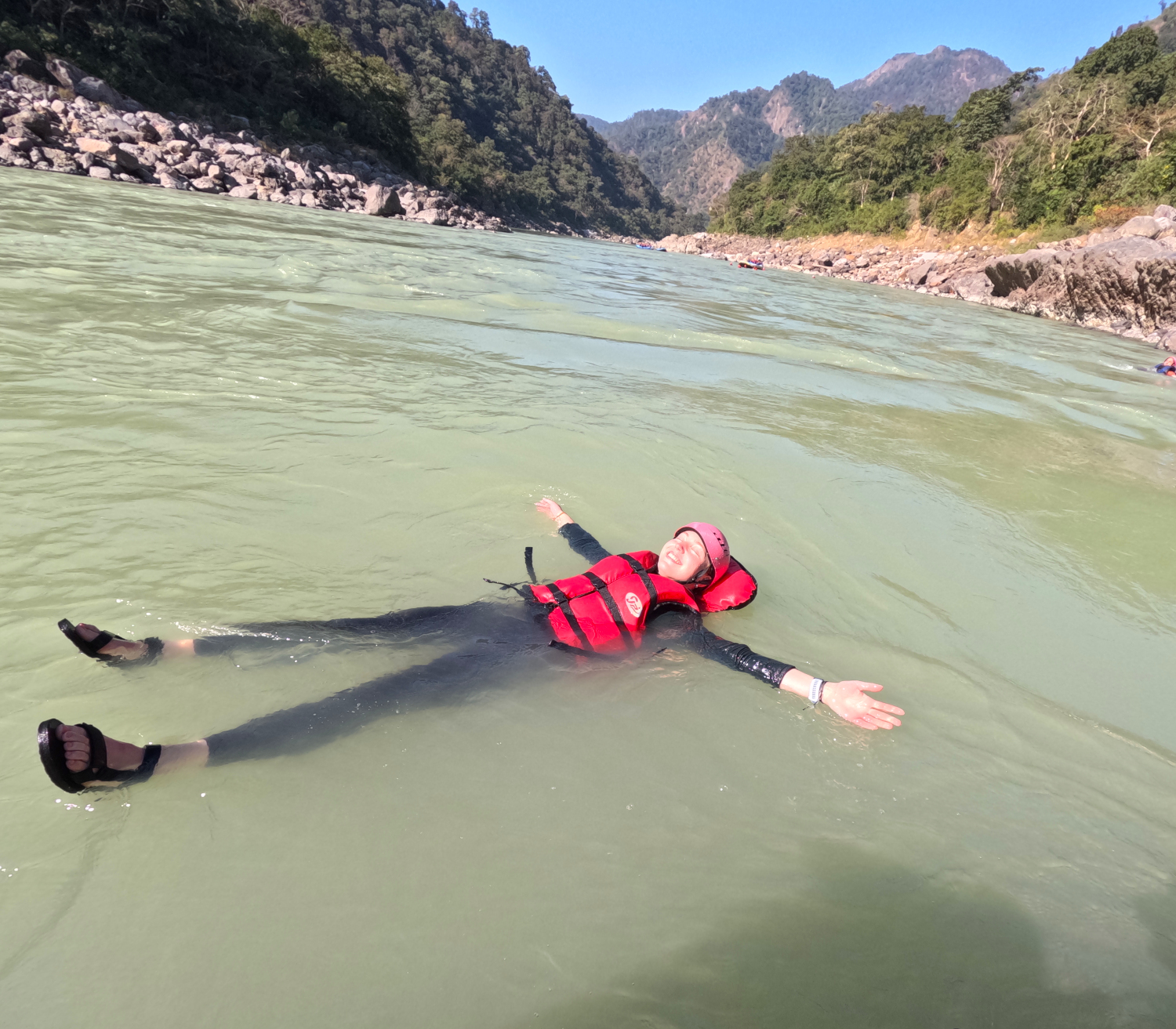
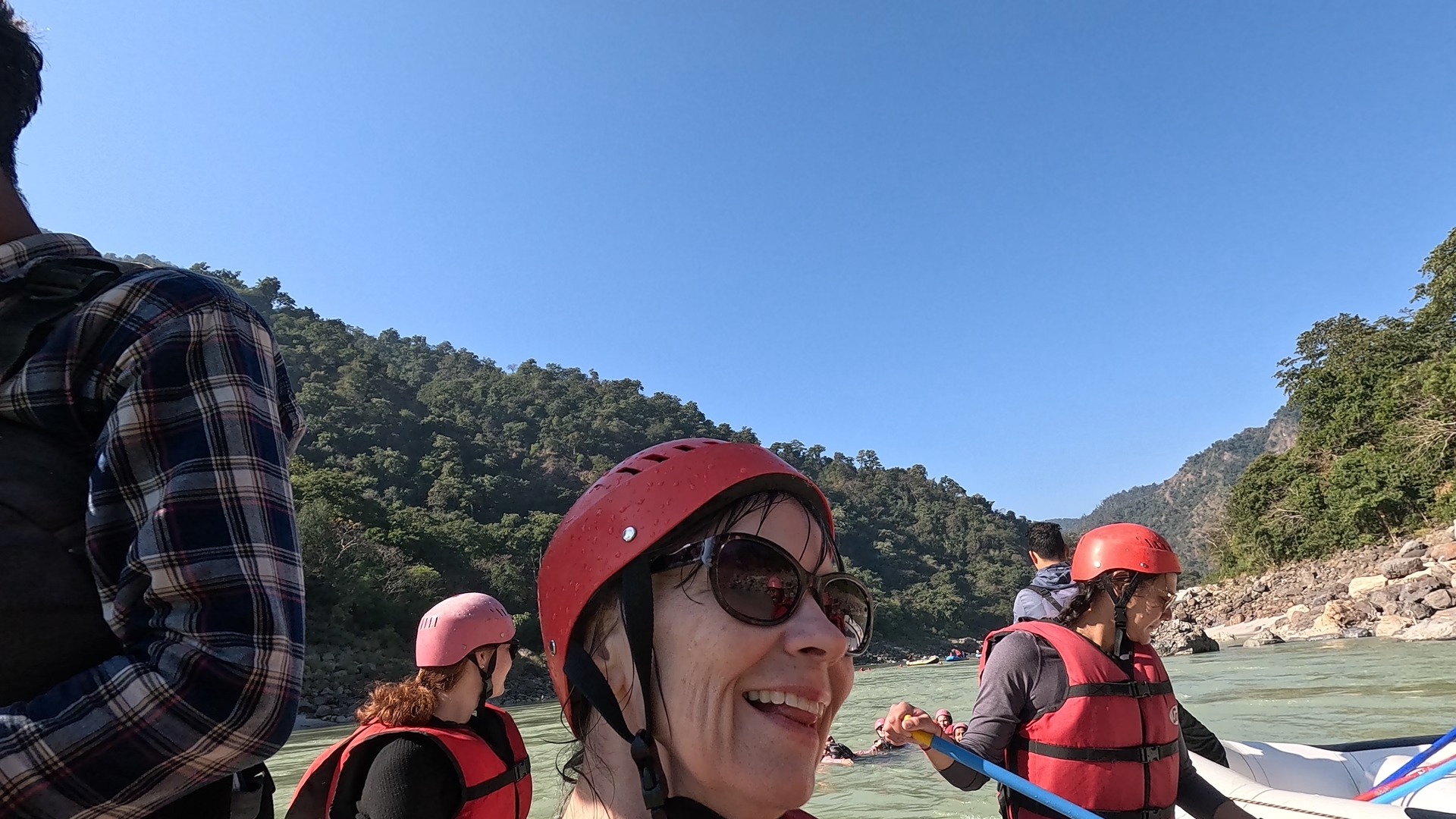
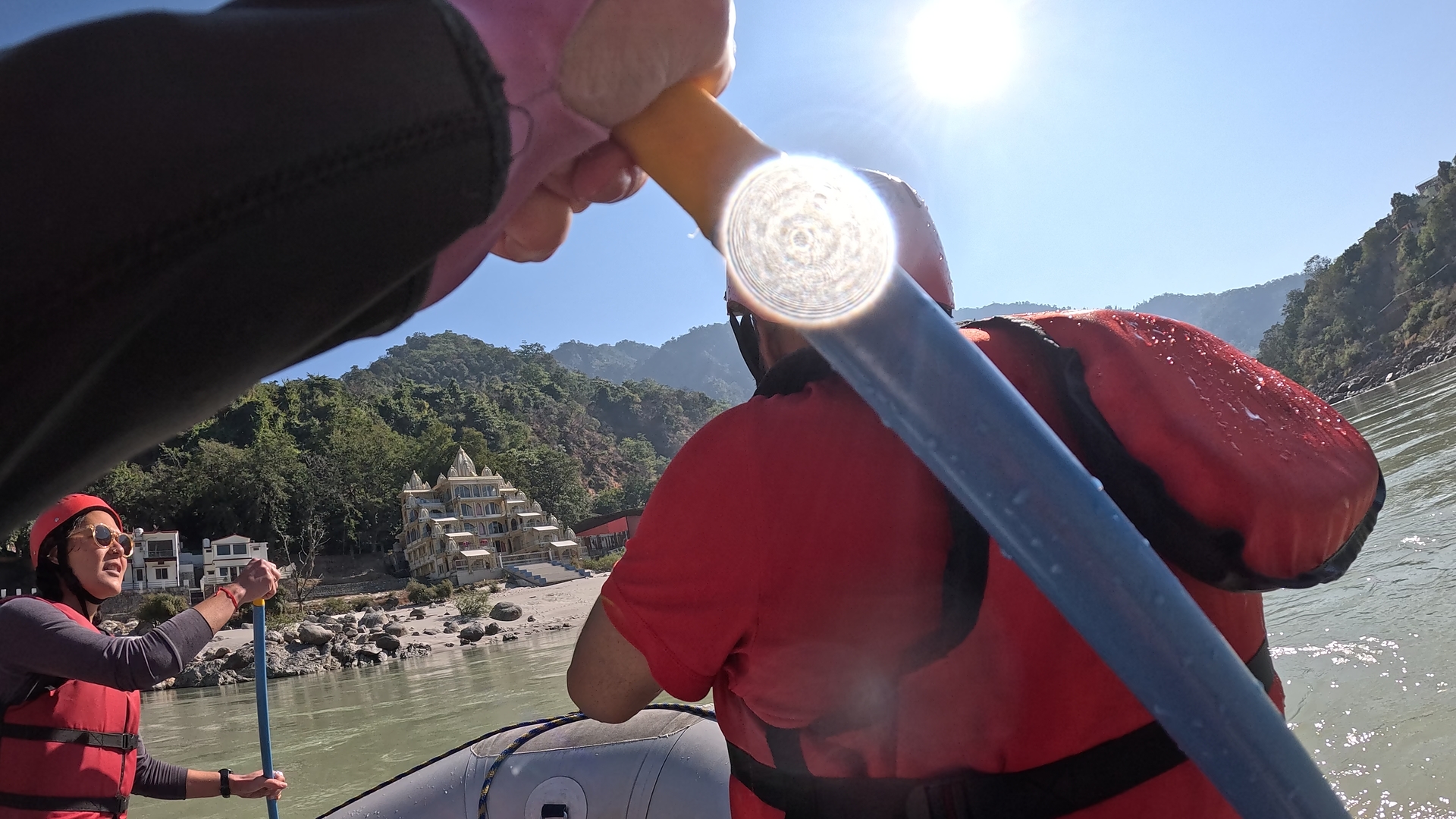
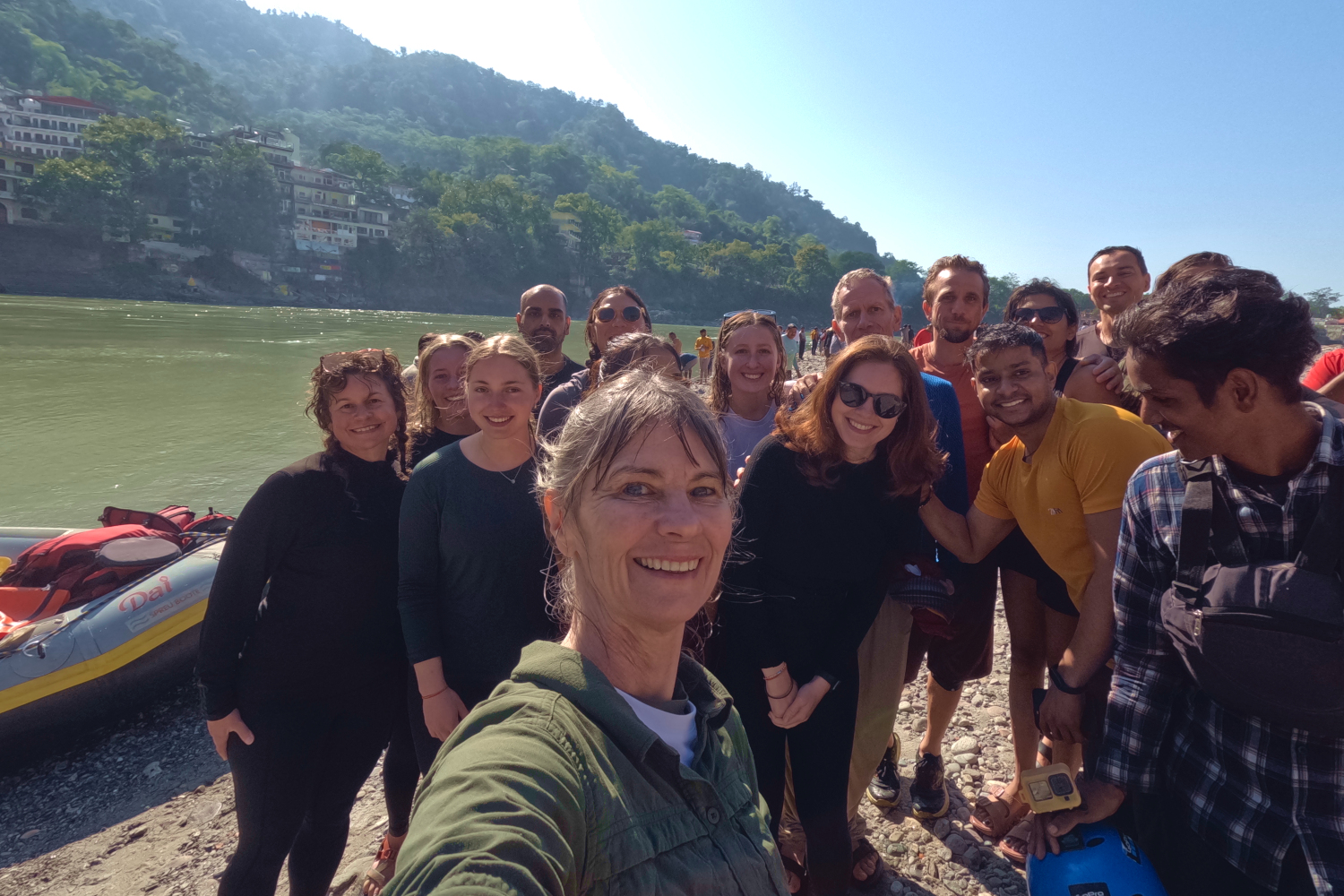
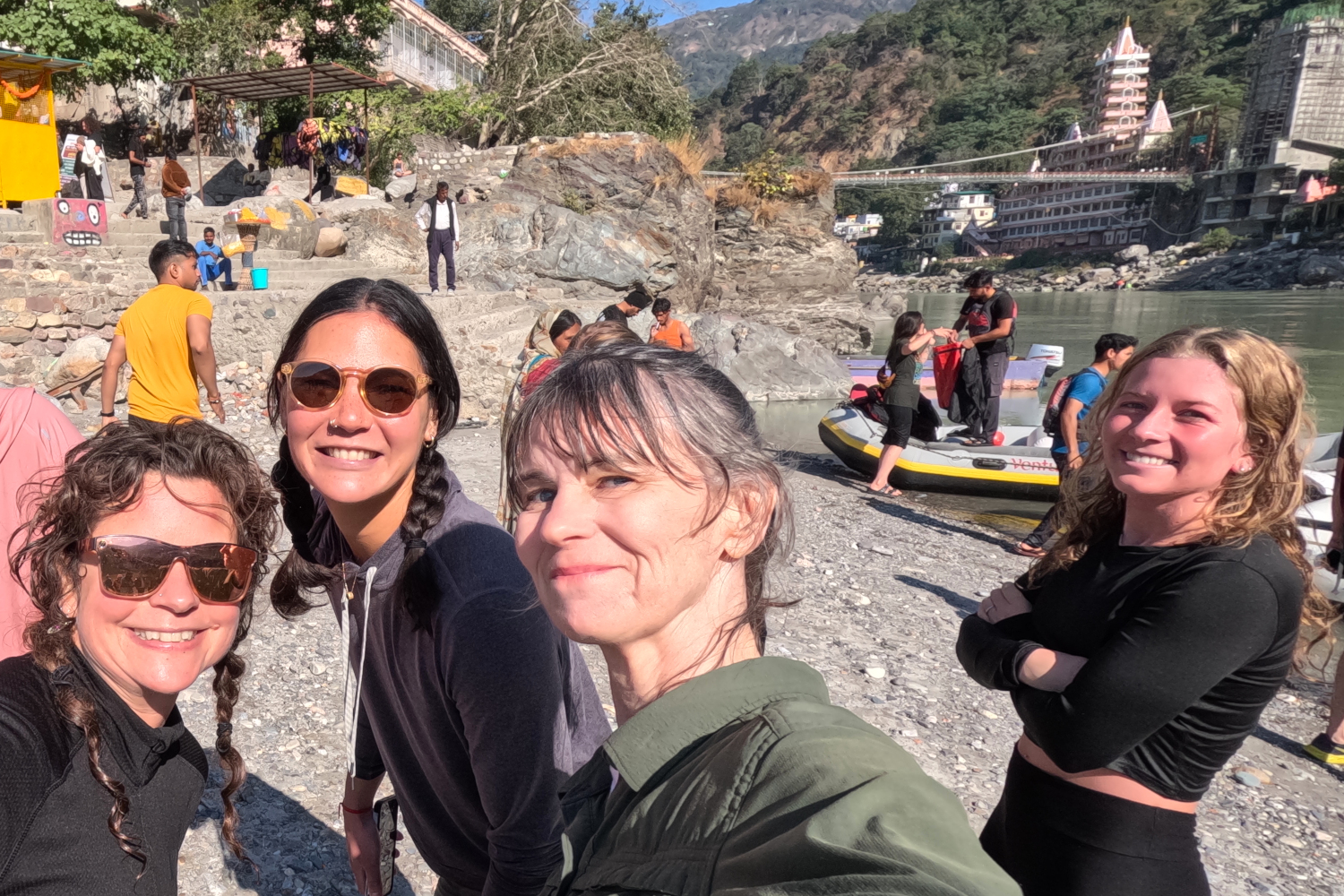
Once we dock, shivering but exhilarated, we gather around to take some group photos of all who survived our watery adventure. What you can’t tell by looking at the pictures is just how frozen we all feel. Luckily, the sun is shining enough to slowly thaw us out.
The journey isn’t over yet, though; we have to walk about a mile, dripping wet, back through town to the Yogashala. All of our dry clothes are still in the van that dropped us off upriver. The shaded areas are especially cold, causing my teeth to chatter. Luckily, I am the only one from my room who went on the rafting trip, so when I get back, I get dibs on the warm shower – a true luxury after that icy dip – and then got ready for more classes. And a couple of hours later the van gets around to delivering our extra clothing and we are reunited.
This week also marks the beginning of our study of Ashtanga practice, which makes me especially happy. I’ve been practicing Ashtanga style yoga for quite a few years, appreciating its structured sequence and challenging flow. It was one of the key reasons I chose Vinyasa Yogashala over some of the other Teacher Training Schools in Rishikesh; their emphasis on traditional Ashtanga aligns perfectly with my own practice and aspirations.
Ganga Aarti Sthal
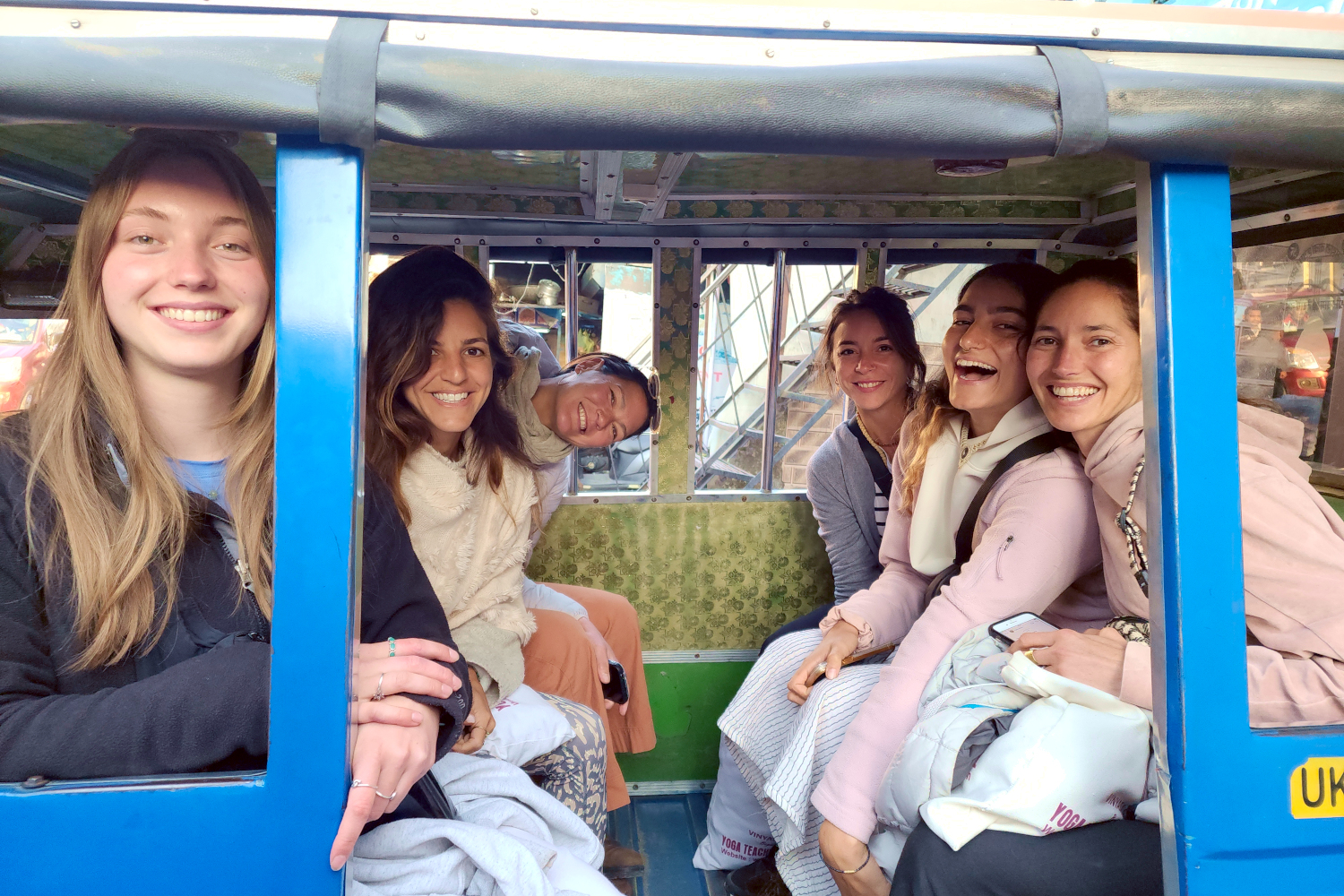
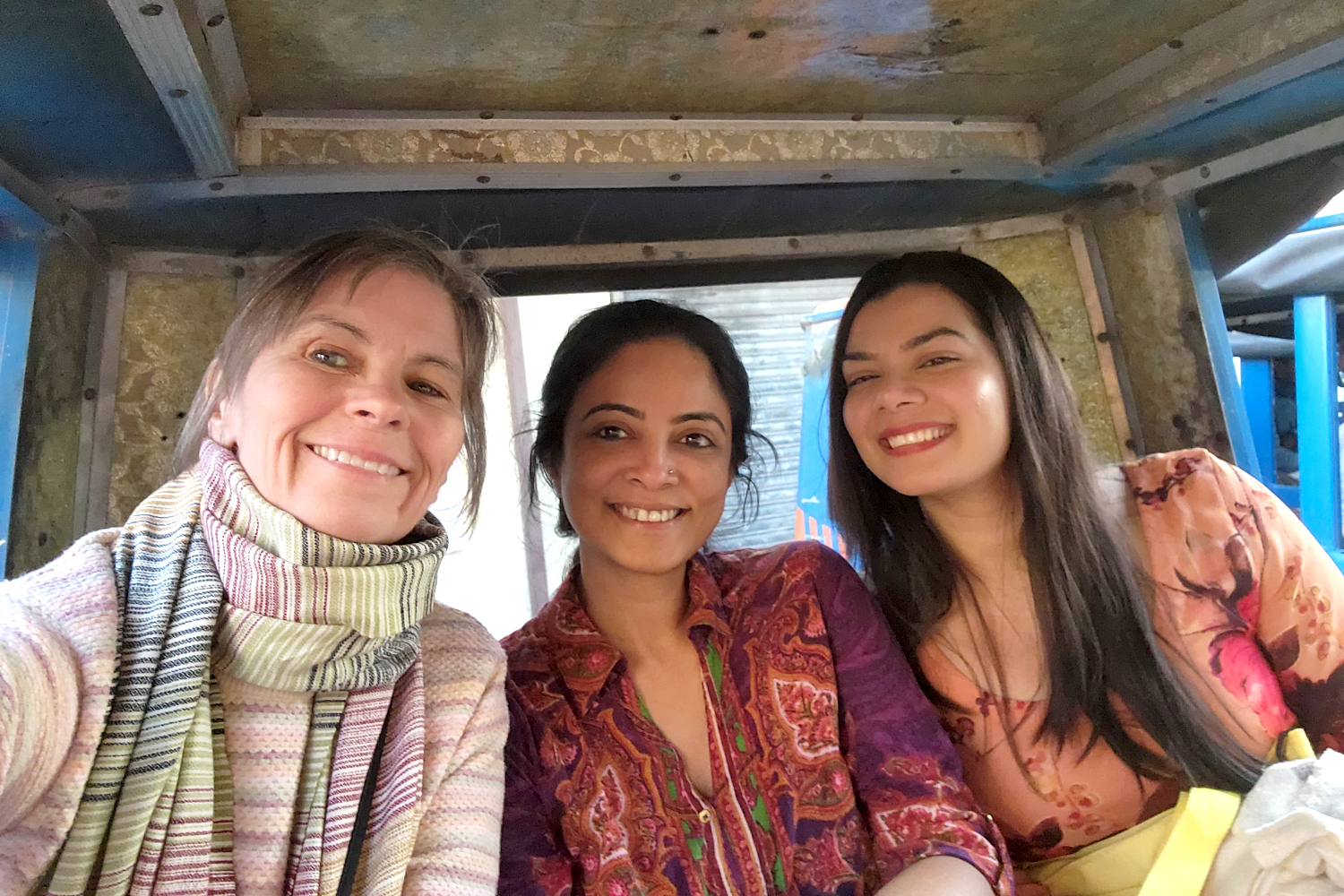
The very next day, December 13, we take part in another powerful cultural opportunity, this one involving the element of fire: the Ganga Aarti. To get there, we walk down to the main road and pack as many of us as we can squeeze into several tuk-tuks, which the school has generously paid for, to shuttle us down to the river.
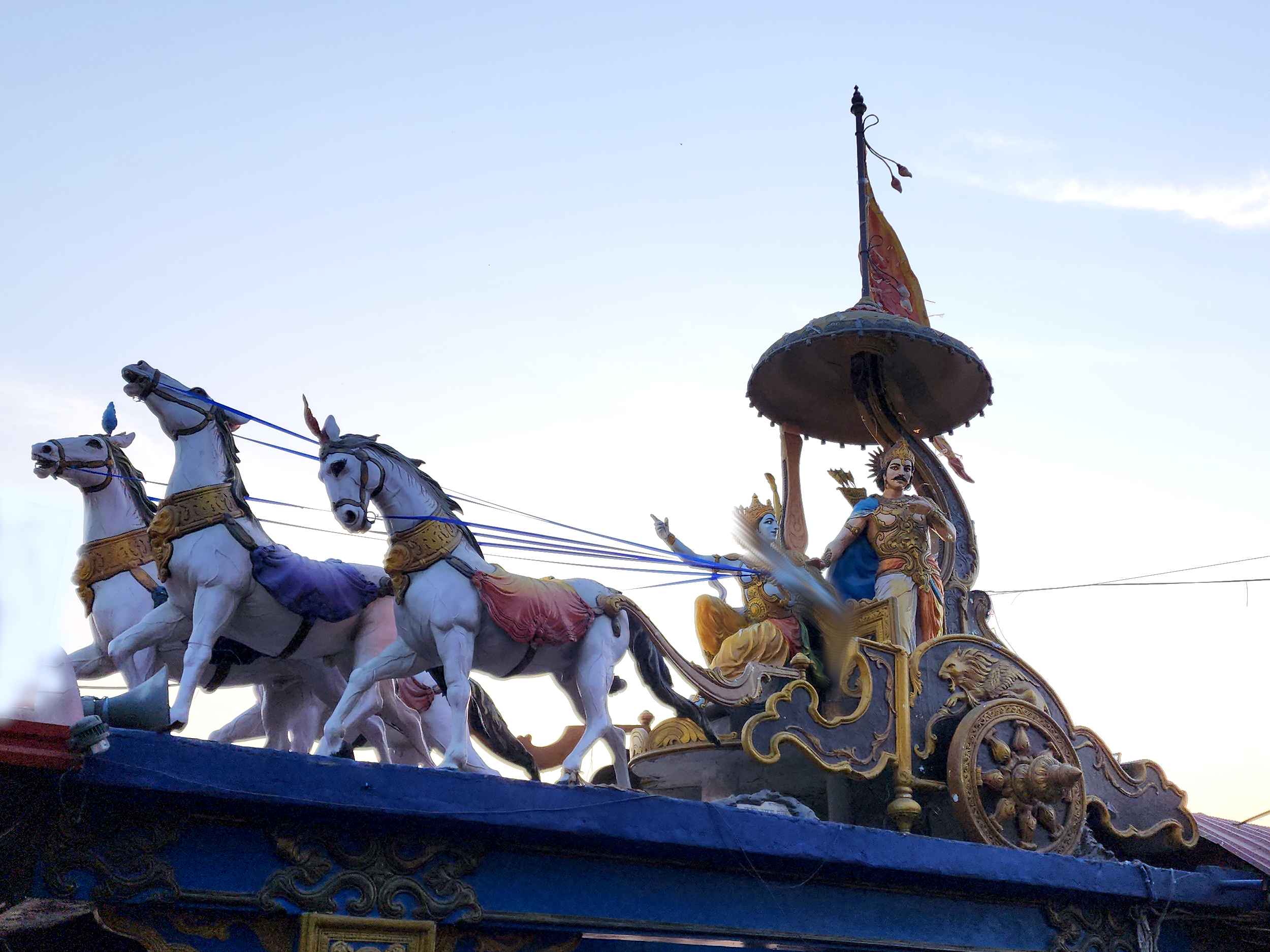
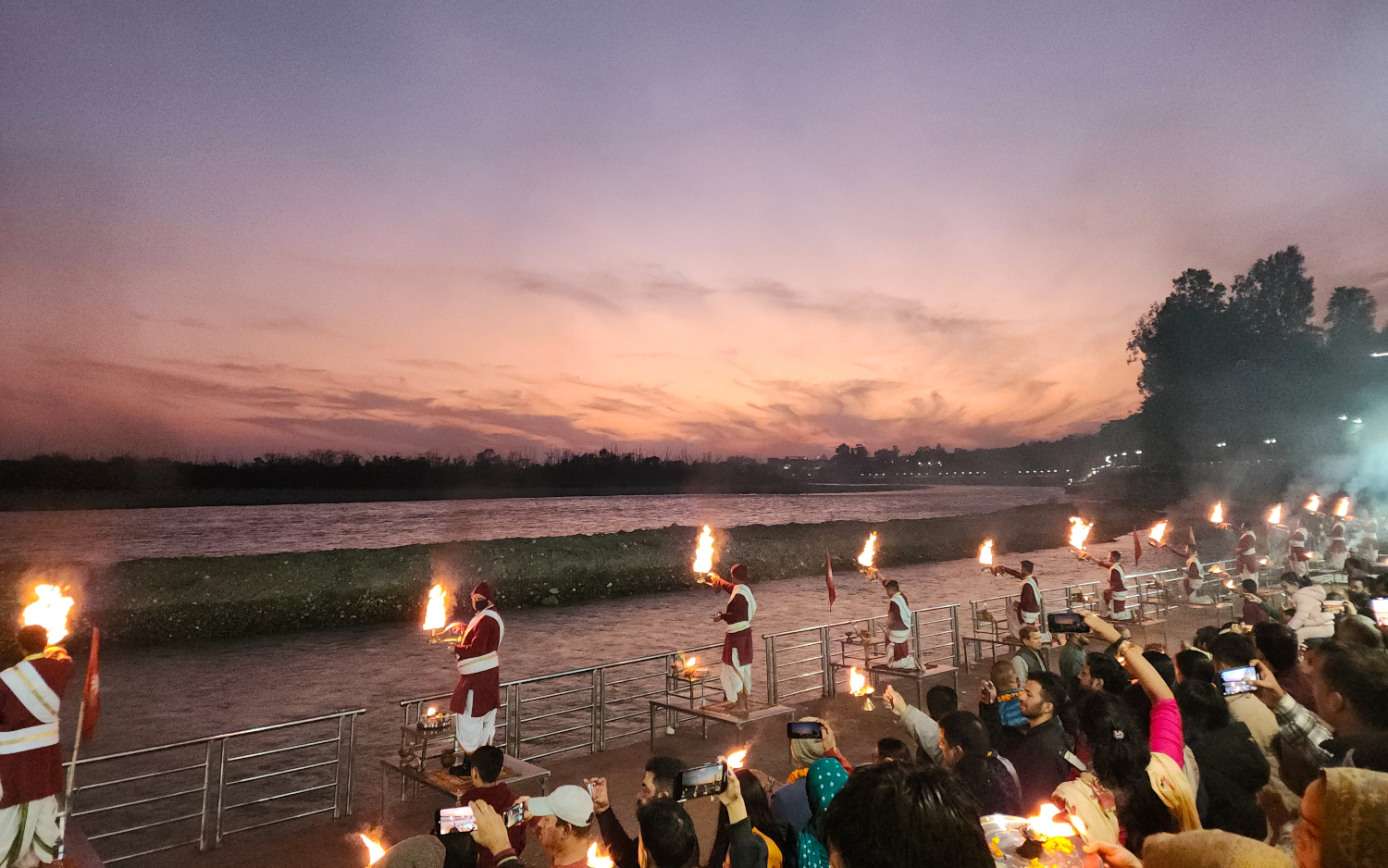
This Aarti, held at Parmarth Niketan Ashram, is incredibly special and, in my opinion, even better than the one on the other side of the river that I attended with Dennis a few weeks earlier. It’s often cited as the longest-running and most prominent Aarti in Rishikesh, a truly grand spectacle of devotion. As the sun begins to set, tinging the Ganga with gold, the energy on the ghat builds up steadily. Priests, dressed in traditional saffron robes, begin the rhythmic chanting and synchronized movements with large, multi-tiered lamps. The air fills with the scent of incense and the sound of bells and conch shells.
The participants, including me, are invited to pass the fire around. When you receive the plate holding the small flame, the custom is to gently swirl it around three times, offering your prayers and gratitude to the sacred Ganga, and then pass it on. It’s believed that participating in the Aarti purifies the soul and brings blessings, and you can feel that collective intention in the air. The floating diyas (small lamps with flowers) that many devotees release onto the river add another layer of ethereal beauty, their flickering lights dancing on the water, carrying hopes and wishes downstream.


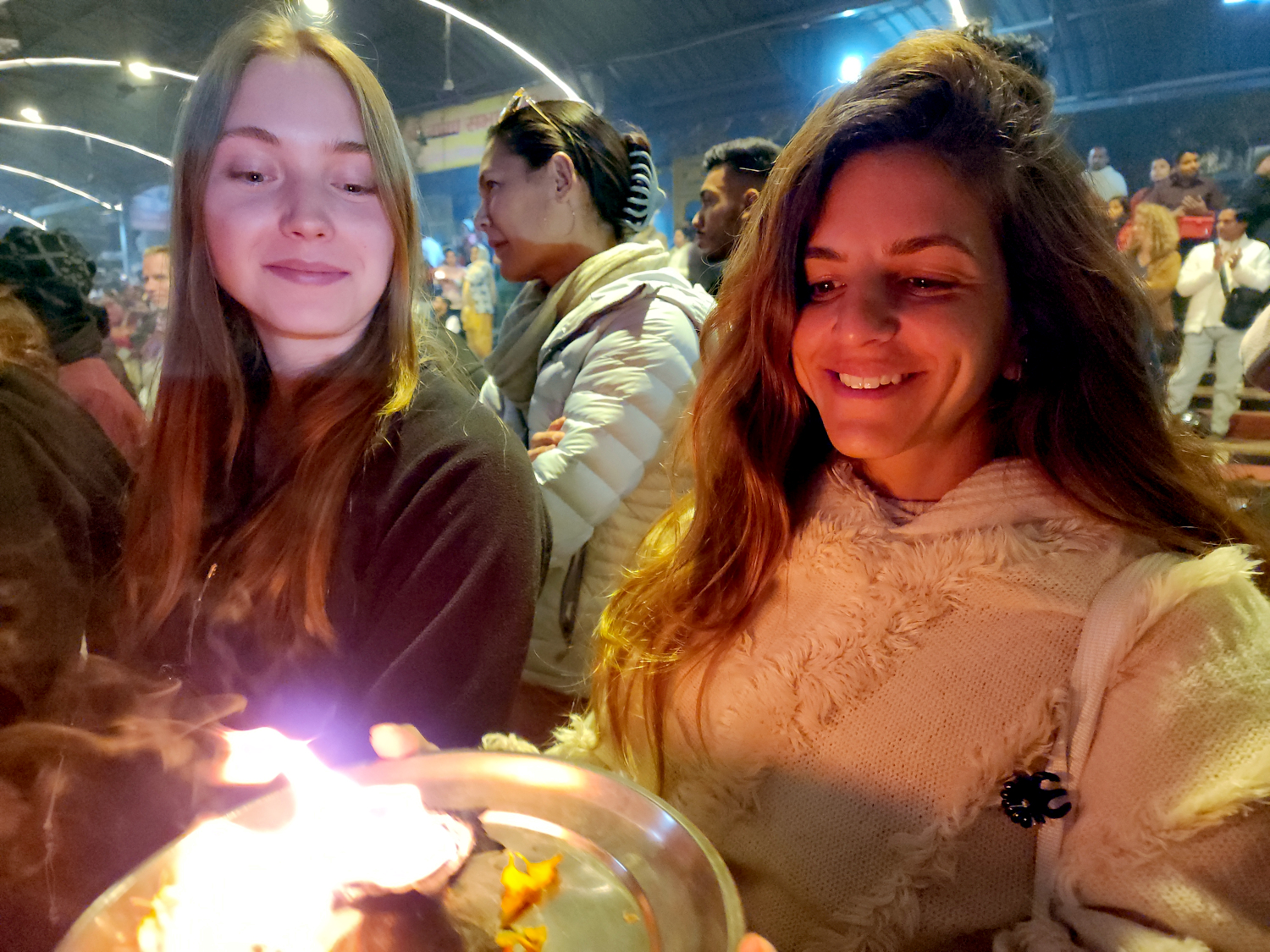
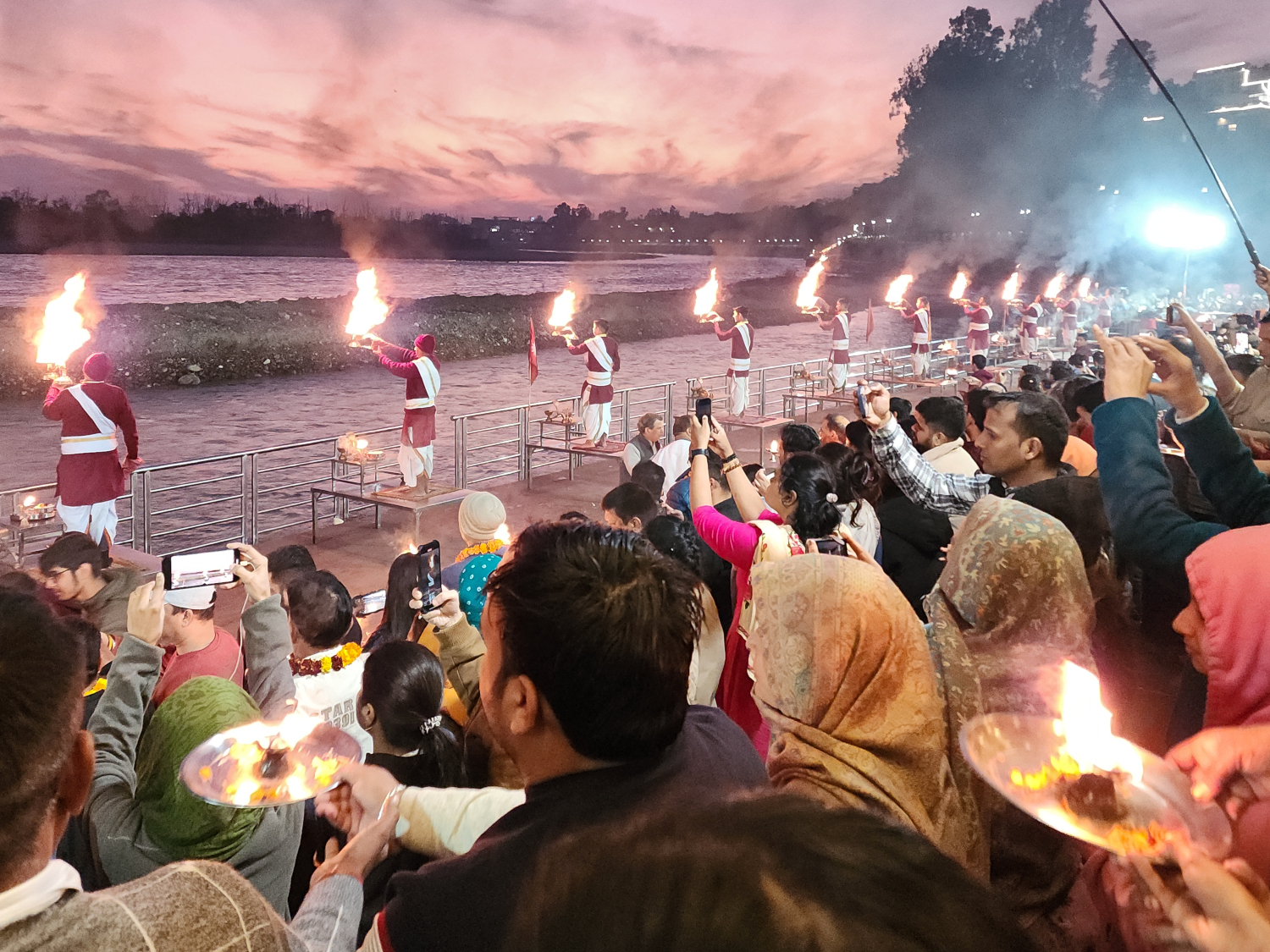
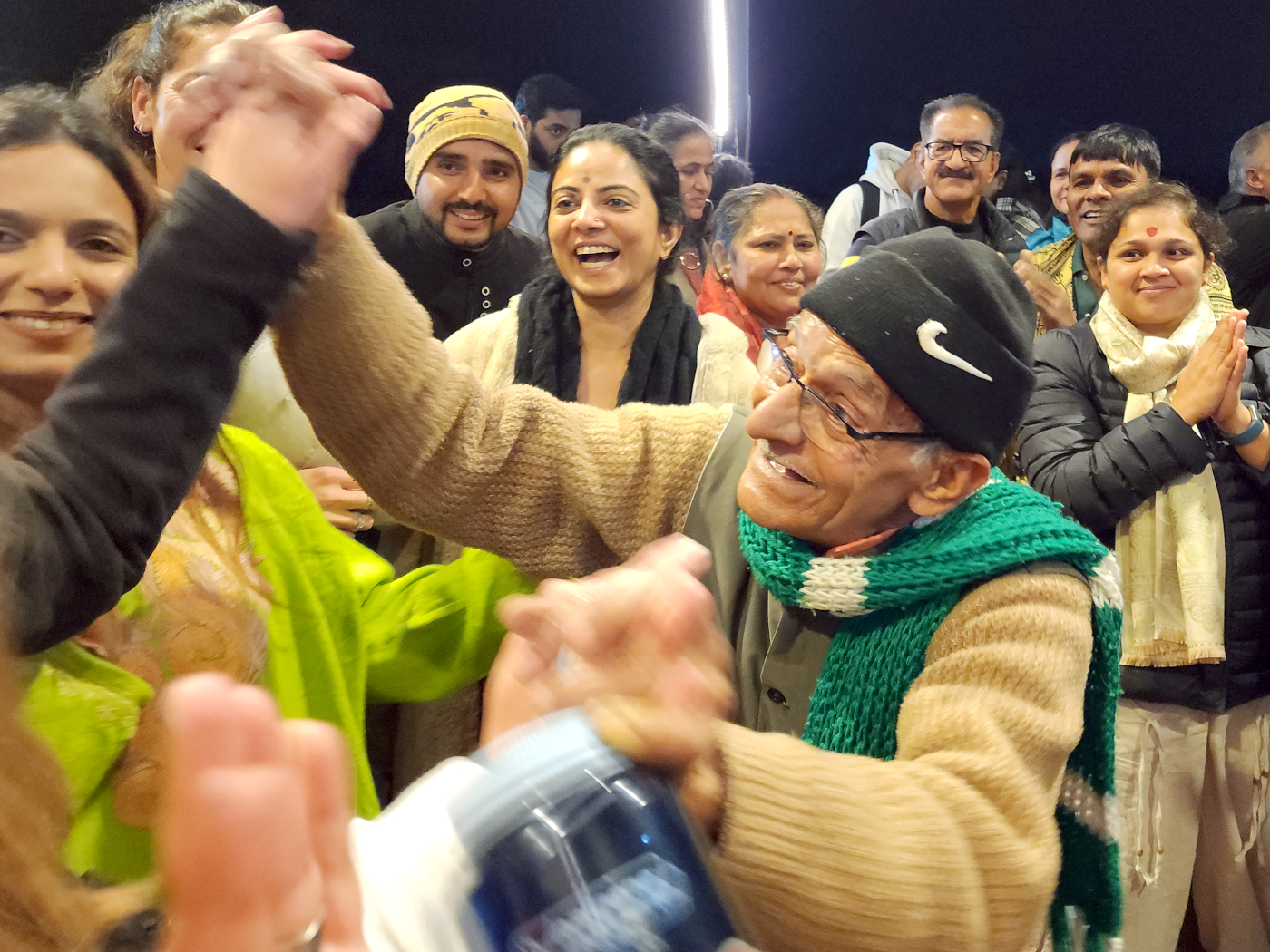
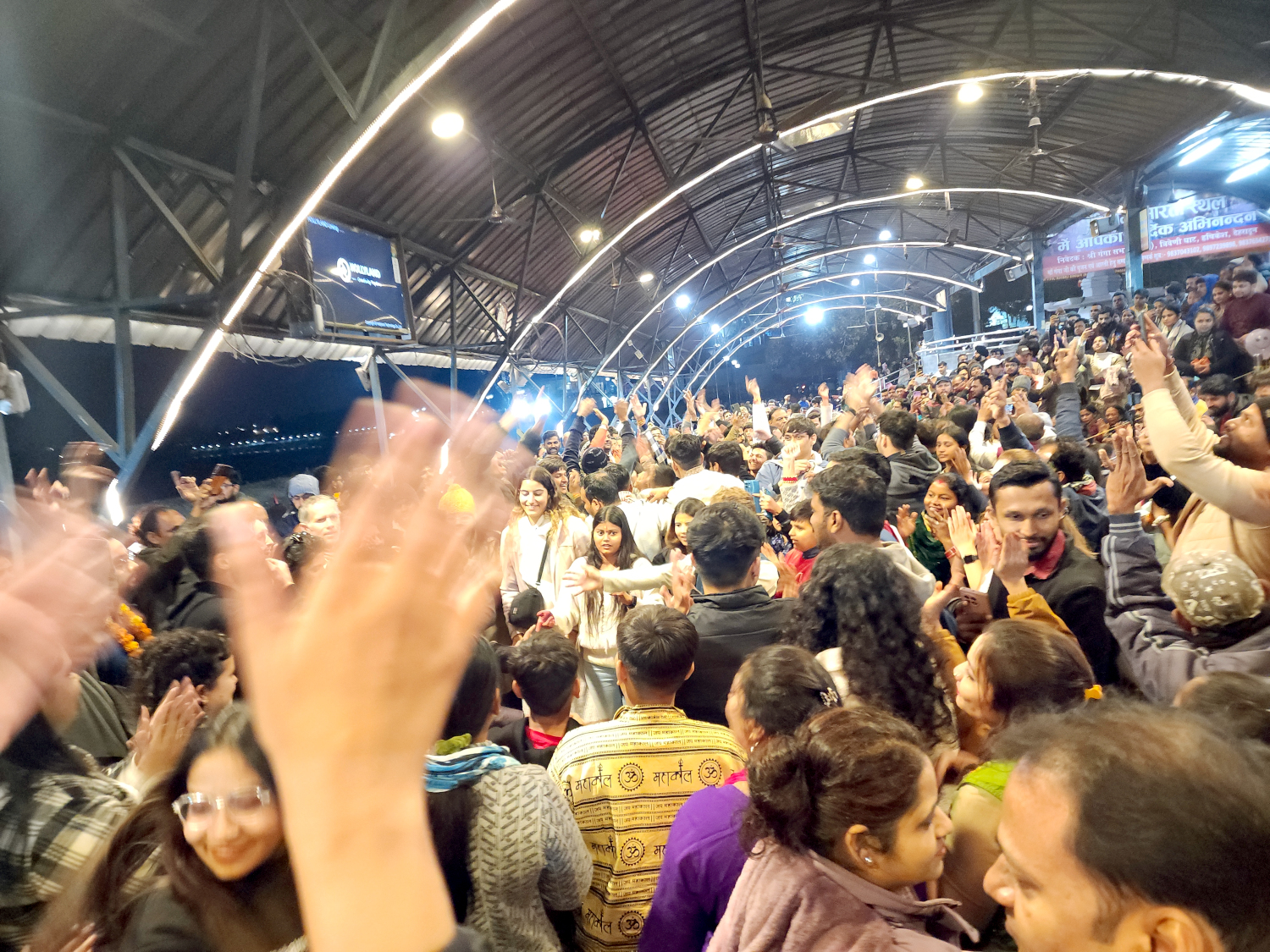
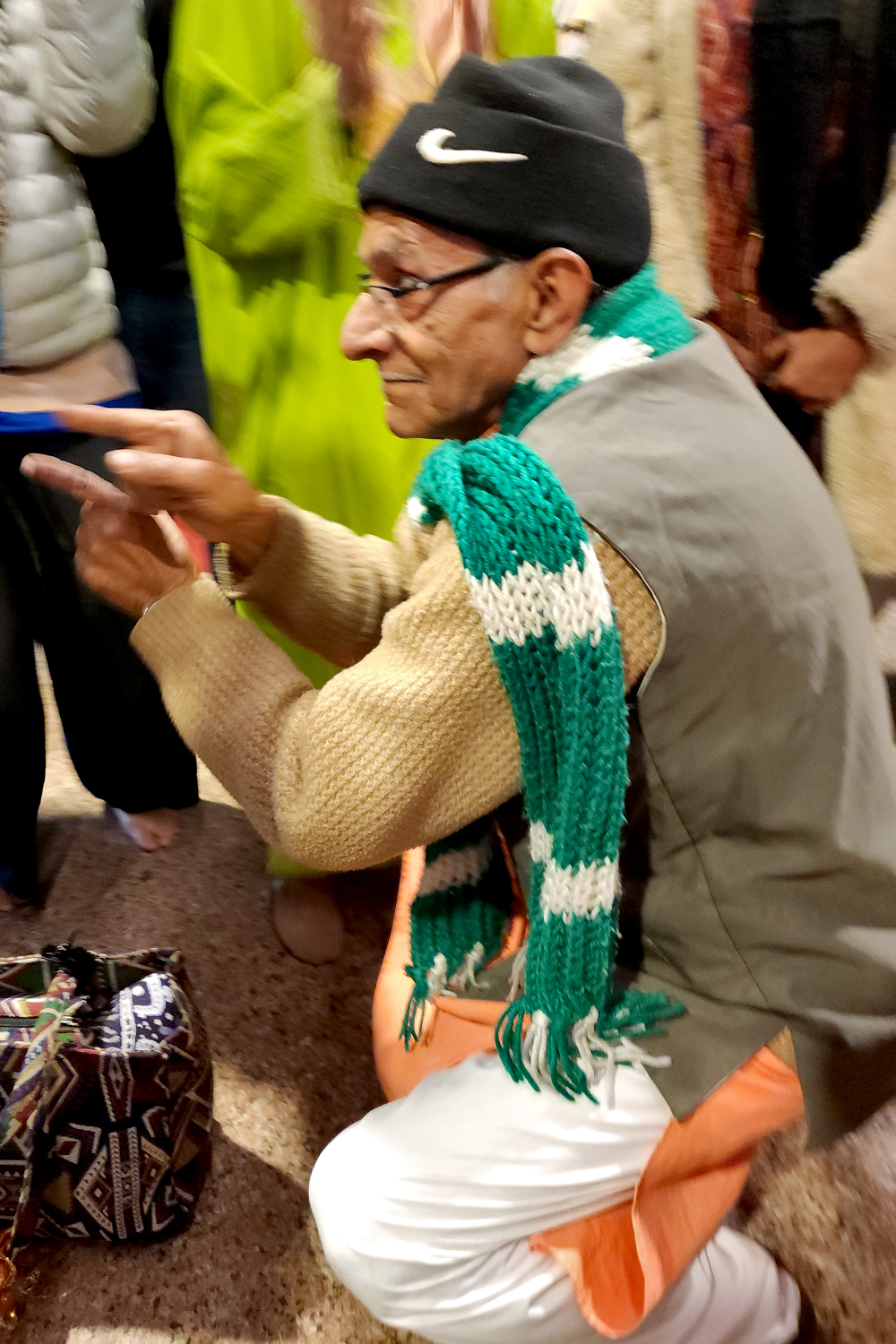
Then, as the main ceremony concludes, the dancing begins! The atmosphere shifts from solemn reverence to joyful celebration. This one particular local guy is an absolute character, full of infectious energy, flirting and dancing with everyone. He makes sure everybody feels welcome and encourages even the shyest of us to join in. It’s a beautiful expression of devotion through movement and community, a perfect culmination of a day connecting with the elements.
These experiences, both the wild exhilaration of the rapids and the serene devotion of the Aarti, have been integral to my journey here in Rishikesh. They’ve not only deepened my understanding of yoga’s philosophical principles but also immersed me in the vibrant spiritual and cultural tapestry of India. Every day here is a lesson, a challenge, and a profound discovery.
Parallel Paths in Rishikesh: One City, Many Experiences
Looking back on our separate but parallel journeys, it seems that Rishikesh held a unique set of lessons for each of us. Dennis found efficiency and unexpected value in the everyday, tempered by a poignant awareness of the local economic landscape. Kimberly, meanwhile, found her yoga practice enriched by direct engagement with the elements and the profound cultural traditions of the Ganga. Though our paths didn’t physically intersect, our stories intertwine to illustrate the diverse ways one can connect with this extraordinary place. From unexpected doctors’ visits to exhilarating river rapids, Rishikesh certainly kept us on our toes.
Events occurred 12/12-13/2024
Have you ever visited Rishikesh or another spiritual hub in India? What was your most surprising or memorable experience? We’d love to hear about it in the comments!

 world travel with a theatrical flair
Leave a comment