

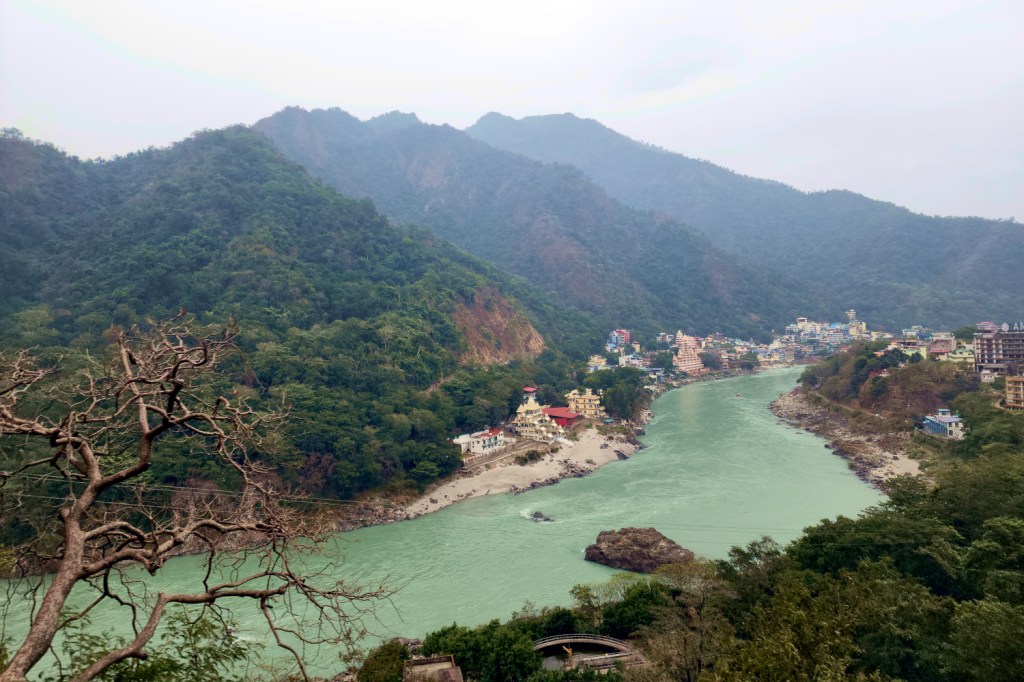
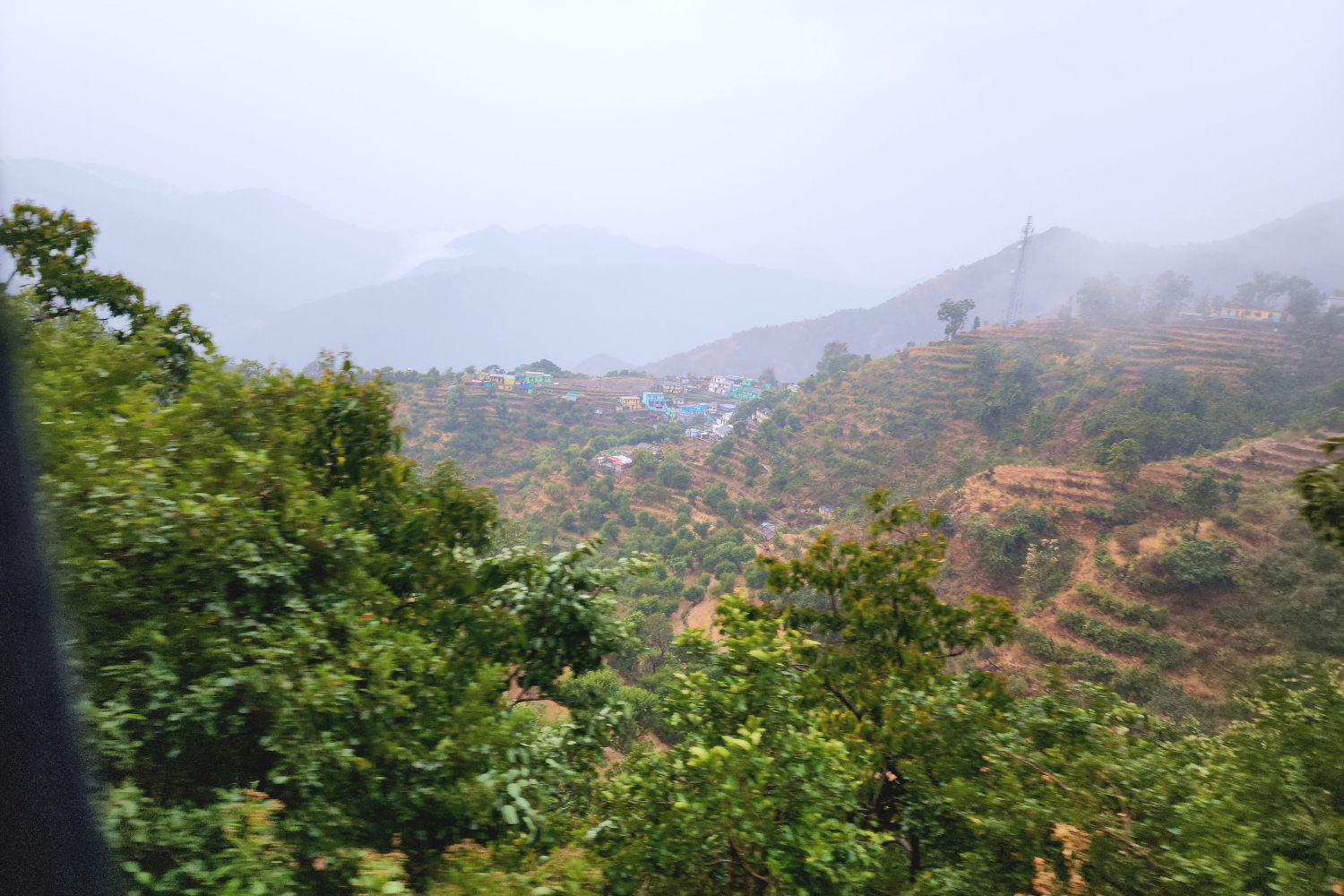
Devikhet is a little Indian village high up in the foothills of the Himalayas. Rishikesh is a thriving city way down in the valley on the banks of the Ganga. The distance between them is only about 30 miles as the crow flies, or the monkey tumbles. But getting there takes a good 4 hours — or more likely, a not so good 4 hours — in a rickety and/or jam-packed vehicle, up roads that practically make pretzels. Up, up up and more up. If you’re going to take this trip, you need to have plenty of patience, a tolerance for motion sickness (or medicine to relieve it) and — very important — a very empty and cooperative bladder.
If you don’t have access to your own vehicle or someone else’s, there are three options for getting up the “hill”: private taxi, shared taxi, or bus. The private taxi runs about 25 bucks, whereas the bus is only a little over a dollar each. So we choose the cheapo option. After all, it can’t be that much worse. Can it?
Having finished up in Rishikesh and vicinity, where Kimberly trained to be a yoga teacher in the area called Tapovan, and both of us spent several weeks doing volunteer teaching in a nearby village. we’re ready for the next port of call: a volunteer post near Devikhet. So we check out of our Airbnb at 9:30 in the morning to make our way toward the bus station. The bus doesn’t leave until after noon, but we want to get there plenty early, as we still have some confusion about the trip, including where to catch the bus — our intel says it departs from across the street, rather than from the station itself.
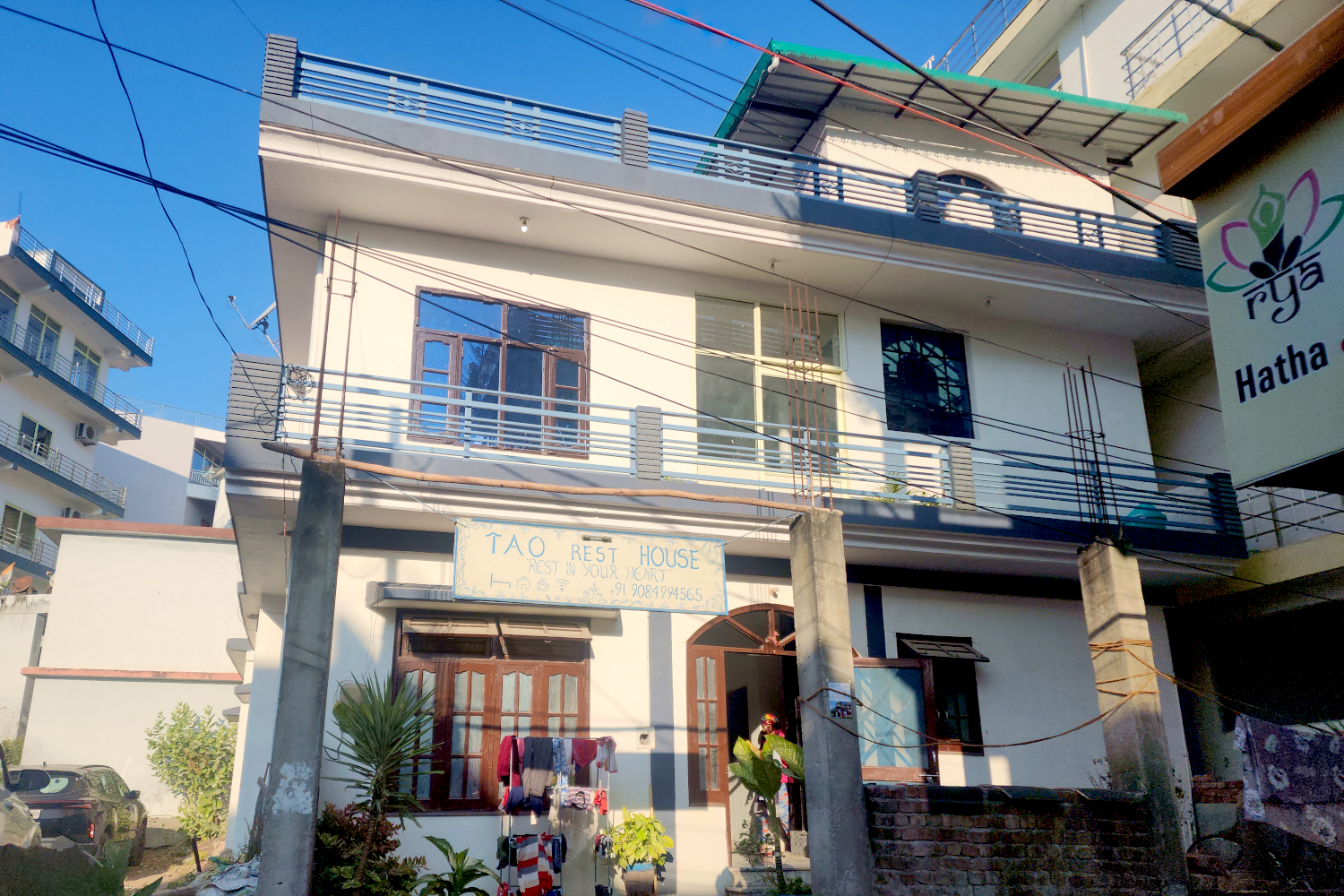
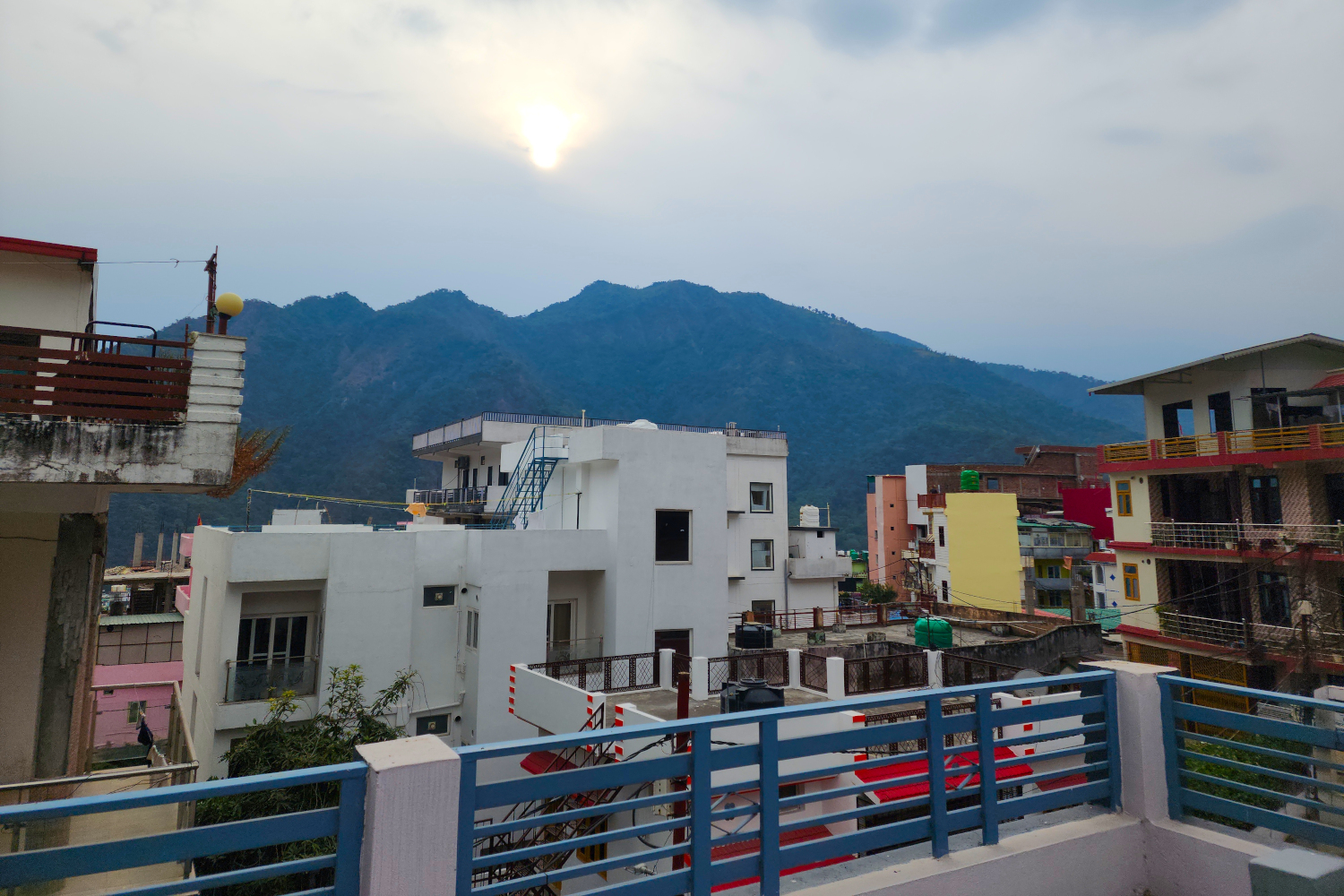

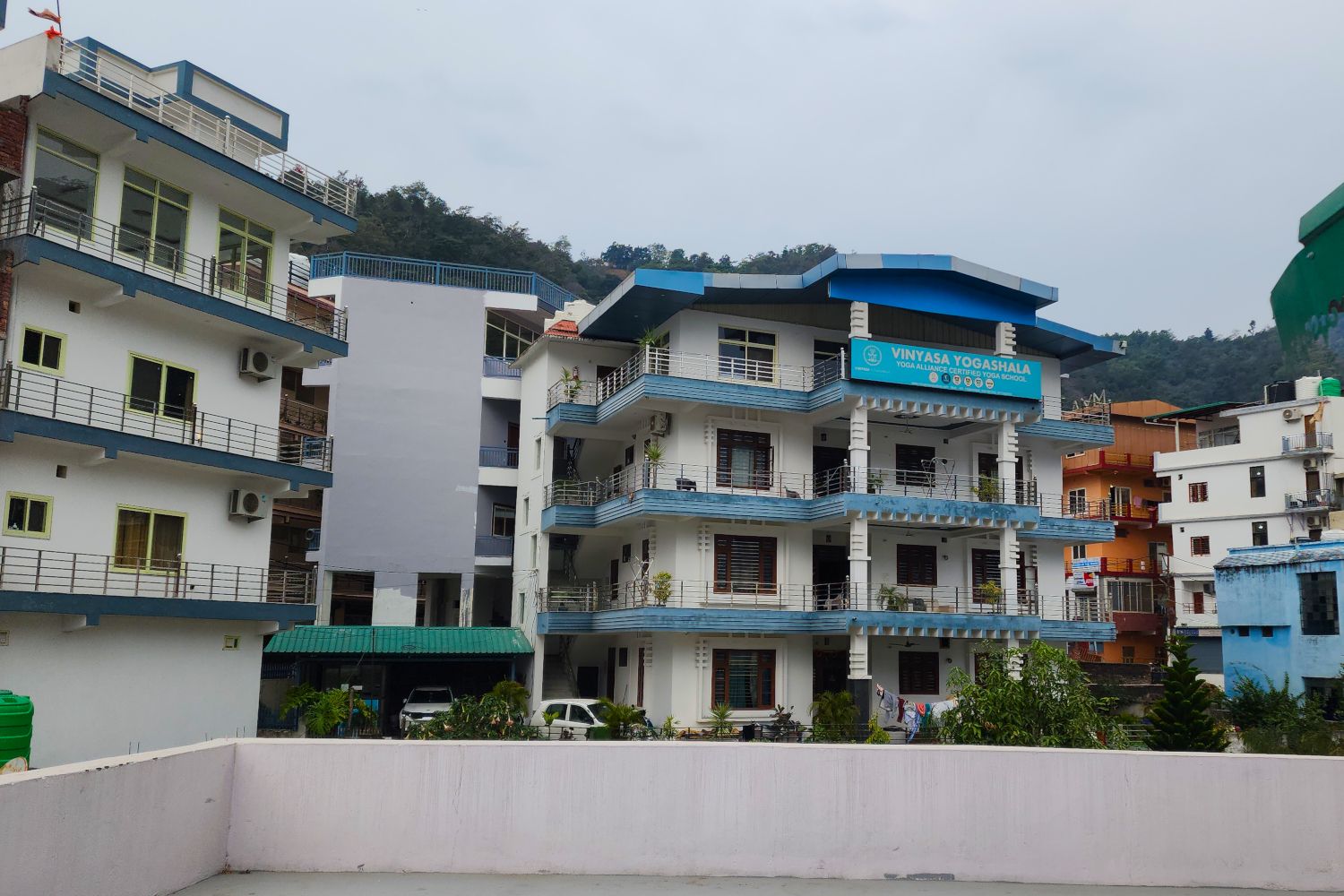
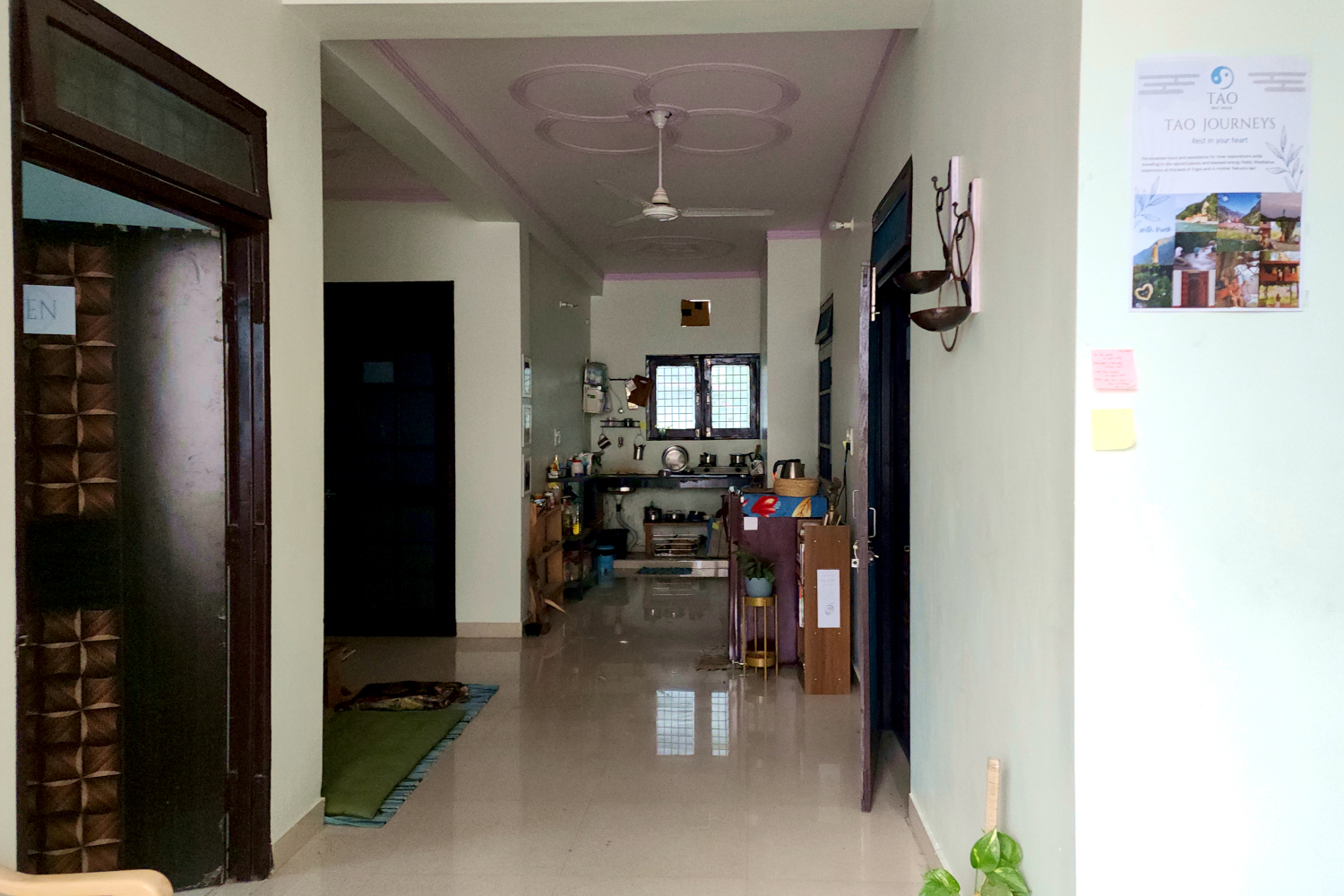
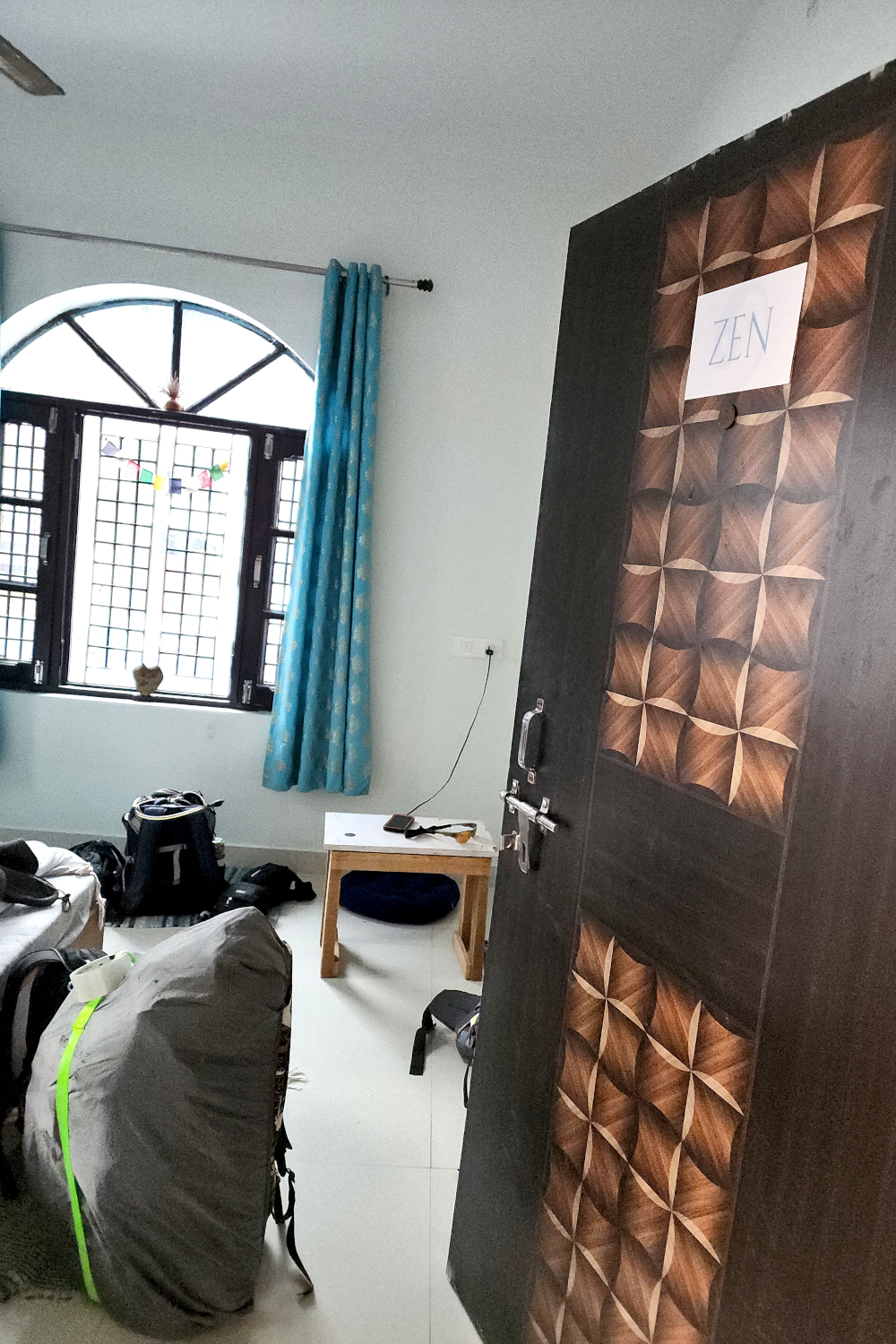
So we head down the hill, and down the busy road to where there is a gathering spot for tuk-tuks angling to haul drivers into the main part of Rishikesh, where the station is located. As always, there is haggling over price. Ultimately we get jammed, along with all our bags, into a vehicle that appears to be already packed to capacity with passengers, some of whom also have bags. And bear in mind that these tuk-tuks are hardly bigger than a soda can. The driver rattles off something to us in Hindi, apparently to the effect that we have to pay extra because of all our bags.
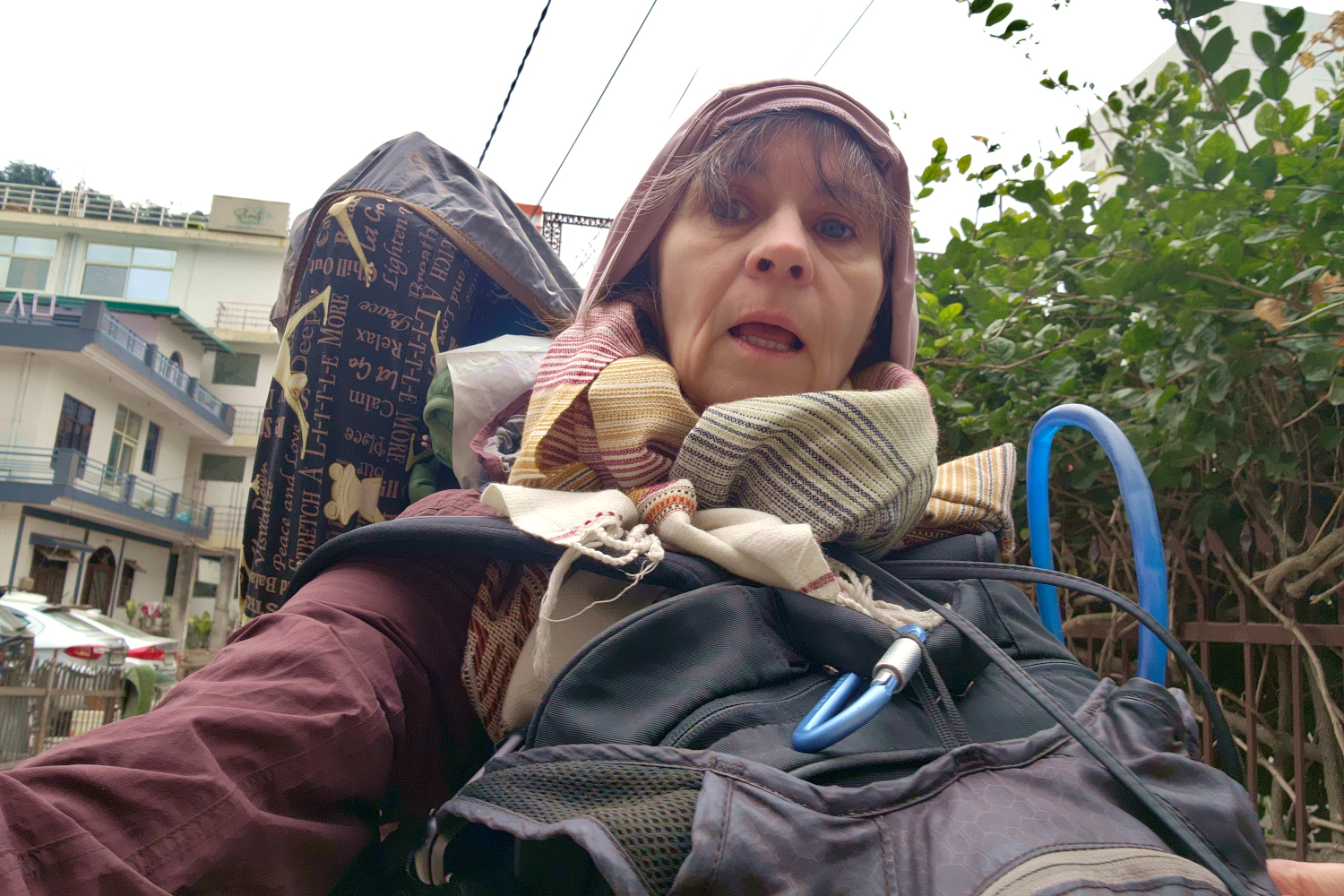
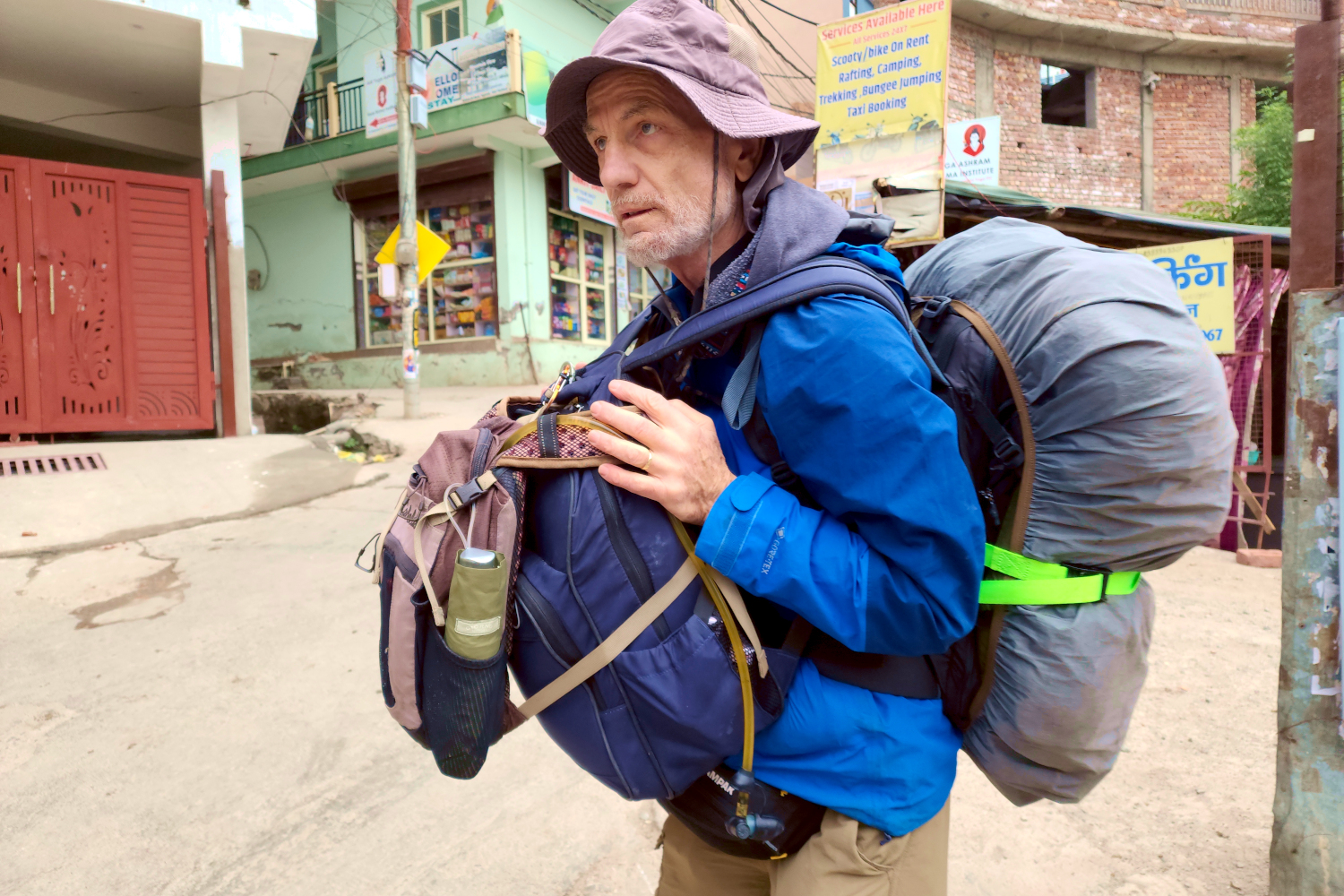
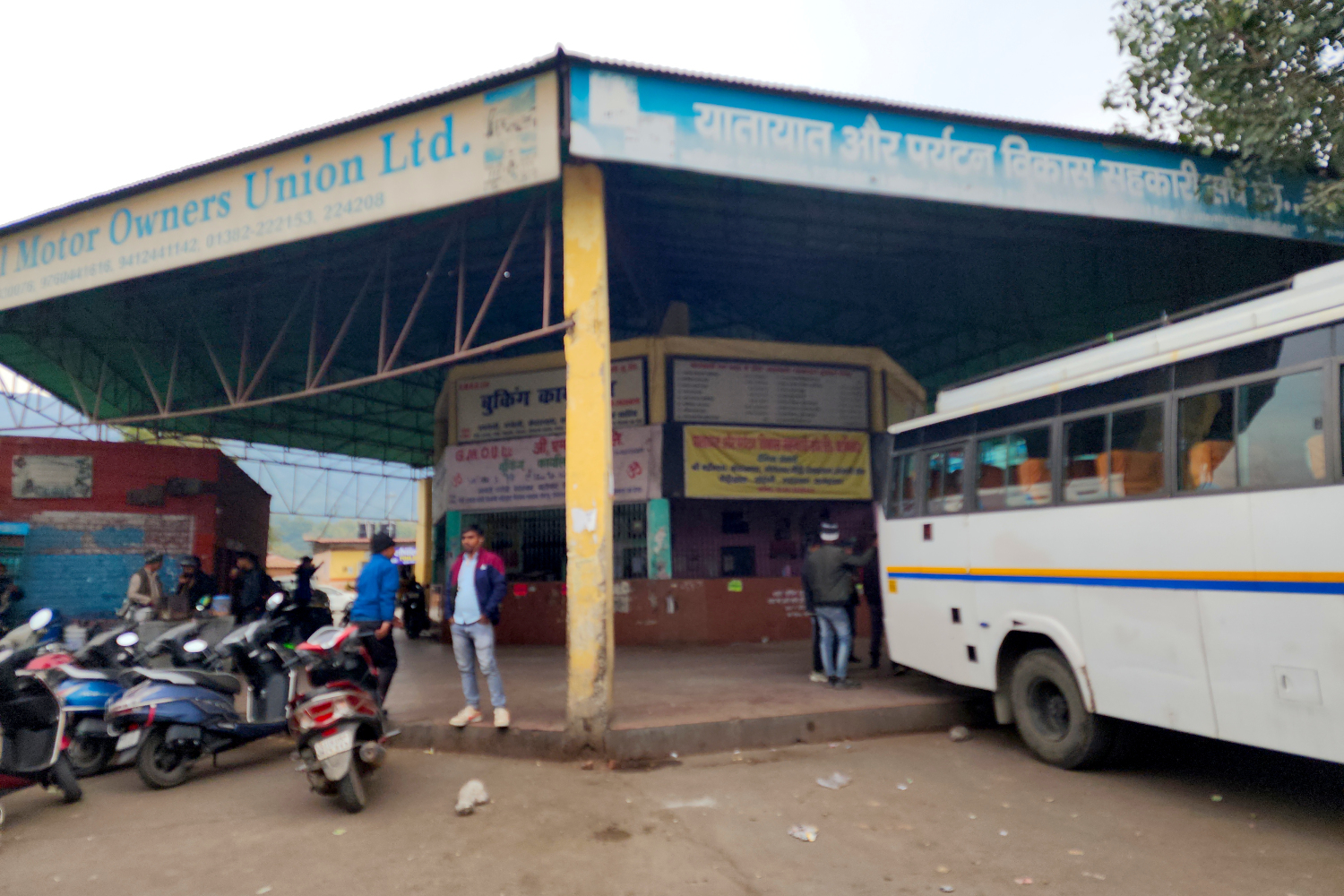


The station, or at least the waiting area, is an open-air affair. The hub has some ticket offices, which are closed when we arrive, and there are some benches around it for passengers to wait on, bordered by stalls of food and gift vendors. All the signs are in Hindi, and even with Google Translate, they’re not much help in answering any questions we might, and do, have.
As we wait on a bench out front, a ragged little boy approaches us and begins panhandling rather aggressively, refusing to go away no matter how much we try to discourage him. (Many of these beggar kids are exploited by adults. And giving money to any beggar in such a high visibility location would paint a huge red dollar sign on our backs.) Finally, a man nearby tells him in Hindi to get lost, and he does.
It starts to rain, so we move to a bench under the roof. Not having many snackable foods with us, we scout around in the nearby stalls for something to supplement our rations — actually Dennis does, while Kimberly watches the bags. All he can come up with is some roasted chickpeas (“chana”) which are quite good, but a little variety would have been nice.
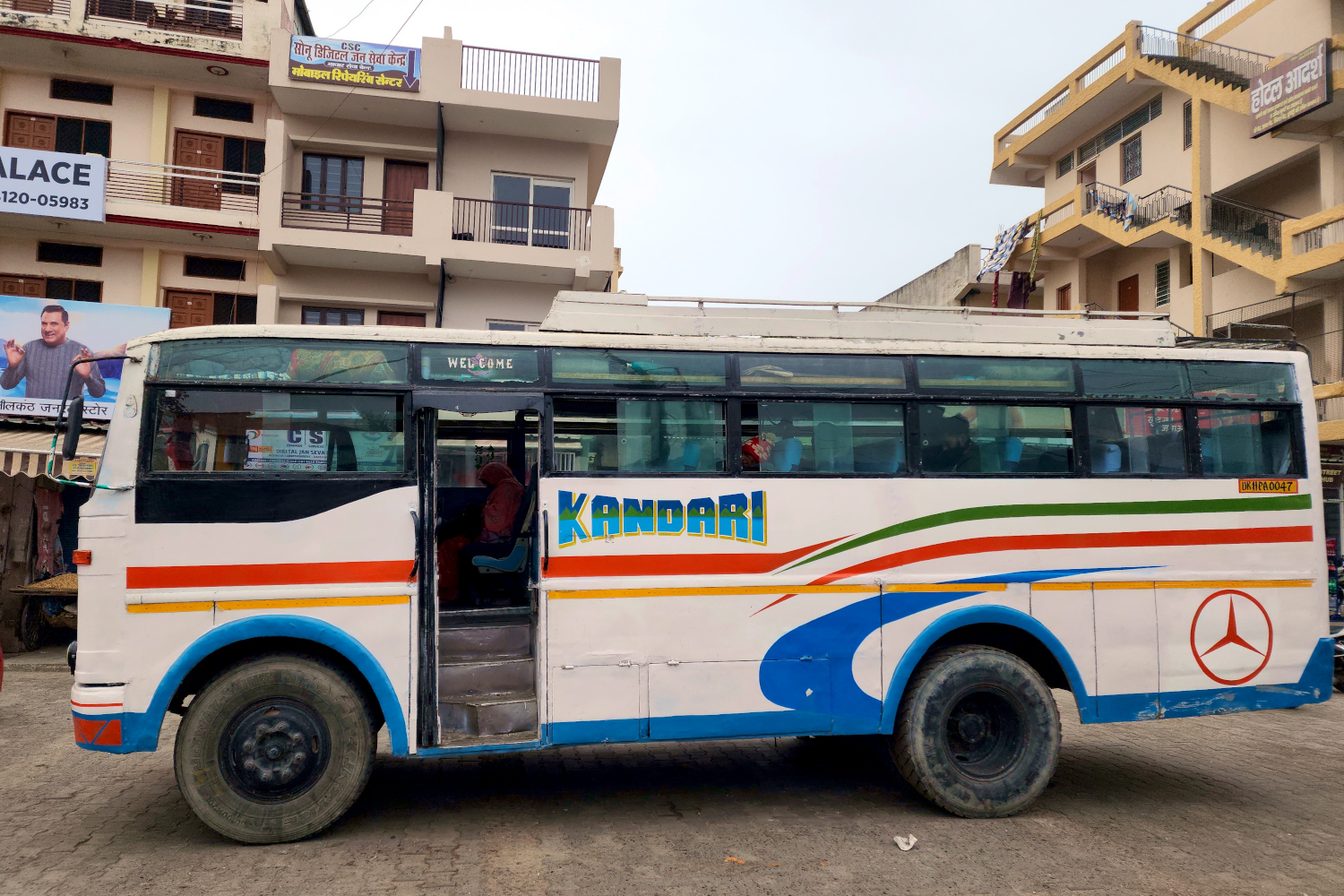
After a while, the ticket window opens, and we are able to go up and talk to someone — not very effectively, but enough to ascertain that yes, the bus does leave from across the street. So after we wait as long as we can to work in a final trip to the WC first, we cross over and board the tattered old bus. The driver shoves our big backpacks into the rear storage compartment — and we do mean shoves, none too gingerly. The rain cover on Kimberly’s gets badly ripped. (The cover on Dennis’s is already slightly ripped, and, the compartment being leaky, the back pack will get rather soaked during the ride.)
The road twists and turns and whips and snarls enough to make a serpent dizzy. And yet the driver keeps zooming at a pretty good clip, sometimes zipping around curves so hard that we have to hold onto the metal bars of the ratty seat in front of us to keep from being thrown into the aisle or farther. As the afternoon wears on the air grows more frigid — first merely because of the wind and fog, but later because the rain picks up. Most of the windows are mostly down, and indeed most of them wouldn’t budge with a crowbar; they seem to have been left in place so long that they’ve become cemented by rust and gunk.
And the road? Well, perhaps calling it a road is too generous. It’s more like the bus is walking a tightrope. Back in the states, this road would have been considered almost too narrow for a one-way lane. Here, it’s a two-way road; and our bus isn’t the only wide load that travels on it. Sometimes meeting another large vehicle requires having one of them pull onto the shoulder — if there is anything that can be charitably called a shoulder. Sometimes, it appears that our bus actually has a wheel or two dangling off the side. At other times, one or both vehicles must back up a little to create a suitable passing space — and that’s often no easy feat, since there is almost invariably traffic behind it.

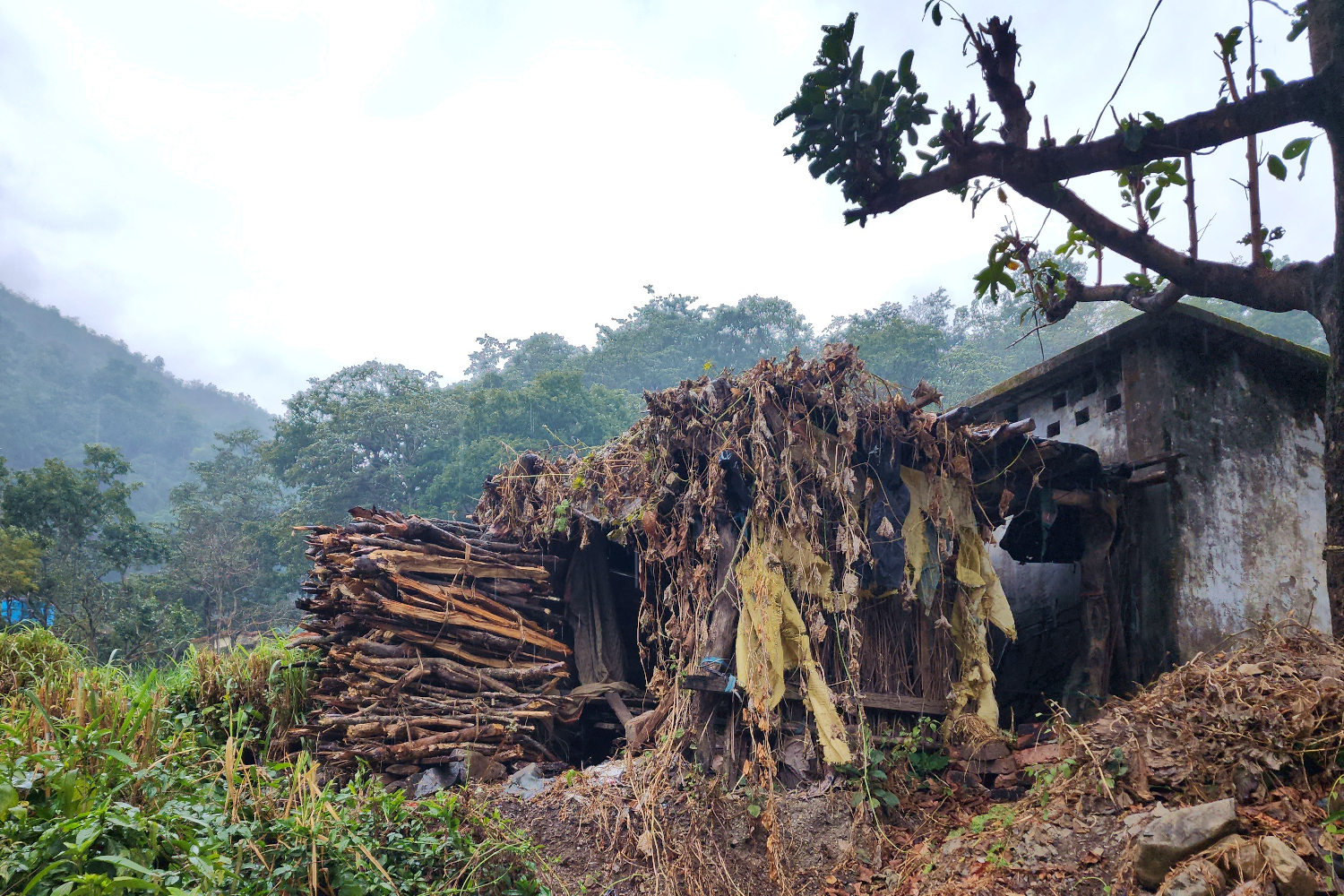
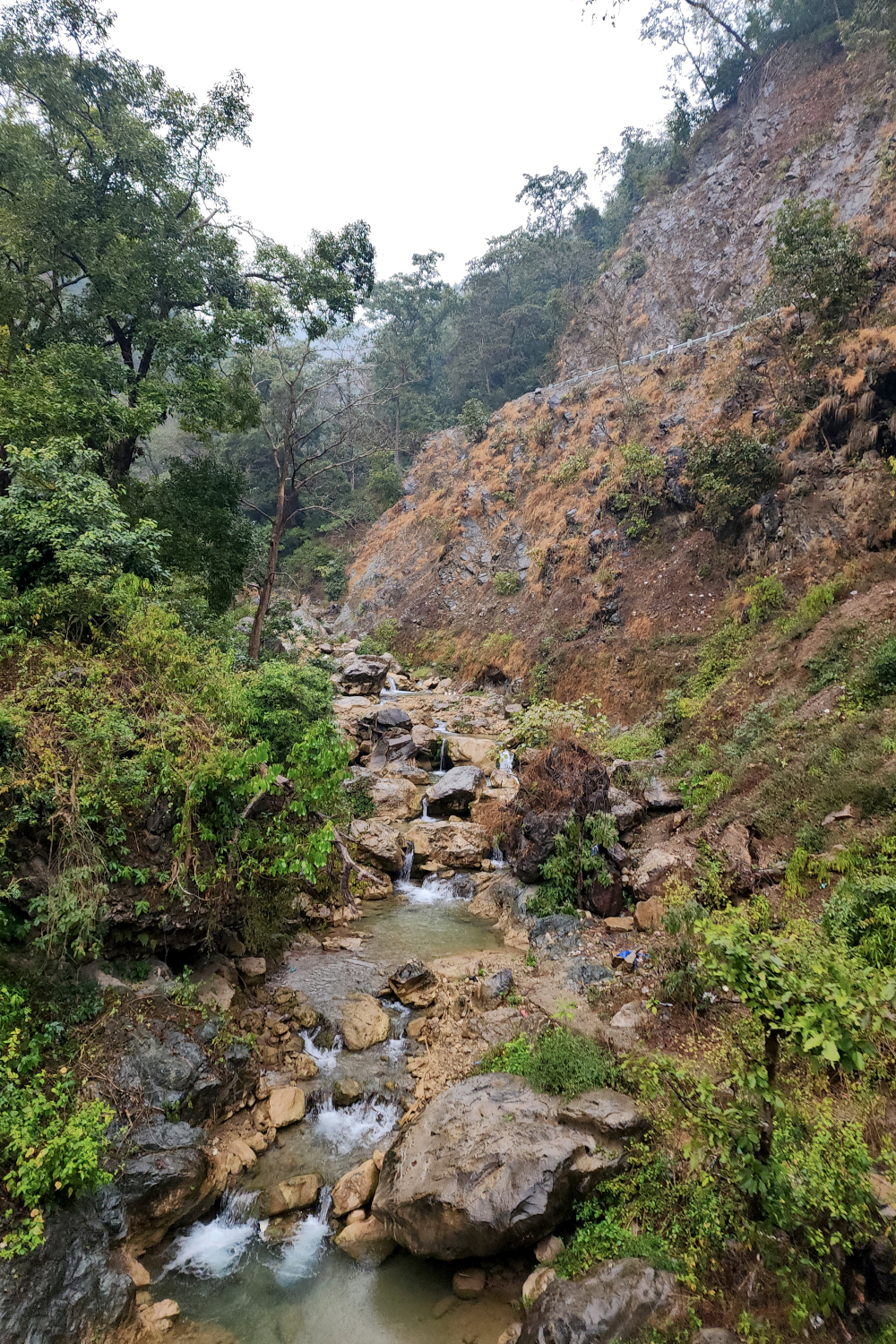
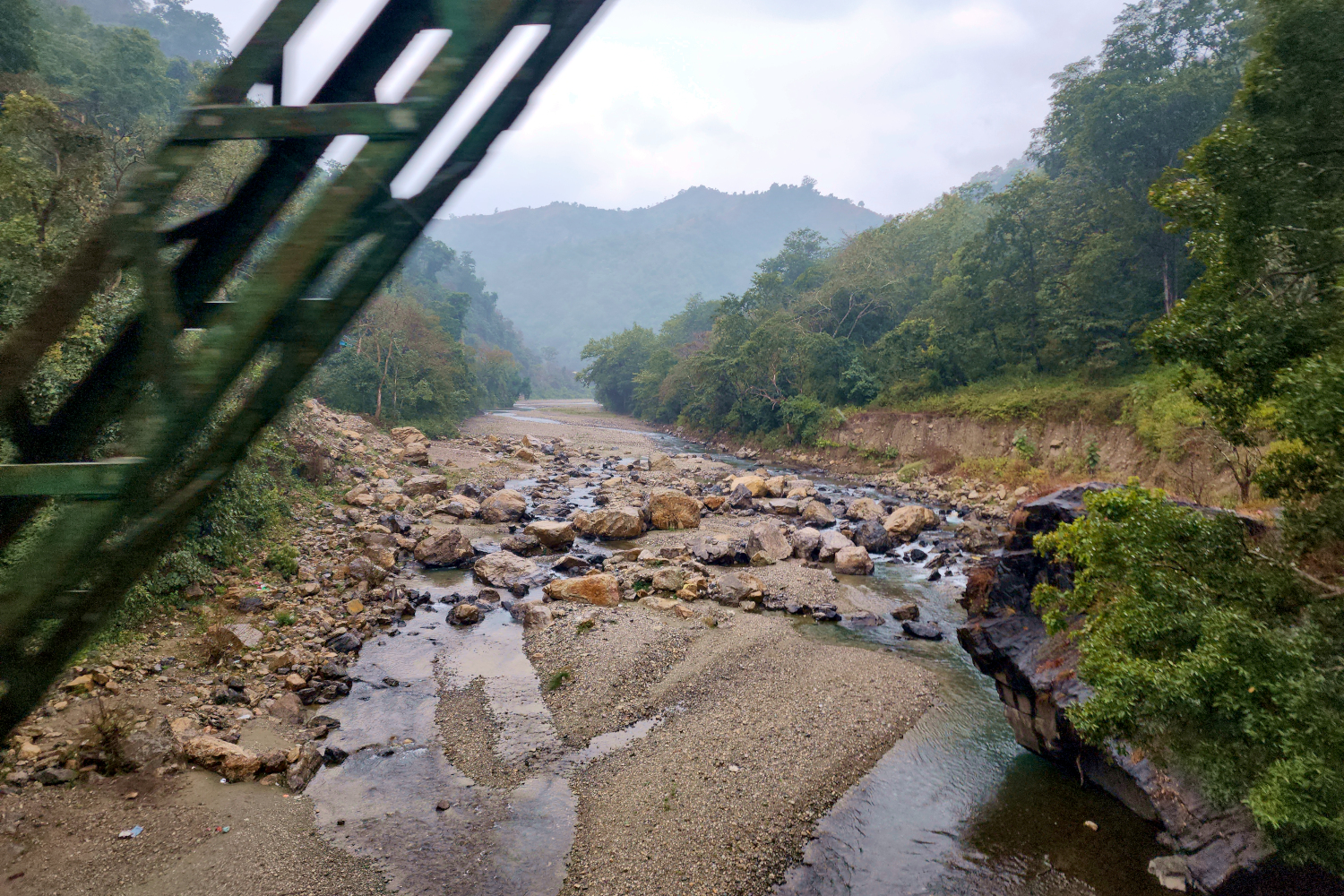
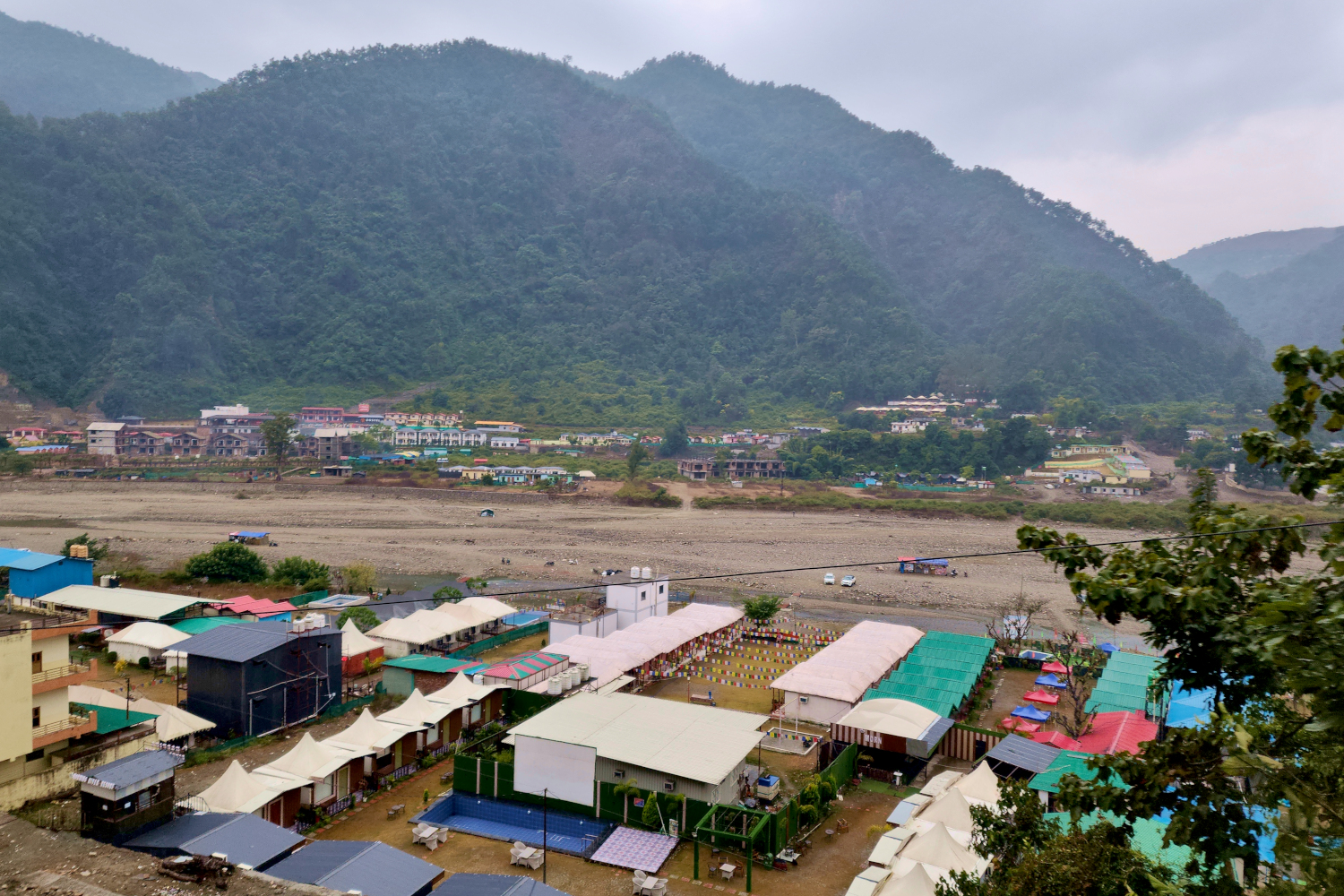

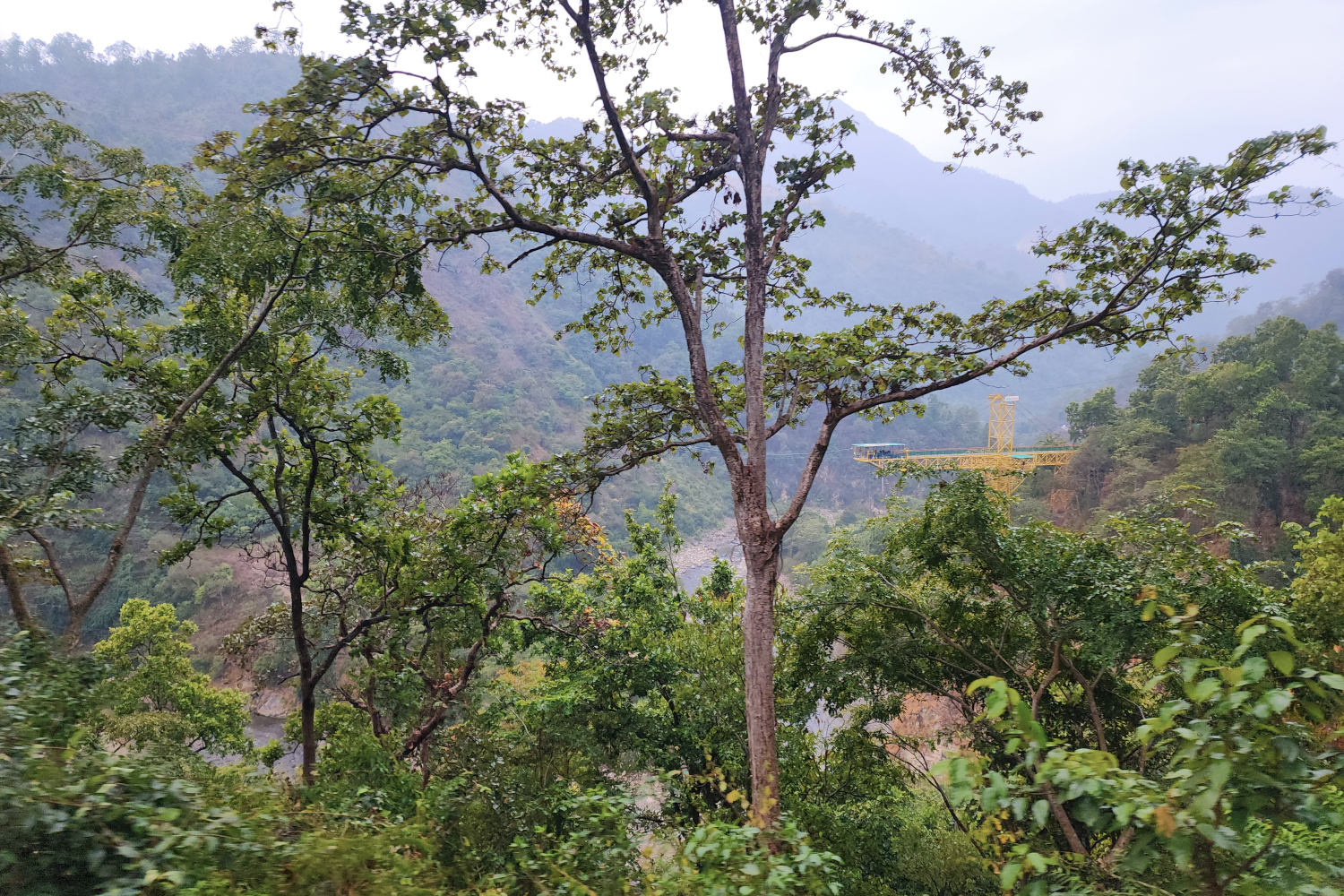
View out the window. Vishnu on the back of a chicken statue at a temple. A valley that looks resorty – with a suspension bridge.
As we already knew, there is no bathroom on the bus. And as we already feared we knew, the driver seems to have a strong aversion to making rest stops, as if he’s being challenged to make record time (if so, he’s apparently very far from succeeding despite his breakneck pace). At one point, we pass a resort in a valley, not far off the road. Surely there’s an accessible WC or two there. But we don’t stop. Farther up the mountain, we come to a bungee jumping tower. With all the tourists it attracts, surely there must be a potty on the premises. But we don’t stop.
Dennis is getting especially desperate, as he not only seems to have a limited bladder capacity, but is trying to avoid stretching it to the limit, in order to avoid a recurrence of kidney stones. At one point he goes up to the driver — or rather the person sitting next to the driver in the cockpit of sorts — and says, “Washroom?” (That’s the expression of choice in these parts.) The fellow gives something halfway between a nod and a shrug, and Dennis thinks that perhaps relief is forthcoming.
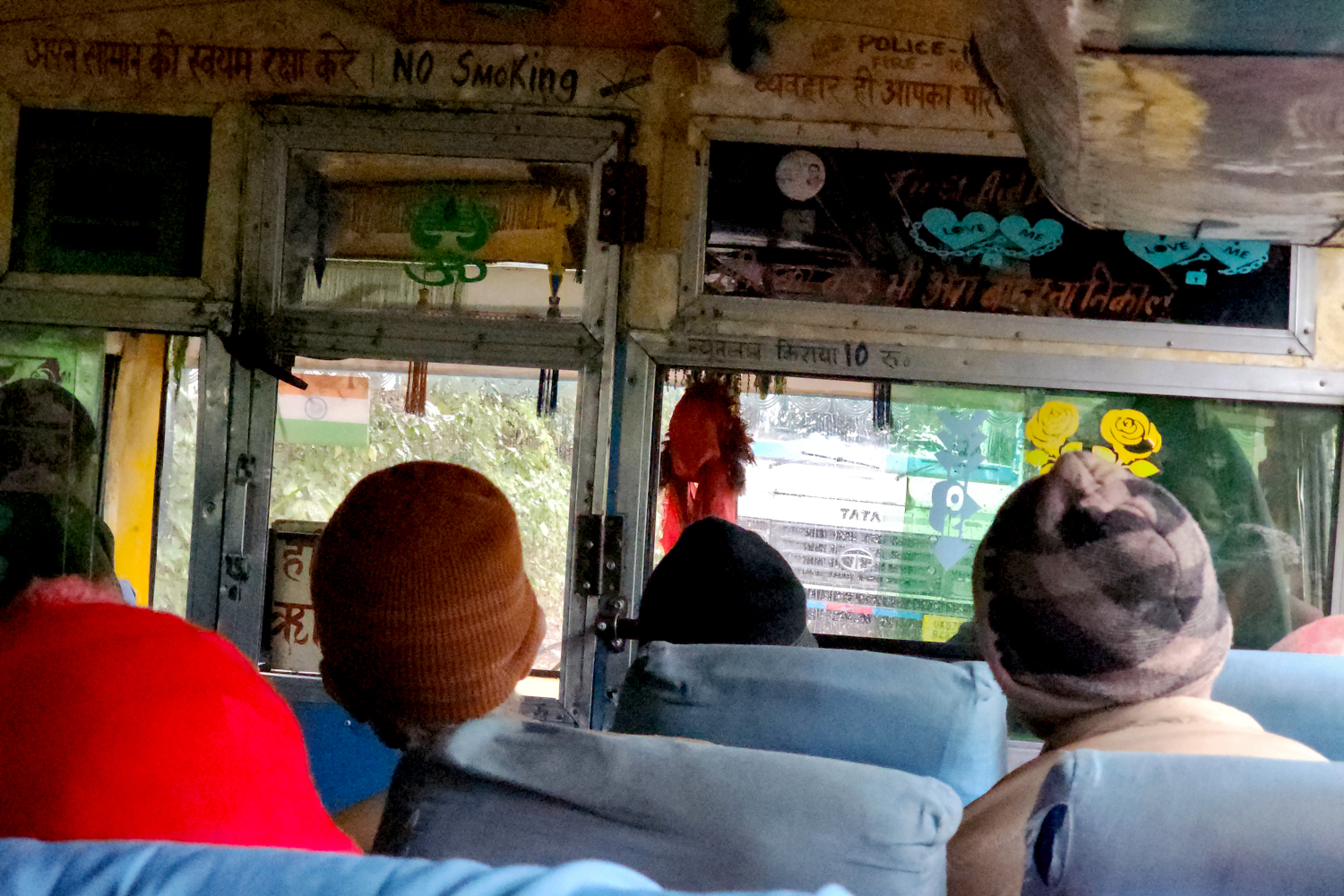
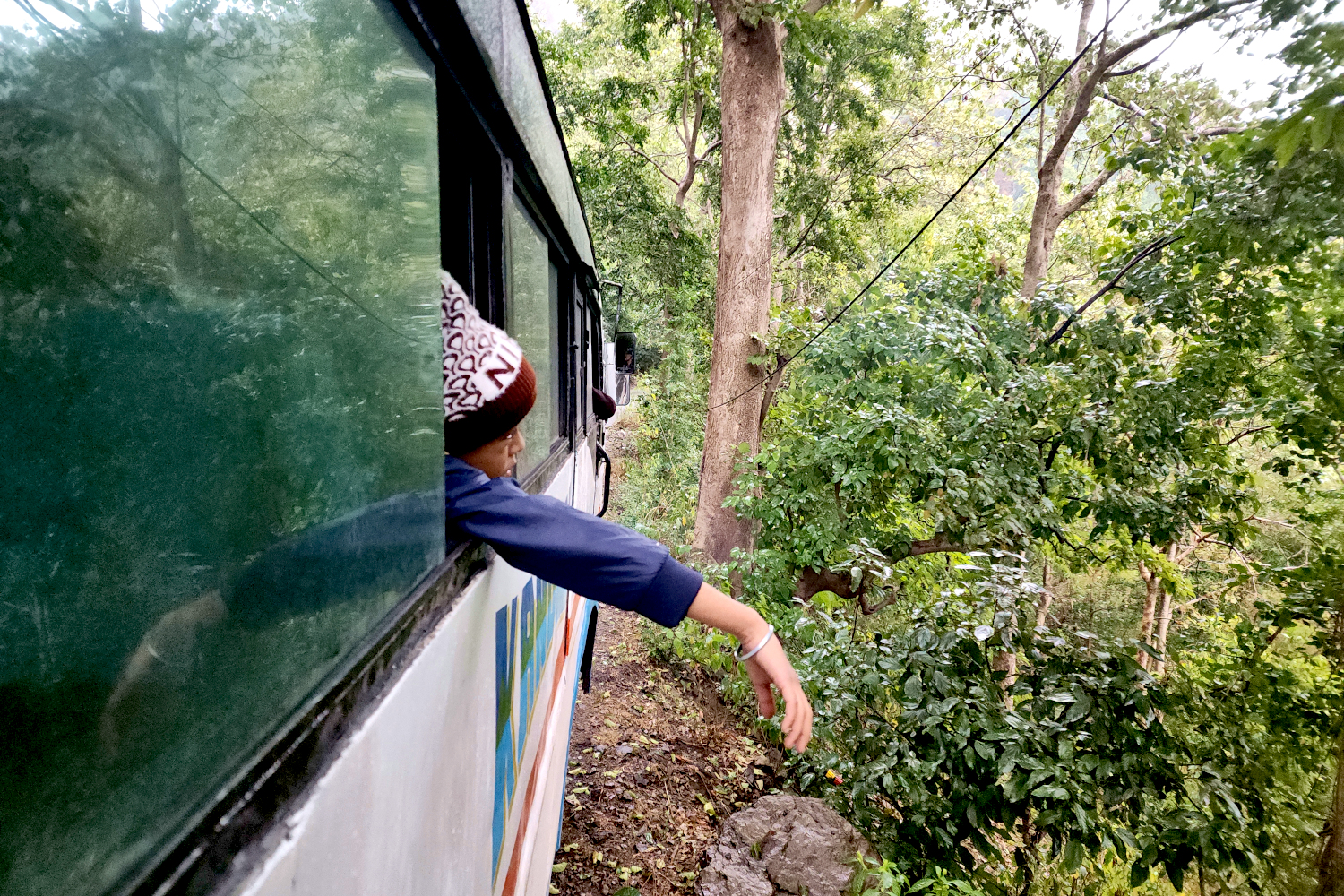
Playing chicken with two construction trucks on a narrow stretch of road. You can make out one of the trucks through the front window of the bus. The trucks had to back up so we could pass.
But it is not until we are a good three hours (or a not so good three hours, if you must) into the trip that the bus finally pulls over in a tiny village. A “washroom” break does not seem to be the official intent — a couple of passengers are getting on and/or off, and the driver is grabbing a snack. But a few other men are also getting out temporarily, and it seems clear that we’ll be here at least a few minutes. The man sitting in front of us — a resident of Devikhet who speaks English, and made our acquaintance already — turns to us and says the magic word, “Washroom?” Dennis needs no second word, but bounds off the bus and heads in the same direction as the other guys are heading.
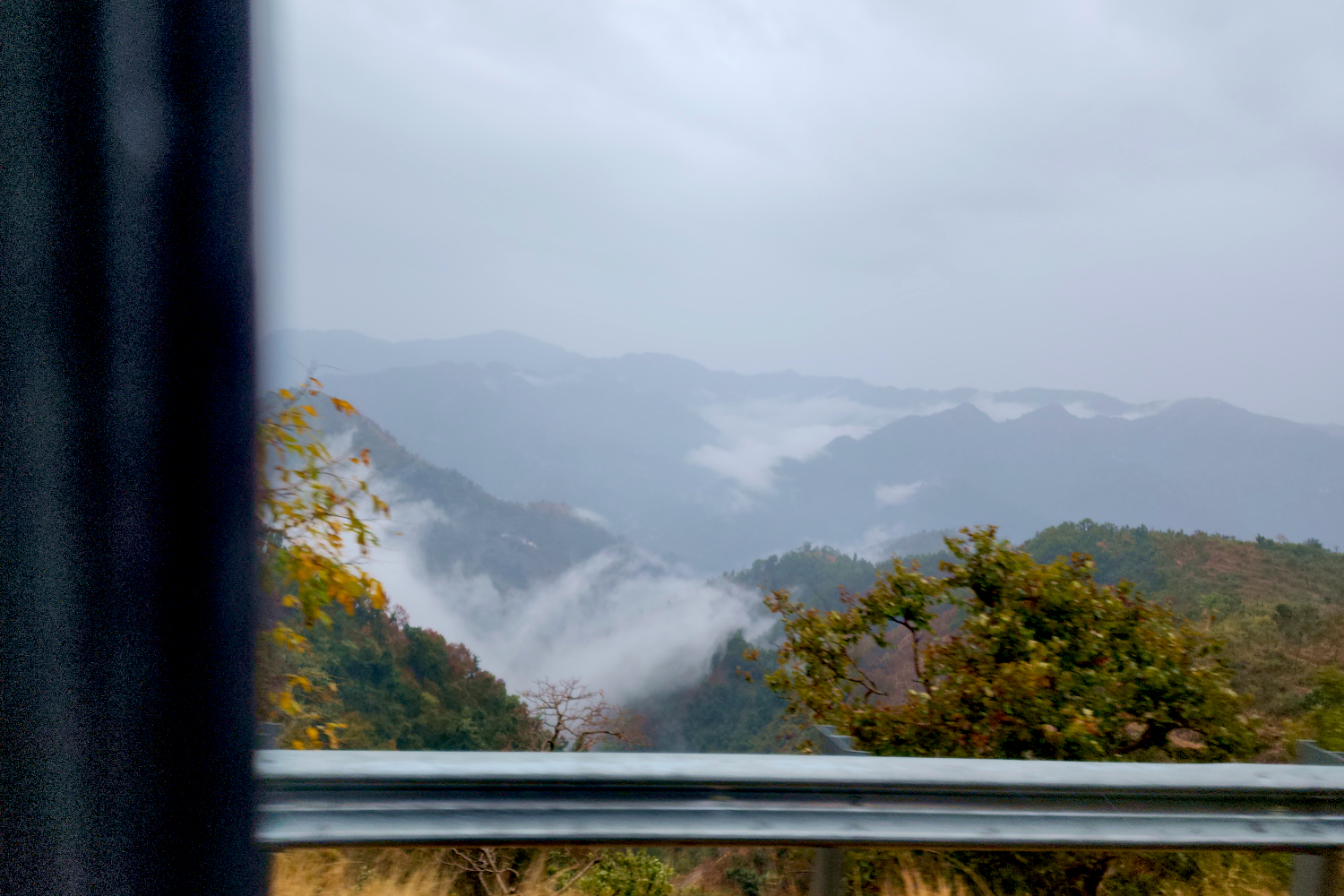

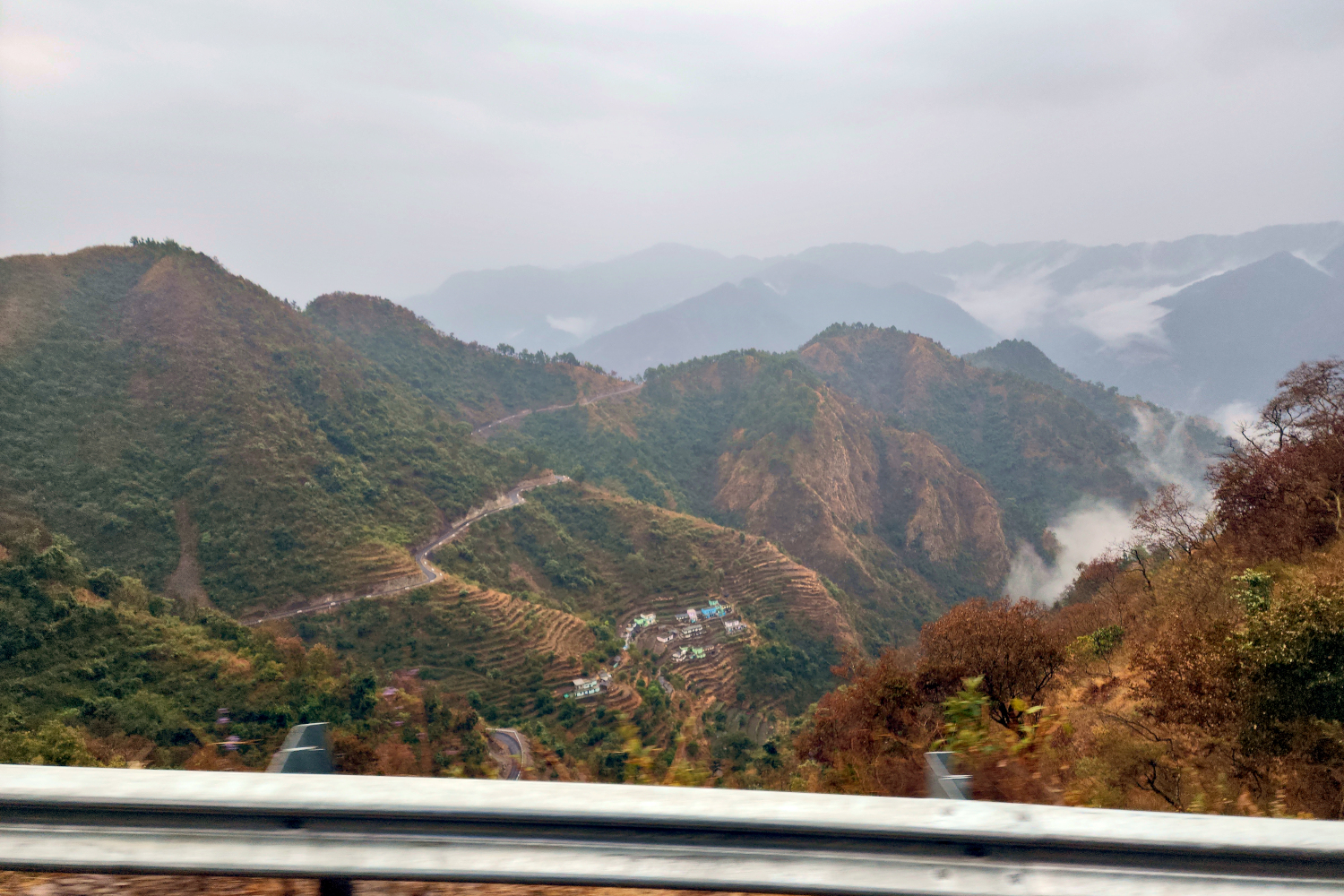
This turns out to be a series of three wooden cubicles on the side of the road, about 50 yards ahead. Dennis dashes to one of them, opens the door, and finds… nothing. There are no toilet facilities inside, not even an old-fashioned wooden seat. Nothing but bottles, cans and other refuse on the ground. He turns quizzically to the fellow entering the cubicle next to him, who nods. So a toilet it is, no matter what it may have been designed for originally. And then it’s a dash back to the bus, which is already beginning to pull out slowly; it’s not unusual for drivers in some countries to do this, as a signal to the passengers that it’s time to hustle back aboard — yes, while the bus is slowly moving.
You may have noticed that something was missing from the preceding paragraph: namely, any mention of females. Quite often, when it comes to ad hoc washroom stops in many developing nations, it seems to be just taken for granted that they are done for the benefit of men only — sometimes, absent any other facilities, they will just pee beside the road. The bus drivers, being themselves invariably men, never seem to consider the possibility that women might need to go as well.
During the remainder of the journey, there are a couple of more stops to discharge passengers — in what looks to us very much like either the middle of nowhere or its far reaches — and a few stops to pick up and drop off schoolchildren in their crisp blue and white uniforms, who pay the driver for their passage.
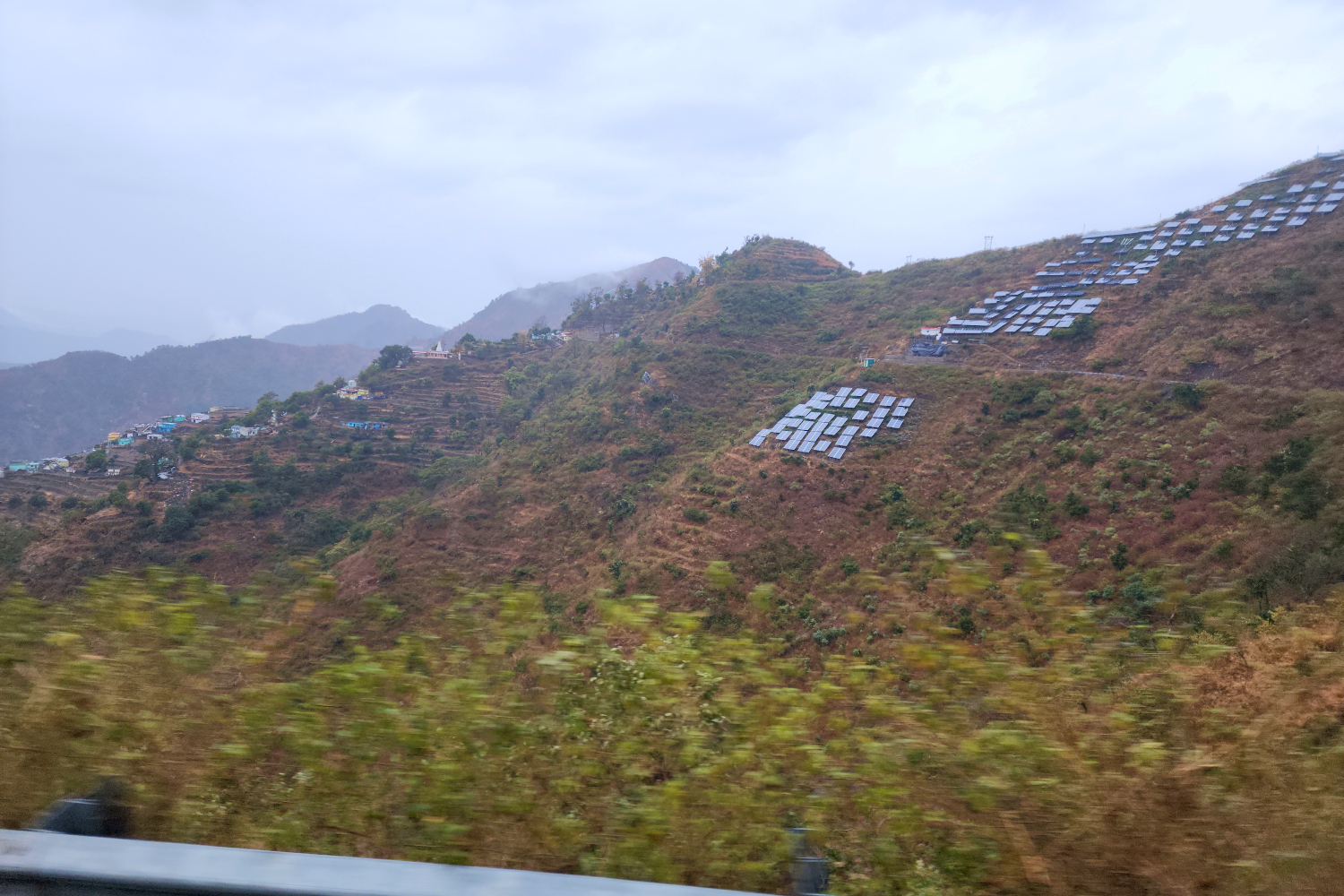
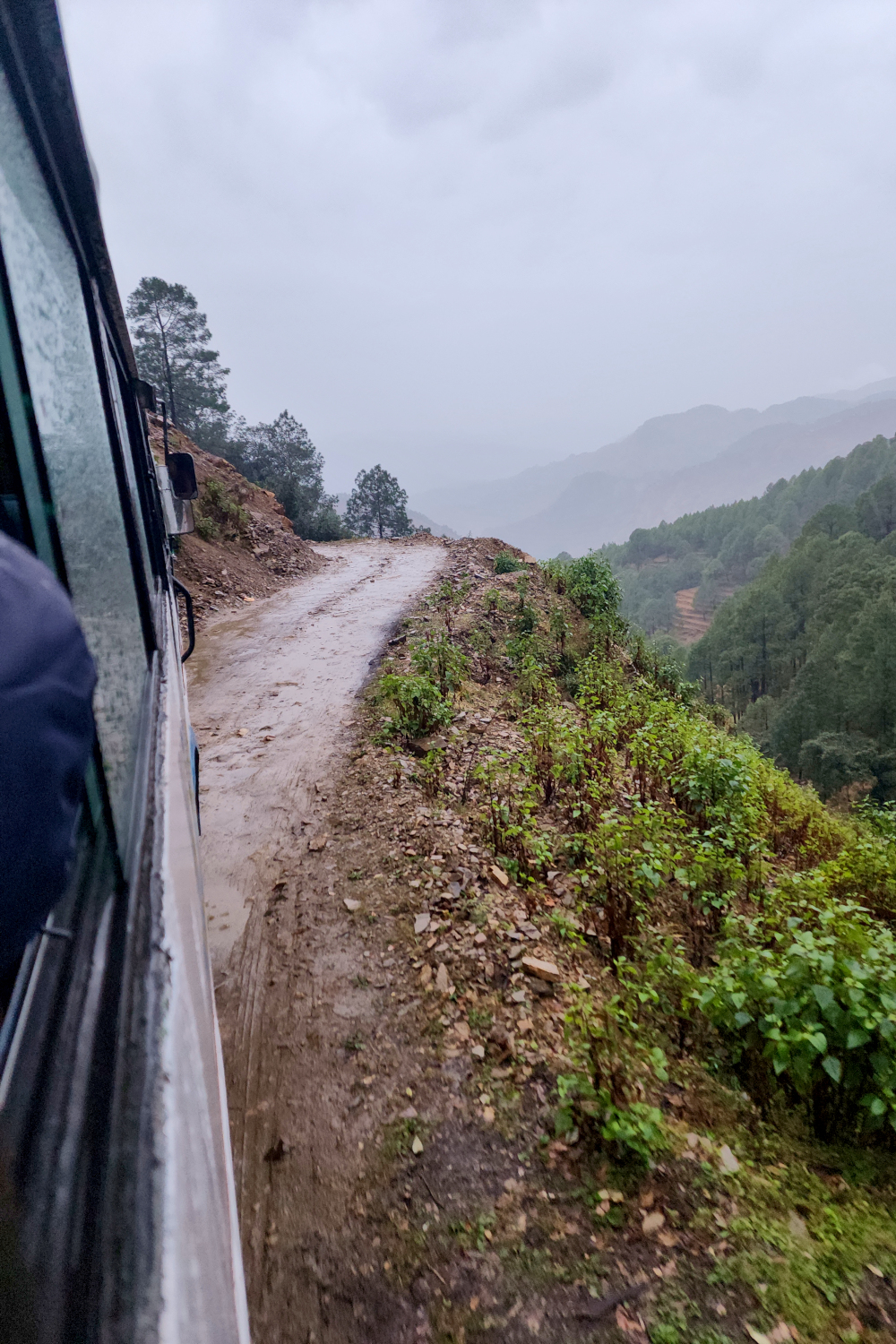
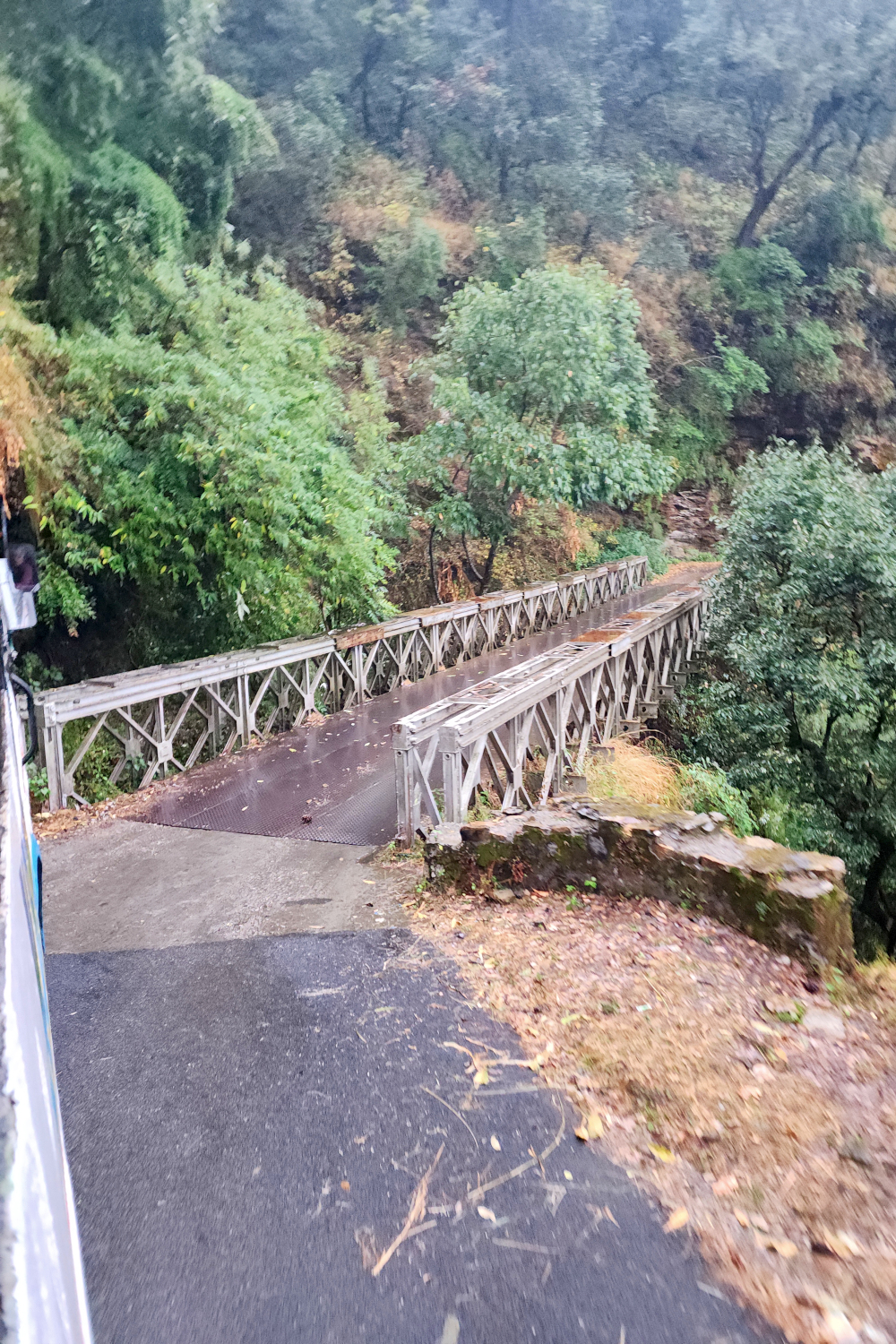
Solar panels on the mountain side. Narrow bridge …we survived by holding our breath.
It’s after 5:00 when the bus at last pulls into Devikhet, which appears to be little more than (to use a southern expression) a wide place in the road — though there are a few little shops, and a few little side paths that evidently are the local equivalent of streets. The terminus of this trek is in front of one of these shops. But we still have a couple of miles to reach our real destination, the even smaller village of Shri Timli. When we call our contact there, he tells us to catch a ride with one of the fellows hanging around with 4-wheel drive vehicles (these are apparently the local taxis), of which there are three or four. So for 200 rupees (about $2.30), we pay one of them to tote us and our bags the rest of the way.
He drops us at a walkway going down the side of a hill. And we do mean down. It’s a steep and tortuous path that seems to be a scale model of the road we’ve just traveled in the bus. It takes us down and around, down and around, about a quarter of a mile, and it occurs to us that it would not be fun to go back up this hill carrying all of this weight (forgetting for the moment that, one month hence, we’re going to have to do just that). As we approach what looks like a village or at least a settlement, we meet two guys coming up the hill, and tell them we are new volunteers, and ask them where we should go. They point out a building just ahead — or just below — with a blue roof, just on the other side of the water tank.
Approaching this building, we find the door locked. And there is no answer when we knock. Then along comes a boy, about 10, who informs us that we should (duh) go around to the other side. So then it’s down a few more steps, and then up some steps, and lo and behold, the door is open. This is the kitchen/ dining room/ communal room of the compound where we will be volunteering. And it’s dark inside. We grope around to try all of the light switches on the wall, and nothing happens.
The boy comes along again and informs us that there is no power because of the storm. So we whip out our flashlights, and do our best to make ourselves at home — including, oh yes, making use of the washroom. For all genders. And we learn that there will soon be dinner available.
Then along come two other American volunteers, Tina and Andrew, a couple from Mississippi. Andrew is a horticultural whiz who’s been making great headway in launching the compound’s agricultural projects. Tina (who’s originally from Iran, but grew up in the U.S.) is especially cordial and considerate, and will remain so throughout their stay. She has a knack for tuning into the problems people have, and being genuinely helpful. Our contact person, Ashish, also comes to welcome us and take care of our needs.
Then we get shown to our room, a simple compartment with two wooden platforms on which bedding has been mounted, a little table and a couple of chairs. It is, we are told, the warmest room of them all, but it’s still goosebumps city in the present weather. But the blankets are nice and warm.
And so we are home for the next month, having survived a bus trip that we are none to eager to repeat anytime soon.
Events occurred: 12/27/2025



 world travel with a theatrical flair
Leave a comment