

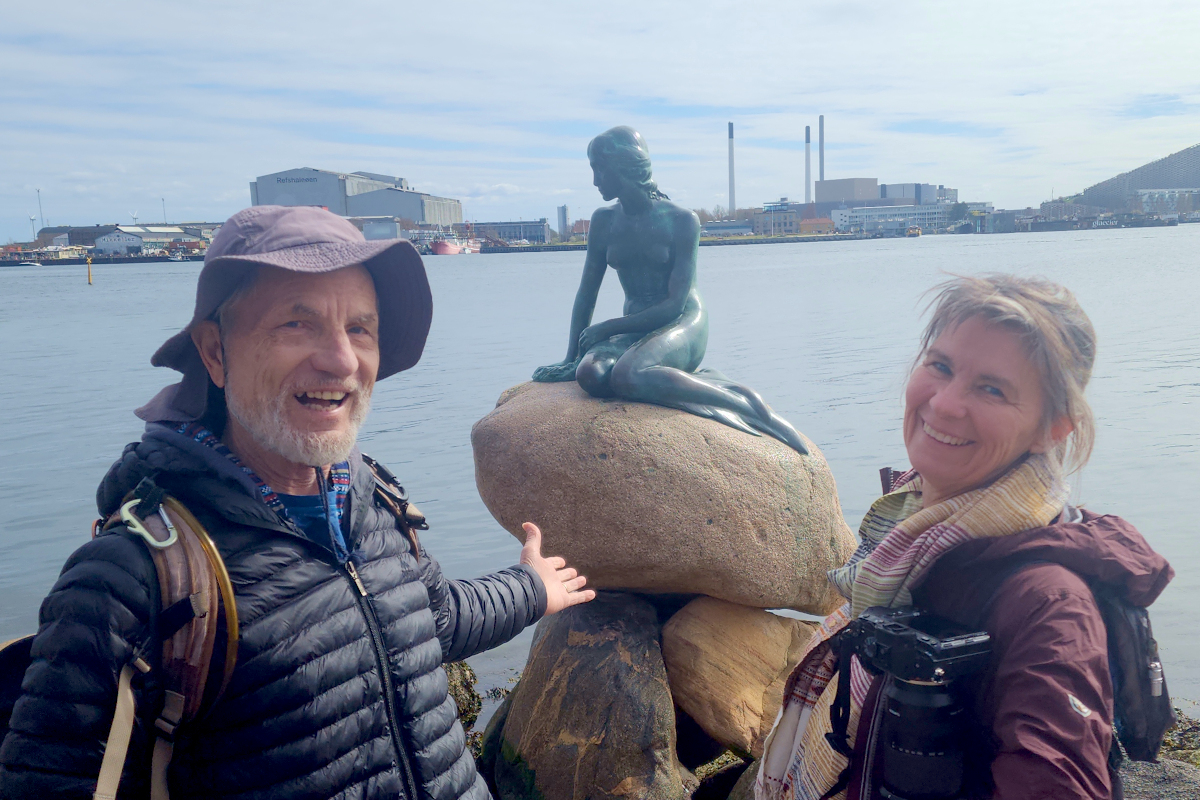
On our first full day ever in Copenhagen, our first priority was to find a mermaid. Let’s face it, if you’re going to Copenhagen, you gotta drop in on the Little Mermaid. No other landmark says “Copenhagen” like she does. For the past century, she’s been the number one star of local photos appearing on postcards — which is what they used to call Instagram in ancient times.


She’s been a fixture in the harbor since 1913, when sculptor Edvard Erikson cast her in bronze. The inspiration was a ballet performance of the story called (drumroll, please) The Little Mermaid, written by local boy Hans Christian Andersen. Ballerina Ellen Price was asked to model for the statue, and she agreed … but only from the neck up. She balked at posing nude, so the sculptor’s wife Elina volunteered to have her own body affixed to Ellen’s head. Ellen, Elina… close enough. Evidently Erikson couldn’t find anyone to model the fish tail, because he merely hinted at it in the sculpture.
Not surprisingly, this mermaid has quite a global fan club. And it seems that all of them have shown up today to gawk at her, so we have to wait our turn to do the obligatory selfie with her. When we do, we find that it’s quite a challenge to establish a clean photo frame — that is, a shot with no unsightly sights in the background, such as industrial plants with towering smokestacks, which rather spoil the theme of enchantment. (Actually what you see directly behind it is Copenhill, a recycling plant with a ski slope built on top of it. It’s on our list to see on this trip.) We’ve seen photos that manage to look idyllic, sporting a splendid sunset/ sunrise. We have to wonder where some of the photographers stood. Were they able to walk on water?
Given all the hype over this piece of sculpture, you’d expect it to be considerably bigger. But it’s only about four feet tall — which, considering that the subject is sitting, means that it’s approximately life-sized. And having spent many years performing stories for kids, including the one this statue refers to, we know how big a mermaid is supposed to be — namely, Kimberly’s size.
We’re lucky that we didn’t come here 15 years earlier, because we might have found the mermaid on vacation to China. From late April to late October of that year, she was exhibited at the Shanghai World Expo, where she sat in the Danish Pavilion in a pool of water that was also transported from Denmark. (They were really sticklers for authentic detail.) It was the only time the mermaid has ever been removed from her home.
Well, at least officially. It’s been a chronic target of vandalism, and on one occasion in 2003, it was blasted off its rock. Furthermore, it has been decapitated at least a couple of times. The first time, in 1964, the head was never recovered, and what we see now is a replica. That one was also chopped off later, but was recovered. Several times, hooligans have poured paint on her or otherwise defaced her. And on many occasions, they have draped her in various articles of clothing, particularly the attire of sports teams. Looks like mermaids still don’t get much respect.
The mermaid’s home is on the Langelinie Promenade, a seaside walkway that includes a park with a windmill, statues and monuments, and — on this occasion — a profusion of cherry blossoms. At one windmill, a maintenance crew is, for whatever reason, clipping the windmill’s wings today. Climbing up to the turret, they remove the canvas coverings of the vanes and pack them away, leaving only the bare skeletons, which won’t hold any wind. Does that mean the windy season is over, and the arms wouldn’t have been turning much anymore? Or does that mean the serious windy season is about to get underway, and they’re afraid the windmills will lift off and fly?


This windmill is actually on the grounds of the Kastellat (citadel) a fortification constructed in 1626 and used as a military fortress for two centuries. When viewed from the air, its walls form the shape of the proverbial pentagonal star. It’s still a military installation of sorts, and there are even a couple of MP types stationed at the gate, though we suspect they’re largely just for show. There’s no checkpoint of any kind.
Its buildings, including the former barracks, are still standing, but they mostly have been repurposed. Well, except for the church, which is still a church. It was built not only to serve military personnel, but military prisoners. The jail was next door, and there was a hole through the walls so inmates could watch church services from the comfort of their cells, as they prayed for the miracle of chains dissolving and doors collapsing.


We encounter another set of what looks like barracks on the way home, but these are orange-ish, as opposed to the red ones at Kastellat. And they were not really meant as barracks but row houses, built in the Seventeenth Century for sailors and their families. The site is called Nyboder, and it’s still used as housing.


Looming over it is the dome of Frederik’s Church, the largest church dome in Scandinavia. Otherwise known as The Marble Church because of its distinctive marble dome, it constructed over a period of about 150 years, starting in 1749. No, it didn’t really take that long to build. The project was just halted for a while. As in a few generations.


Also on our route is Rosenberg Castle, constructed in 1606 in the Dutch Renaissance style. We could have shelled out good money to take a tour and see how royalty lived back in the day, but it would have taken a big chunk of our first of only two days in Copenhagen. And on this first trip, we wanted to soak in as much of the city as possible. Besides, as enormous as this palace is, it was only the king’s summer home. Instead of going inside, we sit out in the gardens and had our lunch as we admire the castle’s exterior.


When we reach the heart of the city, more or less, we come up the statue of Hans Christian Andersen himself. It’s only one of many statues of Denmark’s famous literary giant, but it’s perhaps the best known, a bronze larger-than-life likeness cast in 1965.


Old Hans has a good view across the way of Tivoli Gardens, a fixture in Copenhagen since 1843 — which means it was here during his lifetime. It’s the second oldest theme park in the world; in almost any other world, an establishment that old would be the oldest, but Tivoli has the misfortune of competing for the honor against Dyrehavsbakken, which dates all the way back to 1583 — and is located only about 5 miles north of here. So Tivoli is not even the oldest in the neighborhood. But it’s one of the best known and best loved in the world, and provided Walt Disney with inspiration for his own little project.


Though it combines recently installed high-tech attractions with much older ones, overall it looks quite antiquated, and somehow has a bit of a Twilight Zone aura about it. Our impressions are based on what we can glimpse from the inside; we don’t purchase tickets and go in, not this time around. Our son, a Disney and general theme park fanatic, might disown us for that failure, but with only a couple of days to explore Copenhagen our first time here, we didn’t want to spend one day riding roller coasters. Maybe on our next time around, we’ll go around and around, and up and down. And we do plan to have a next time.
Events occurred: 4/06/2025

Leave a Reply