

Copenhagen doesn’t just invite you to explore; it dares you to keep up with its eccentric sense of humor, as it constantly throws you curveballs. On our last day in town, we were set to check out some of its quirkiest nooks, crannies, and peaks.


Nyhavn
First up is Nyhavn, a colorful (literally) stretch of buildings lining a canal, a former residential and shipping district turned commercial district that dates back to the 17th Century. Its brightly painted antique houses, encompassing just about every color of the palette, really give the Little Mermaid statue a run for the money in terms of tourist visits and shutter snaps. And speaking of the Little Mermaid, there are three houses here at which Hans Christian Andersen made his home at some time or other. Nowadays, the former homes have been put to use as cafes, restaurants, bars, and — needless to say — gift shops.
This seems like an opportune time to take advantage of one of the city’s seventy-something public restrooms, made available absolutely free (a contrast to elsewhere in Europe and most other places). It’s even more enticing because this is one of a handful of public toilets that are historic sites, dating back a century or so, and still sporting its vintage decor of hardwood and brass in pristine condition. You might not expect that a functioning bathroom would make the grade as a tourist attraction, but one like this almost makes you want to drink a quart of tea so you’ll have an excuse to drop in.


As we continue strolling along the canal toward the sea, we pass a salvage crew that includes divers submerging themselves into the water to retrieve detritus that has settled onto the bottom, about 15 feet deep. This includes a couple of old bicycles, and it might make an interesting story to hear how they ended up there. Anyway, we have to hand it to the divers to undertake such an undertaking at this time of year, when the water surely must be even crisper than the air, to quite a degree of degrees.
Church Of Our Saviour
Next on our walking route is the baroque Church Of Our Saviour, built in 1696. It’s noted for several things, including its celebrated carillon, which plays tunes every hour from 8:00 until the witching hour of midnight. But even more interesting, as far as we’re concerned, are the 40 elephants displayed in its interior, some rather inconspicuously like Hidden Mickeys at Disneyland. These pachyderms commemorate the Order Of The Elephant, established in 1693, which is an exclusive chivalric order that is the nation’s highest honor, and thus is reserved exclusively to be conferred upon royalty and other denizens of the upper crust. Its emblem is an elephant with an Indian jockey because at the time it was adopted, Denmark ruled parts of India.


But the crowning glory of this church is its handsome brown and gold spire, which was tacked on top of it in 1752. What makes it really distinctive is the spiral staircase winding around the outside, 400 steps to the peak and a peek at the panorama of the city. Legend has it that the designer of the spire committed suicide by hurling himself off the top when he discovered that the stairs wound counterclockwise rather than clockwise. But that sounds more like a bad joke than a historical anecdote; if you don’t realize until the project is completed that the stairs are going in the “wrong” direction, you hardly could have been competent enough to have conceived the whole concept in the first place.
This tower is supposed to offer one of the best views in Copenhagen, but alas, we won’t be able to find out for sure on this occasion. We wanted to do the climb, even though it requires paying admission. But there are a limited number of slots available, and on this day they’re already booked up. So it will have to be something we save for our next excursion to Copenhagen.
Thomas Dambo Green George Troll Sculpture
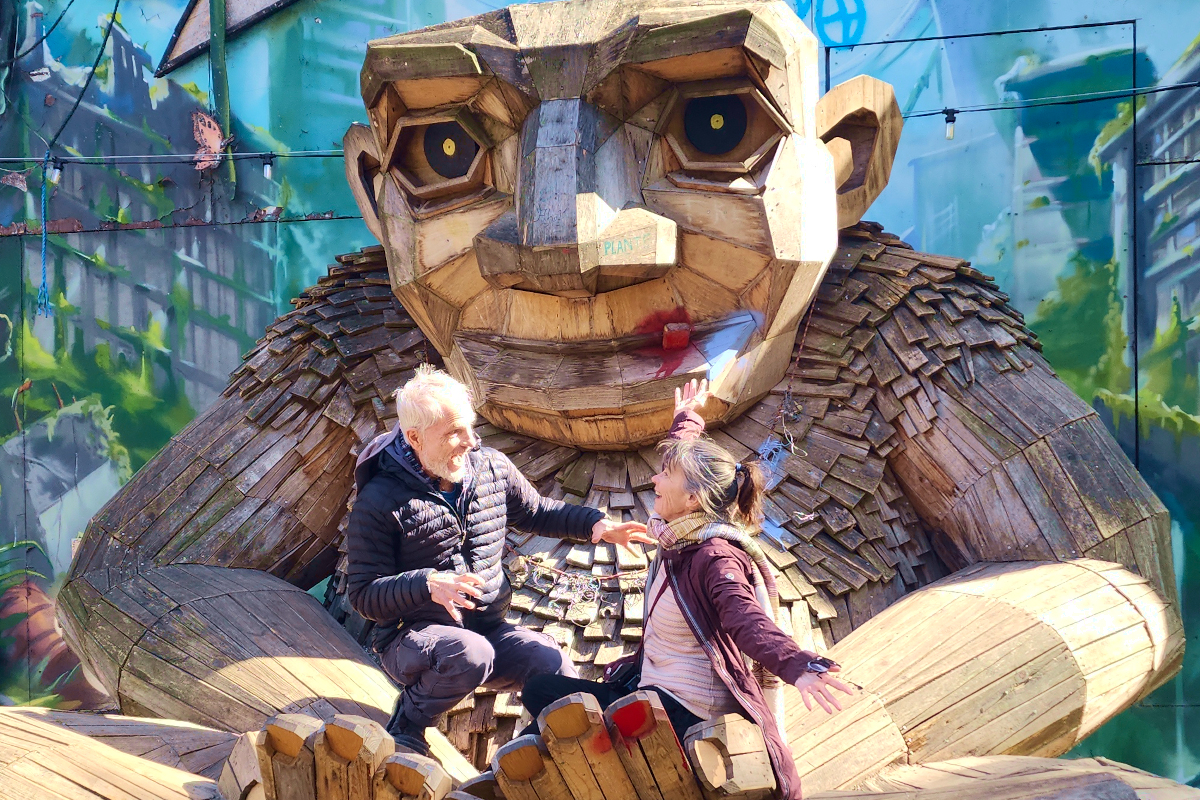
The next point of interest we come to is a troll. A huge wooden troll that welcomes visitors to sit in his arms and pose for photos. Called Green George, this sculpture was fashioned during the pandemic by the sculptor Thomas Dambo, who has created more than 170 such trolls around the world, from recycled wood salvaged from the dumps.


Freetown Christiana
George stands guard at more or less the entrance to Freetown Christiana, a funky little pedestrian neighborhood that looks like a hippie commune — because that’s what it was established as, and what it pretty much still is. The community was founded in 1971, when a group of counterculture types began squatting in former military buildings that were left on the site. They eventually acquired ownership of the property, and have constructed other homes, some of which are creatively hatched houses that seem mostly constructed of windows, and would do Buckminster Fuller proud.
Ambling along the car-less little thoroughfares, we come upon many vendor booths and what appear to be makeshift storefronts, selling an oddment of books and other items. It has the flavor of a Renaissance fair, except the accompanying artwork and graffiti are much more modern. Many of the signs appear to be handpainted, or at least homespun like so much of the rest of the infrastructure.


Among the signs is a large one in Danish and English proclaiming that Pusher Street has been shut down. Pusher Street was a section where for many years there was a legal trade in marijuana (and sometimes other consumables — the sign admonishes visitors not to buy hash) that the authorities mostly turned a blind eye to, allowing Freetown to regulate itself. The street came to be dubbed the Green Light District. But finally both the police and the community itself began cracking down, and decided to eliminate the drug trade altogether.
Then after we’ve read the sign and are about to move on, an older gentleman in a wheelchair calls us over, and asks, “Do you speak English?”
When we respond in the affirmative, he continues, “The sign is a lie. There are still drugs here. In fact, I’m not going to point to anyone, but those two men back there in front of the store are involved in it”, he says. “And there’s still violence here sometimes.” (There have been a couple of violent incidents in Freetown over a period a many years, and as far as we know, that’s all.) He says that he has lived in the community for 30 years despite its problems, and assures us “I don’t smoke anymore myself”. But we’re a bit skeptical of that claim.
On the outskirts of Freetown, the suburbs if you will, are the more rustic homes, some of which appear as if they were assembled in the same manner as the troll. One of them has a corral, with four horses frolicking in it. So Freetown has its rural element as well.


Copenhill
From here we take a short bus ride to the day’s main attraction, Copenhill, which is also known as Amager Bakke, but we think Copenhill rolls off the tongue better — at least English speaking tongues. Opened in 2017, this award-winning structure is an innovative plant for converting non-recyclable trash into energy. It’s a bit of a trade-off; while the facility does reduce landfills, it also produces CO2 because it burns the waste — though it does so through a process that minimizes pollutants.


In any case, we’re not really here to see a waste-to-energy conversion, exciting though that might be. The real draw is not what’s on the inside but what’s on the outside. The steeply slanted roof of the building features a ski slope and running track. And where else can you see such a combination of practical and recreational use?


After a bit of deliberation, we decide to forego the elevator this time, and, like the hardy adventurers we profess to be, hike up the trail to the top. While there is no official step count to gauge your fortitude, it’s surely comprised of hundreds (thousands?) of steps. Hey, at least we walk up. Along the way, we pass, or rather are passed by, a fellow running up.
At the top we find an excellent view of Copenhagen, though probably not as good as that from the top of the spiral church, since it’s on the other side of the water, closer to the action. There are also restrooms and a little snack stand, with tables for eating. We, however, have brought along our own lunch. And on a crisp day like today, you can stand near a blast of warm air drafting up from the bowels of the building, and warm your bones a bit.


On the way back down — which, amazingly, is easier than the hike up — we pause to gander at the climbing wall. Not just any climbing wall, but the world’s tallest climbing wall, shooting up to a height of 85 meters (279 feet!). Does anybody ever really make it all the way to the top? We have no illusions that we could do it ourselves, but it still might be fun sometime to see how far up we can make it. And hey, then we could boast that we climbed the world’s tallest. (Shh!! Don’t tell anyone that we didn’t specify we climbed the whole thing.)


When we return to Copenhill, however, and we do hope to return sometime, perhaps it would be best to come in the middle of winter. Then we could actually try out the ski slope. Neither of us is an Olympian skier, not by a long shot. But how can you resist skiing on top of a waste plant?
Events occurred 04/08/2025
Copenhagen Quick Facts: Planning Your Visit
If you’re following in our footsteps, here is the “need-to-know” info for these eccentric spots:
Church of Our Saviour (Vor Frelsers Kirke)
- The Spire: 400 steps in total (the last 150 are on the outside!).
- Admission: Climbing the tower requires a ticket (approx. 70 DKK / $10 USD).
- Pro Tip: Slots are limited and book up fast online, especially in peak season. If you want that panorama, book a few days in advance.
- The Elephants: Entry to the church interior to spot the 40 pachyderms is free.
Freetown Christiania & Green George
- Finding the Troll: Green George (Troll #50 by Thomas Dambo) sits right near the main entrance to Christiania. He’s made entirely of recycled wood from the neighborhood. See the Troll Map to discover more giant trolls by the artist world wide.
- Pusher Street: As of 2024/2025, the famous “Green Light District” has been officially dismantled. While the “no photo” signs are largely gone, always be respectful of residents’ privacy when snapping pictures.
- Rules of the Freetown: No cars are allowed inside; it is a strictly pedestrian and bicycle-only zone.
Copenhill (Amager Bakke)
- The Hike: It is free to hike or run up the trail to the rooftop.
- Opening Hours: Generally open 12:00 – 19:00 on weekdays and 10:00 – 17:00 on weekends (check their site for seasonal “Sunset Sessions”).
- Activities: You can ski, sled, or use the world’s tallest climbing wall for a fee, but the elevator to the cafe/viewpoint is accessible to all.
Nyhavn’s “Historic” Pit Stop
- The Toilets: The famous vintage public restrooms are located underground at Nyhavn 1F.
- Hours: Usually attended and open from 9:00 to 22:30.
- Cost: Absolutely free! (And yes, the brass and hardwood are worth a look even if you aren’t “drinking a quart of tea”).
Leave a Reply