

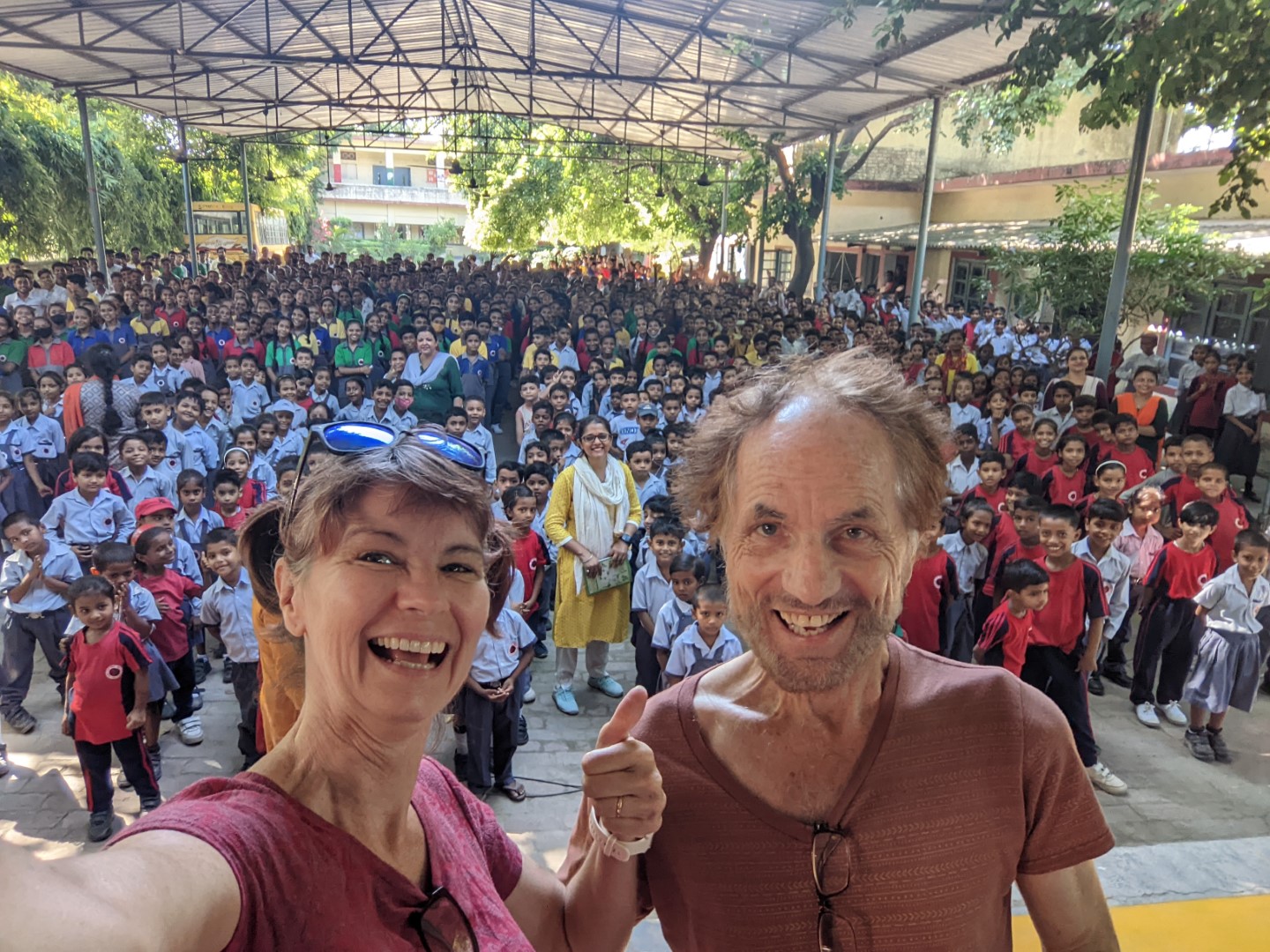
On Thursday, July 14, we put in our first day (or rather half day) of volunteer teaching at the remote campus of Jingle Bell Schools, that we arranged through WorkAway. To get there, we were driven about half an hour, along with the principal and two of the teachers from that campus. The driver was a man named Omprakash, a pleasant fellow who spoke no English, and would be our regular driver to and from that site. (Omprakash, which in Hindi means “light of God”, seems to be a fairly common name in India; at least this would not be the last time we’d encounter it.)
The remote campus is located next to a plant that manufactures biodegradable plates and other dining implements out of recycled materials. There is a business connection between this factory and the school, where you can see some of these goods in use.
Upon arrival, we were ushered into the office where — of course — we were served tea and “biscuits”. Then we were led out to the courtyard where the students, hundreds of them, were having their morning assembly. A teacher introduced us to them, and had us go up on the stage to say hello to them for ourselves. Which we did — rather awkwardly, we fear.


Then it was back to the office, where we waited for some time for our schedule to be sorted out. Finally we were conducted to our respective classes. Dennis was to teach 6th and 7th grades, both of whom were quite reticent (in part, perhaps, because of a language barrier). It was very difficult at first to get them to participate, though in each case they started loosening up by the end of class.
Kimberly’s assignment was to teach the 4th graders and try to incorporate the thematic unit that each class was focusing on if at all possible. Ocean and water animals. On your mark, get set, go. With a few minutes to pull her thoughts together she dived in, adapting an activity she’d developed in previous classes of drawing a monster, well a sea-monster in this case, with the students determining the shape, and number of eyes, ears and tentacles each creation had. After a demo, the students worked in teams, which gave them a chance to communicate with one another in English.


One thing was immediately apparent: the students at the remote campus aren’t as well versed in English as their counterparts in town. Primarily due to the fact that these students take one class in English whereas the other school is full immersion in English. So our expectations had to be adapted and adjusted on the fly. Dennis was supposed to focus on writing, which is really his wheelhouse; but he had to re-think things carefully to cater to students who had difficulty understanding him, not only because of lack of fluency, but also because of the American accent — not to mention poor acoustics made worse by ceiling fans that had to be left on if you didn’t want to suffocate.
At the conclusion of the morning’s classes, we went back to the office for an excellent lunch. This was to become the routine for our Thursdays and Fridays at this campus. Then we were driven back home.


Kimberly was not feeling well, so she spent most of the afternoon in bed. Dennis, however, had to go to another in his interminable series of dental appointments. This time the culprit was a crown that kept coming loose on an implant (he’d already had it tightened a month earlier down in Kerala). But by the time he was ready to leave, at about 2:30, it was absolutely impossible to get a tuk-tuk, because they’d all been commandeered by groups of students — the tuk-tuks are the only “school buses” they have here. So he set out walking.
He walked about halfway to the dentist’s office, which was about two miles away, before finally being able to snag a tuk-tuk. The driver didn’t speak English and wasn’t familiar with the dentist, so he had to ask a couple of people for directions. At one point, he took Dennis’s phone and dashed across the street with it. Hey, at least he left his tuk-tuk behind for collateral.


The dentist’s office was very tiny and unassuming to say the least; and the dentist seemed to have his entire family on the payroll. His verdict was that the crown would need to be replaced, and it would have to be shipped in from Lucknow; another appointment would be needed to make a mold and a temporary crown. The cost would be 8000 rupees, which is about 97 dollars — extremely low by U.S. standards, but seemingly a bit on the high end for India.
Dennis ended up walking all the way back home, going beside the railroad tracks to make the route as direct as possible. At one point, he passed a group of boys playing “football” (soccer) and he really hoped they wouldn’t notice him; he was in no mood to pose for selfies and play the role of Caucasian celebrity. They did spot him, and began running toward him, game be damned. But he yelled “I’m really in a hurry now, sorry”, and continued walking at a brief pace, so they backed away disappointed.
Back at home, Kimberly was still recuperating (and couldn’t tear herself away from of all the monkeys cavorting on the balcony), so he went by himself again to the swimming pool in the school director’s yard, where several other people were taking a dip. When he told the director about his dental adventure, she suggested that he try her own dentist for another opinion. She got the two of them connected on the phone right then, and the arrangements were made.


The next day, Friday, Kimberly was feeling better, and was able to go back to the remote campus and teach again. Dennis taught a different group of students than the day before, and this time they were much more responsive and willing to participate in activities. He led them in a couple of writing exercises designed to get them warmed up, assess their skill level and nudge them into being creative: writing an acrostic poem based upon the student’s name (or nickname), and making a list of things the student is proud of — which is then turned into complete sentences and organized into a paragraph. One student inquired about the U.S. national anthem, and asked if Dennis would sing it. He did, not realizing that he was setting a precedent.
The weekend was free for us, even though students were in school half a day on Saturday. A man came to our room and offered to clean it, but we assured him we would handle the job ourselves. Maybe we were not as thorough, but it was less awkward than having someone else in our room.


We also received a delivery of a 20-liter (about 5 gallon) jug of drinking water, which the school is supplying as one of our perks. (In most of the countries we’re visiting, this is the norm for getting drinking water — people never drink the tap water.) Additionally, we’d be getting a delivery at least once a week of extra food items that we requested by filling out a form. The room was already stocked with a few such items when we moved in, including tea, instant coffee, milk, butter, and snacks (as we’ve mentioned before, India has the most irresistible junk food in the world). Our requests included fruit, nuts, and cocoa.
The first delivery, however, taught us a lesson about being more explicit. We’d requested oatmeal, since we make our own breakfast, and oatmeal did indeed arrive. But it was oatmeal such as apparently exists only in India; it was mixed with a great deal of spice, including curry — it seemed to our Western palates to be suited, if anything, as a dinner food rather than a breakfast food, and we couldn’t handle very much of it. And in the future, we were certain to specify that we wanted plain unflavored and unsweetened oatmeal.
Any items that seemed to be a bit on the extravagant side, we bought ourselves rather than ask the school to buy them for us. This included honey, eggs, olive oil, chocolate bars, and Dennis’ beloved decaf coffee when he could actually get his hands on any.


In quest of such things, and to take in the sights of the community, we went on an excursion on Sunday afternoon. Our roundabout route took us back to Vishal Mega Mart, to some produce stands, and to a couple of mom and pop shops. And the scavenger hunt was largely successful, even netting us a jar of decent peanut butter. As in the U.S., many stores sell something labeled as peanut butter, but it’s usually a highly commercialized and largely unpalatable concoction heavily adulterated with salt, sugar, mono and diglycerides, and hydrogenated oil — which sound like additives to rocket fuel. Some labels boast that the product is 90 percent peanuts, as if that’s a number to be proud of. Finding a product that’s 97 to 100 percent is often far more difficult. But this time we scored.


When you have a clean room, a comfortable bed, a bathroom with a flush toilet and hot water, electricity most of the time, kitchen facilities, a swimming pool in the back yard, monkeys on the balcony, and peanut butter in the pantry, life definitely could be worse.

7/14-17/2022

Leave a Reply to Stepping Out of our Comfort Zone in Faizabad – world travel with a theatrical flairCancel reply