

On Saturday, October 15, we’d planned to return for another day of exploring the ruined temples at Angkor Wat. But Kimberly was very ill, and could hardly get out of bed — one of only a couple of times that either of us has been really sick during our two years of international travel. So we postponed the expedition. The next day, she wasn’t much better. So Dennis opted to take a solo outing while she recuperated. Following is his account.

Temple Ta Keo
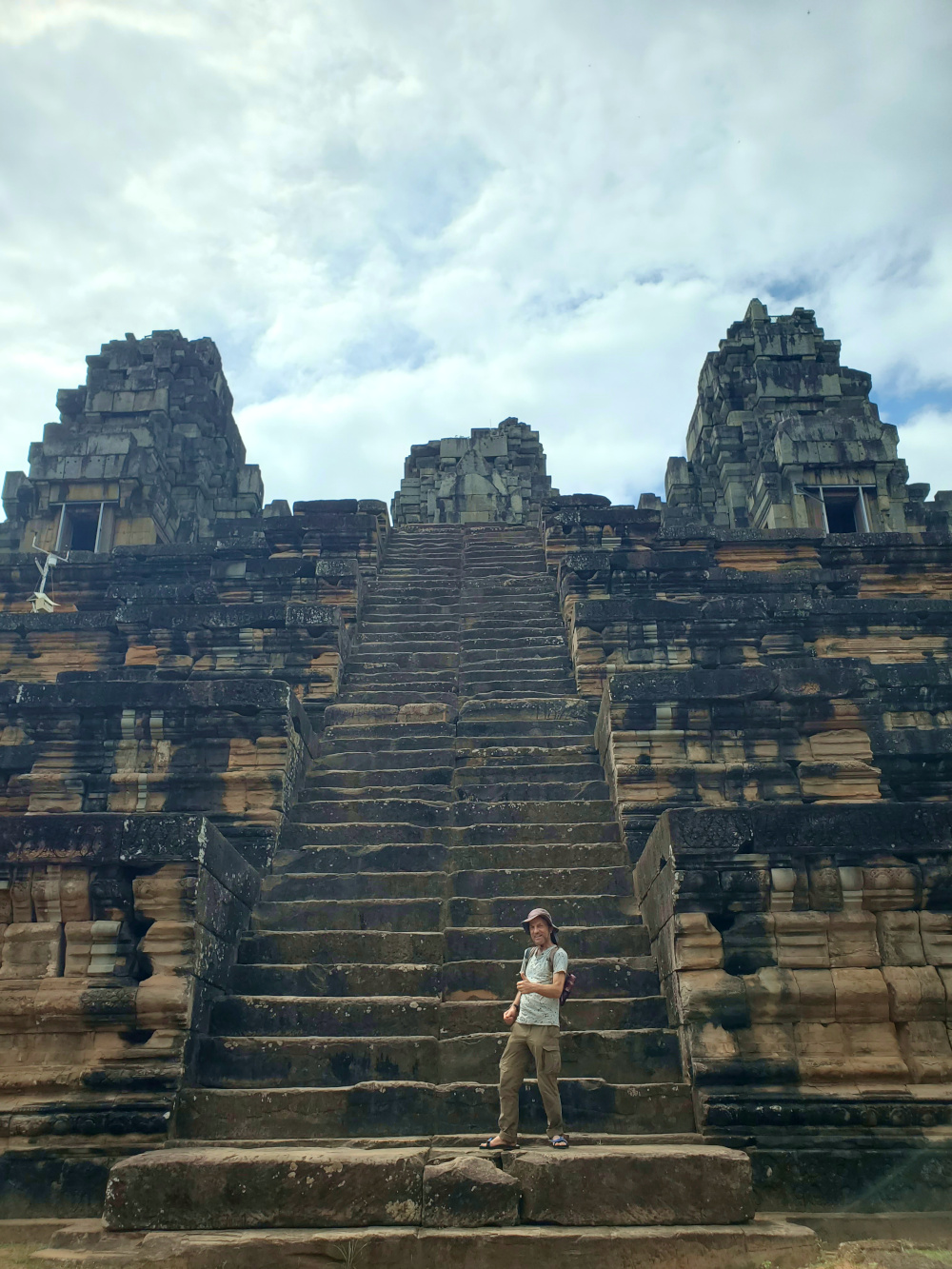
“Today’s primary destination was the temple Ta Keo, which is one of the oldest, with construction on it begun around 975 CE. But even with such a head start, it still was never finished. Why? Nobody knows. One theory is that it was abandoned simply because the king died. Another is that, it was struck by lightning, which people regarded as a bad omen, having never heard the saying about lightning never striking twice. (An inscription on the walls confirms at least the part about it being hit by lightning at least once.)”


“In any case, it was the first temple in the city to be made of sandstone, which might account for its sparseness of surface design — sandstone being rather tricky to carve.”
“The structure consists of five levels, with a tower atop four terraces. It would have been very interesting to see what the whole thing was supposed to look like after it was completed. But of course, judging by the condition the other temples are in, there’s still no guarantee we’d be able to witness it in all or most of its glory today.”
Temple Ta Nei
“From there, I checked out nearby Ta Nei, a much smaller temple that is accessed via a quiet path through the woods, past the Angkor Zipline — which just might provide an aerial view worth indulging in. Ta Nei is a much smaller temple, and it didn’t take long to investigate.”


Temple Ta Prohm
“I also paid a visit to Ta Prohm, often called the “Tomb Raider” temple because it figured prominently in the film Lara Croft, Tomb Raider, starring Angelina Jolie. It turned out to be one of our two favorite temples in the whole complex (the other being Bayon, which we’ve already covered). But we’ll wait to talk about until after both of us were able to visit it. After all, Kimberly is the photographer in the family.”
“When my day at the temples was done, I found it hard to get a ride back to town this time. There were, for once, few tuk-tuks available. After I’d finally managed to book one on the app, I waited for some time without having one show up. Then finally one did pull up, but it stopped about 25 yards from me, and picked up two other passengers. Then my app informed me that “you are on your ride”, for which I begged to differ. It was clear that the other two people were just trying to catch a ride on the spot, and the driver assumed that they were the ones who had booked him.”


“I tried calling him, but he didn’t respond. And when I tried the app again, I was informed that there were no other rides available at the moment. I later contacted the company to get a refund, which they gave me, and they said they’d have a talk with the driver; but that didn’t help me in real time.”
“Looking around for drivers who were just waiting on the premises to offer a ride to someone who didn’t have arrangements (and charging top dollar in the process), all I was able to find was a rickety old jalopy that looked like it might get me home if I was truly lucky and didn’t make any sudden movements. The driver wanted 12 dollars, which was an outrageous sum, because he said he lived near the temples, and so would have to return after he dropped me off. I managed to talk him down to about half his asking price.”
“Since our school is not accurately shown on Google Maps, I had to give him the destination of the wat (temple) across the street from us. Initially, he took me to the wrong temple, which was in the heart of town, so I had to try to give him better directions despite the language barrier.”
“Finally, he headed in the right direction, but the whole ride was apparently farther than he anticipated. He kept asking me if we were close, and I would say, “a little more”, until finally I was at last back home safe and sound.”


The next day, Kimberly was well enough to go back to work. But it was a challenge with these students, who were just about the most rambunctious group we’d encountered yet. They were (mostly) adorable kids, but they had few boundaries. (One of their habits was giving each other the finger, a ritual they’d apparently learned just recently and were intent on practicing it to perfection.)
Rather than assisting teachers, as volunteers normally do, we’d be just dumped into a classroom to teach all by ourselves, with no one who spoke the language to assist us in maintaining order. It was a demanding gig, to say the least. Good thing we had the Angor temples nearby to make our time in Siem Reap worth the trouble.
Ta Keo
- A daring climb: Ta Keo is famous for its steep and challenging climb to the top. While it offers breathtaking views, it’s not for the faint-hearted!
- Sandstone pioneer: As the first large-scale sandstone temple in Angkor, Ta Keo showcases a different architectural style compared to its later counterparts.
- Unfinished mystery: The reason for Ta Keo’s abandonment remains a captivating enigma, with theories ranging from the king’s death to a lightning strike.
Ta Nei
- Tranquil escape: Often overshadowed by its more famous neighbors, Ta Nei offers a peaceful retreat for those seeking solitude and tranquility.
- Hidden gem: While smaller, Ta Nei boasts intricate carvings and architectural details that reward close inspection.
- Zipline perspective: For a unique vantage point, consider taking the Angkor Zipline for aerial views of Ta Nei and the surrounding jungle.
Ta Prohm
- Living temple: Ta Prohm’s iconic appearance, with trees growing through its ruins, is a result of a deliberate decision to preserve the temple in its natural state.
- Monastery and university: Originally built as a Buddhist monastery and university, Ta Prohm was a bustling center of learning and religious life.
- Tomb Raider fame: Its starring role in the movie “Lara Croft: Tomb Raider” catapulted Ta Prohm to international fame, making it one of Angkor’s most visited temples.
10/15-19/2022

Leave a Reply to Monkeys, Bananas, and the Gate of the Dead: Exploring the Hidden Gems of Angkor Wat – world travel with a theatrical flairCancel reply