

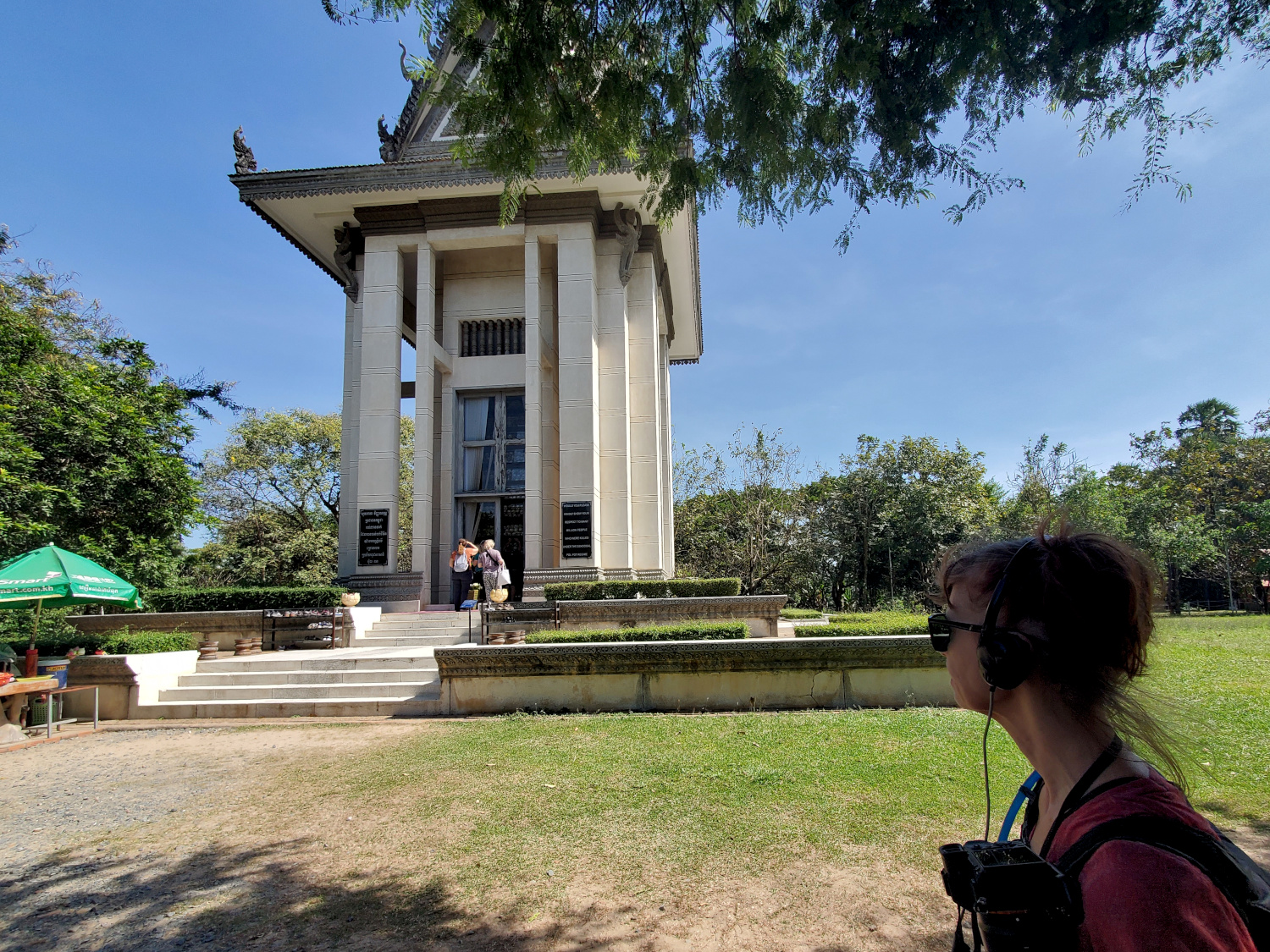
(Content Warning: this post contains descriptions of disturbing events.)
There are some attractions you just have to visit, not because they are fun or scenic or pleasant, but because they are just the opposite; they have sobering history lessons to teach. There’s Auschwitz. There’s the World Trade Center Memorial. There’s the Salem Witch Trial Memorial. And in Phnom Penh, or just outside it, there is Choeung Ek, the best known of Cambodia’s 300 or so “killing fields”.


In April 1975, the government of Cambodia was seized by the Khmer Rouge, a revolutionary force under the command of ruthless dictator Pol Pot. In an effort to establish a totally agrarian society, they abolished money, forced citizens into labor camps, and closed the schools. And they began killing people. Lots and lots of people. At least a million, though the fatal victims of their three-year reign (which ended when Vietnamese troops invaded in 1978) was as high as 2 million, about a quarter of the nation’s population. They especially targeted teachers, lawyers, doctors or anyone else who was educated — or even appeared to be. Anyone who wore glasses or had soft hands was suspected to be an enemy of the state, and thus could be tortured and killed.
Today, Choeung Ek is a memorial to the victims of this genocide. And despite our trepidations, we felt we had to go pay our respects.
After arriving at the site, about 10 miles out of town, we tried paying our tuk-tuk driver, but for some reason he only accepted 11,000 riel (about $2.75) instead of the 11,400 that the app had set for the ride. We tried again giving him the extra 400, but he sternly refused it. We have no idea what that was all about, but when we went into the gate we found that foreigners had to pay an entrance fee twice as high as citizens, so it was just as well that we got a bit of a break on transportation.


The tour included audio narration via headset, with bits of interviews with, and actor impersonations of, survivors of the genocide. The first stop was also the first stop for the prisoners: the point where the packed trucks were unloaded, sending confused, frightened and blindfolded detainees to their execution, if it could be done right away. If there was a lengthy waiting list, they would be taken into a crowded hut and chained to a metal bar in the middle to await their final appointment.
Some of these prisoners had already been detained and tortured into “confessing” to their “crimes” at a center in the city that was set up in what had been a high school building. It’s now the site of the Tuol Sleng Genocide Museum, which is only a few blocks from the apartment where we lived.
To save bullets, the Khmer Rouge dispatched its prisoners with farm tools; some victims had holes bored into their skulls with drills. The bodies were then dumped into mass graves, of which there were several on the property. Sometimes DDT was spread onto the corpses to stifle the stench — some of the canisters are on exhibit in a sealed glass case.
Outside a stupa (a little round — or in this case, square — structure to house Buddhist relics) a man was selling flowers and incense to honor the murdered. Inside the stupa is an orderly arrangement, on shelves of many levels, of the skulls of hundreds of victims, along with the tools/ weapons that killed them. You don’t need a microscope to spot the signs of blunt trauma — holes, cracks and so on — on these skulls.


After a certain amount of rain, bone fragments continue to surface from the locations of the pits; they refuse to stay silent, refuse to let their stories fade. They are periodically collected, catalogued, and exhibited. Bits of clothing also crop to the surface; we spotted a few of them protruding from the soil as we walked around on the special walkways that left the burial grounds untrodden upon.


Near the center of the compound was a large, grotesquely gnarled tree that, for whatever reason, was called the “magic tree”. To this tree the Khmer Rouge would attach speakers to play “revolutionary” music and announcements at loud volume. The main purpose, apparently, was to drown out the screams of those being slaughtered.
Another tree is even more arresting. At first glance, you just see that it’s festooned with hundreds of friendship bracelets left by visitors. But there’s a grim reason for them. This is the tree where babies were executed. Yes, babies. Wanting to eliminate “enemies” before they even had a chance to become enemies, the Khmer Rouge would grab babies by the heels and swing them, bashing their heads against this tree.


With such stark reminders of such a disturbing history, the atmosphere of the whole compound is surprisingly serene. Birds chirp away, merrily unaware of the horrors that unfolded here half a century earlier. On the other side of the fence, farmers toil away quietly on their boats in the rice fields. On our headsets, a poignant piece of music by a Cambodian composer exquisitely melded both the sadness and the transcendence of the landscape around us.


Considering how relatively recent the genocide was, it’s astounding to see how the country has lifted itself up and made such a recovery; and that Cambodians are among the friendliest, most cheerful and most positive people on the planet.
Recalling that it took decades to bring some of the Nazis to justice, we asked one of our colleagues, not long before our visit to Choeung Ek, if there were still trials going on for the perpetrators of the Cambodian genocide. “We just finished a few weeks ago”, he replied.
Many Cambodians, including individuals we have talked to, remember the nightmare all too well. And yet for some, particularly the younger ones, there is always the risk that the lessons of the past are forgotten too easily. As we contemplatively strolled around the grounds, we came upon some teenage girls who were giggling and enjoying themselves, seemingly oblivious to the gravity of their surroundings. They even hit us up for money.
For them especially, but really for everyone, centers that commemorate historical atrocities are a crucial component of education and awareness.
Dec 19, 2022


More Resources to Further Your Education
The 1984 film The Killing Fields, adapted from the book The Death and Life of Dith Pran by Pulitzer Prize- winning journalist Sydney Schanberg, is a good dramatization of the events around the Cambodian genocide. It’s the story of Schanberg’s friend, the Cambodian journalist who coined the term “killing fields” after he escaped the brutal regime of the Khmer Rouge. In the film, Dith Pran is portrayed by former physician Haing Ngor, who also escaped the genocide.
Video Documentary of a Khmer Rouge genocide survivor.

Leave a Reply