

The ancient Cambodian city of Angkor is one of our very favorite places on earth.. Comprising nearly 400 square miles, and dating back to the 9th Century, it features some 1000 ruined temples, ranging in size from the minuscule to the palatial, the best known of which is Angkor Wat. We already spent several days exploring it on our previous stay in Siem Reap. But it wasn’t nearly enough time to experience the place fully, so we eagerly seized an opportunity to return.
At first, we’re not certain that we’re going to make it there on the first of our available days, because the rain has been hammering away at the ground all morning. But by about 10:30 it takes a break, so we make a hasty decision to head to Angkor after all.


We walk about a mile to a business called Aima, to rent a mini electric vehicle, about the size of a golf cart, to get around during the day. This was a decision we’d made after realizing that the cost for renting such a buggy would be about the same as hiring a tuk-tuk driver to take us out there and another one to bring us back; furthermore, while there’s no shortage of drivers lurking around eager to take you there, it can be a real challenge sometimes to find one out there to bring you back home, and it can involve a considerable delay. Plus, having your own vehicle gives you much more mobility and flexibility. It was a no-brainer.
Kimberly insists on taking the helm, which isn’t a driver’s wheel, but handlebars like those on a motorcycle. So we climb in and stash our gear in the rear lock-up compartment and, after a brief learning curb — er, curve, involving a curb — we’re off, a bit haltingly at first, on the 10-mile jaunt toward the local UNESCO World Heritage Site.
Bayon
We park in a little lot across the road from Bayon, which is perhaps our favorite of the temples. Unlike Angor Wat, which was constructed earlier under Hindu rule, Bayon was erected in the 12th or 13th Century CE, with Buddhism in mind. And yet it’s known for its distinctive faces sculpted on the exterior in all directions, intended to represent the likeness of the HIndu god Brahma and/or the king who was looking over the work from a safe distance. Another distinctive feature is its wall of images — a mural that is carved rather than painted — depicting historical scenes, a sort of ancient documentary.
Oh yes, and there are also the monkeys, dozens of them on any given day. For whatever reason, the local monkey population has voted that it prefers Bayon to all the other temples, and so this is where 90 percent of them hang out. In fact, they seem to regard it as their turf, and sometimes act a little resentful toward us hairless bipedal interlopers (though they don’t seem to mind sharing it with a pig or two).


One of them, a very young one, tries to grab Dennis’s leg, as if attempting to judo him out of the way, and then he tries to bite Kimberly’s leg — or at least pretends he is going to. Little feller is in training to be part of the Simian Security Force.
Another one hops up onto Dennis’s back, apparently trying to pry into his water pack, which seems to fascinate all of them. These close encounters are cute, but they leave us a bit apprehensive, as Cambodia reportedly has a rather high incidence of rabies. For whatever reason, the critters do seem to have viciously attacked each other on occasion — one of them is missing an arm, and has a mutilated mouth.


They also, we soon discover, have been making themselves at home in our vehicle, leaving muddy paw prints all over the seats and remnants of the ears of corn that someone has given them. We knew we should have put on the rain cover that came with the cart.
Next on the itinerary is Ta Prohm, so we drive there (after cleaning off the seats) and pull into a parking spot by the road alongside some tuk-tuks (after being chased by a pair of barking dogs) and scout out a place to sit on a bench and have lunch before continuing, but the vendors hassle us so much that we give up on the notion of a picnic and just eat in our “car”.
Ta Prohm
On the way to Ta Prohm, we again pass a group of musicians, 6 of them this time, playing native instruments, selling CDs, and of course accepting donations. The musicians who play here are all handicapped — either amputees or blind or such — because they are victims of landmines, which were placed here during the Civil War of the Seventies and Eighties. Reportedly, millions of them remain in place, making it hazardous to hike off the beaten path. They’re being removed, but there is still a long way to go. The proceeds from the busking of these musicians go to a fund to assist these victims; we drop a few thousand riel into the bucket ourselves.
Ta Prohm is another strong contender for our Favorite Ancient Temple Trophy. Completed in 1186, it was, according to records, a pulsing hub of Buddhist worship, employing over 12,000 people in its operation — including 18 priests and 615 dancers. It also was reportedly a storehouse of vast riches.


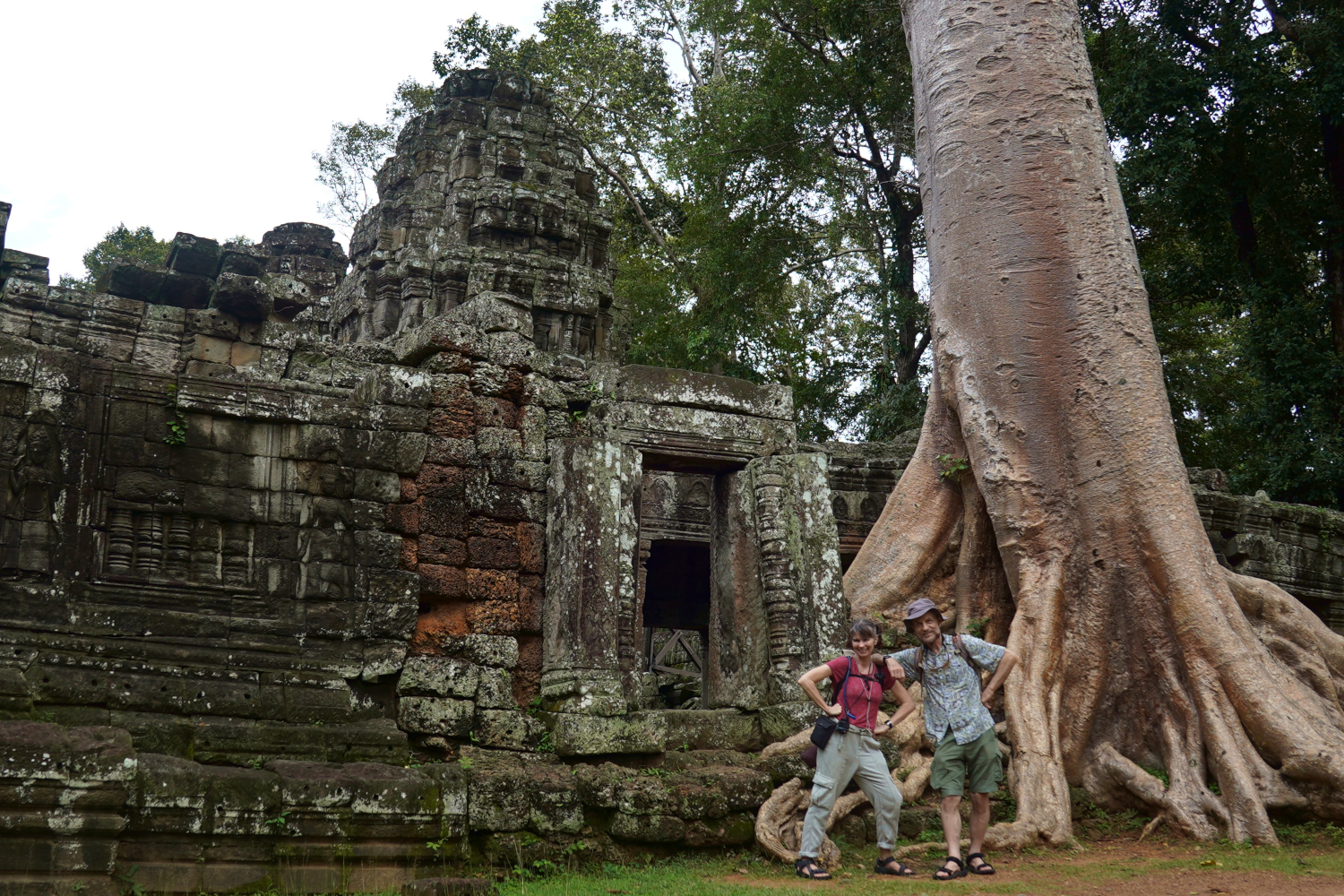
Today, it is best known because of the enormous trees (strangler figs, kapok, and banyan) that have sprung up over the centuries, shooting right through the masonry — an easier task because the temple was constructed without mortar– and towering over the entire structure. The long, thick roots climb all over the walls like the tentacles of a giant squid gripping its bath toy.


The most striking, and most famous of these, is the one that guest stars in the Angelina Jolie flick Lara Croft, Tomb Raider. It’s absolutely mandatory when visiting Ta Prohm to pose for photos in front of this landmark plant, which means that depending on when you go, you might have to wait for everyone else in the world to get their photos first. On this occasion, we have a hard time locating this particular titanic tree, and have to ask for directions three times before we succeed in obtaining our compulsory iconic photo.


Oh yes, and there’s one other thing you should seek out if you go to Ta Prohm: a dinosaur. No, seriously. Among the relief carvings on the exterior walls is a small image, perhaps a foot square, of what appears to be a stegosaurus. Were folks in the ancient Khmer kingdom familiar with long-extinct oversize lizards? Or was this perhaps a stylized representation of some other animal in front of some kind of foliage or abstract design? Having examined it carefully in the flesh, we feel inclined to cast our ballot for the dinosaur. Anyway, locating it might take some effort — even with the aid of hi-tech navigational aids — but it’s as much a must-see as the tree.


As we wander through the temple complex, we encounter a professional photographer doing a photo shoot with a female model. Later, we encounter them again. And then again. On two of these encounters, he relieves us of our struggle to engineer a selfie (or rather two-fie) and snaps a photo for us.


Once we’ve explored these two temples we feel that we’d Indian Jones-ed enough for one day, so we climb back into our jalopy (which this time was unmolested by monkeys) and take it back home, and then take ourselves back home. Since we’ve purchased a three-day pass and are going to be in town for a week, give or take a day, we can take a day off to rest up before heading back for more.


This gives us a chance to take care of some chores like buying some reading glasses for Kimberly. And it gives us a chance to further investigate our neighborhood and the neighboring neighborhoods, which includes trying out all the delectable delights from a nearby bakery. Well, except we elect to take a hard pass on the “baby meat floss cake”.


9/4-5/2024

Leave a Reply