

Although we loved Chiang Mai and found visiting it to be a memorable experience, we were ready when the time came to move on to our next location. But Chiang Mai seemingly didn’t want us to go, because it obstructed our path to the train station by putting flooded streets in our way. While we appreciated being appreciated that much, we needed to get back to Bangkok.
The potential crisis becomes clear when we check out of our Airbnb in the morning and try to summon a tuk-tuk, but learn — after three unsuccessful attempts –that they can not get to the train station because the water is too deep in some streets. Fortunately, our train is not until 5:00, so we have time to figure out an alternative. But what is it going to be?
The logical answer is a songthaew — one of those colorful pickup truck taxis that we’ve seen making the rounds. They have seats in their beds, which are covered with a roof, so passengers can ride comfortably in all weather. They come in several colors — red, green, yellow, orange, white — according to the territory they cover. We’ve never ridden in one, in part because we don’t know how to go about doing it. The time has come to figure it out.


After asking around a bit, we learn that the red truck is the one we need, and we learn of a spot nearby where we can catch one. So we go there, wait a few minutes, and when a red truck comes, we flag it down and get on. One other passenger joins us, a young woman from China who is just arriving in Thailand; the fare is 30 baht (about 80 cents), and the songthaew splashes its way through the maze of underwater thoroughfares with no problem and deposits us at the station. At first we consider using the wait time to take turns exploring the city on foot, as we did the last time we were here; but given the uncertainty of the flooded streets and the possibility of another impending downpour, we elect to just stay put until our train pulls in — which it does, right on time. (We later learn that indeed the flooding got much worse, leaving many people stranded.)


The train we ride on the return voyage to Bangkok is not quite as new or quasi-luxurious as the one we rode in on, but it’s adequate. This time, there are no electrical outlets by all the seats — just a couple of them for the entire car. So we end up plugging our phones in when they need to charge at an outlet by another lady’s seat; and she is quite willing to share it. This time the attendant who makes up our bunks (a male) is not nearly as poetically dazzling to watch as the woman who performed the task on the previous train — and perform is indeed an appropriate description. But the bunks are just as comfortable. And in the meantime, we have more daylight than we did previously to admire the countryside through the window.


Our homestay this time, unlike on our previous visits to Bangkok, is on the outskirts, an almost rural area close to a canal and some woods. But the neighborhood actually has better supermarkets than those we had access to in our city neighborhoods. The accommodations are a spacious one-bedroom apartment on the second floor with all the amenities, including a washing machine and a water filtration system. Getting to it is a bit tricky, because we have to walk down an unpaved alleyway that is, like streets in Chiang Mai, under water, or at least mostly so. With a bit of difficulty, we work our way through it, partly by wading through the weeds on the side. And after some confusion about how to get through the gate (requiring a neighbor’s help to call our host) we are inside and home for a few days.


Our apartment is only a short walk from the canal (on a narrow dirt path past some rustic houses) and then it’s another short walk to a stop where we can catch one of the water buses that tootle along on Bangkok’s numerous canals, and head into the city. There are a few chores we need to take care of, such as printing out our visas for the upcoming trip to India. But mostly, we just want to wander around and see more of the city. And for Kimberly, of course, it’s a mission to find every Pokemon stop in town.


Our amblings take us by chance past the residence of the U.S. Ambassador to Thailand. It’s a huge complex, surrounded by a fence, of course, but we can see that the grounds are lush and expansive, almost plantation-like. Nice work if you can get it.


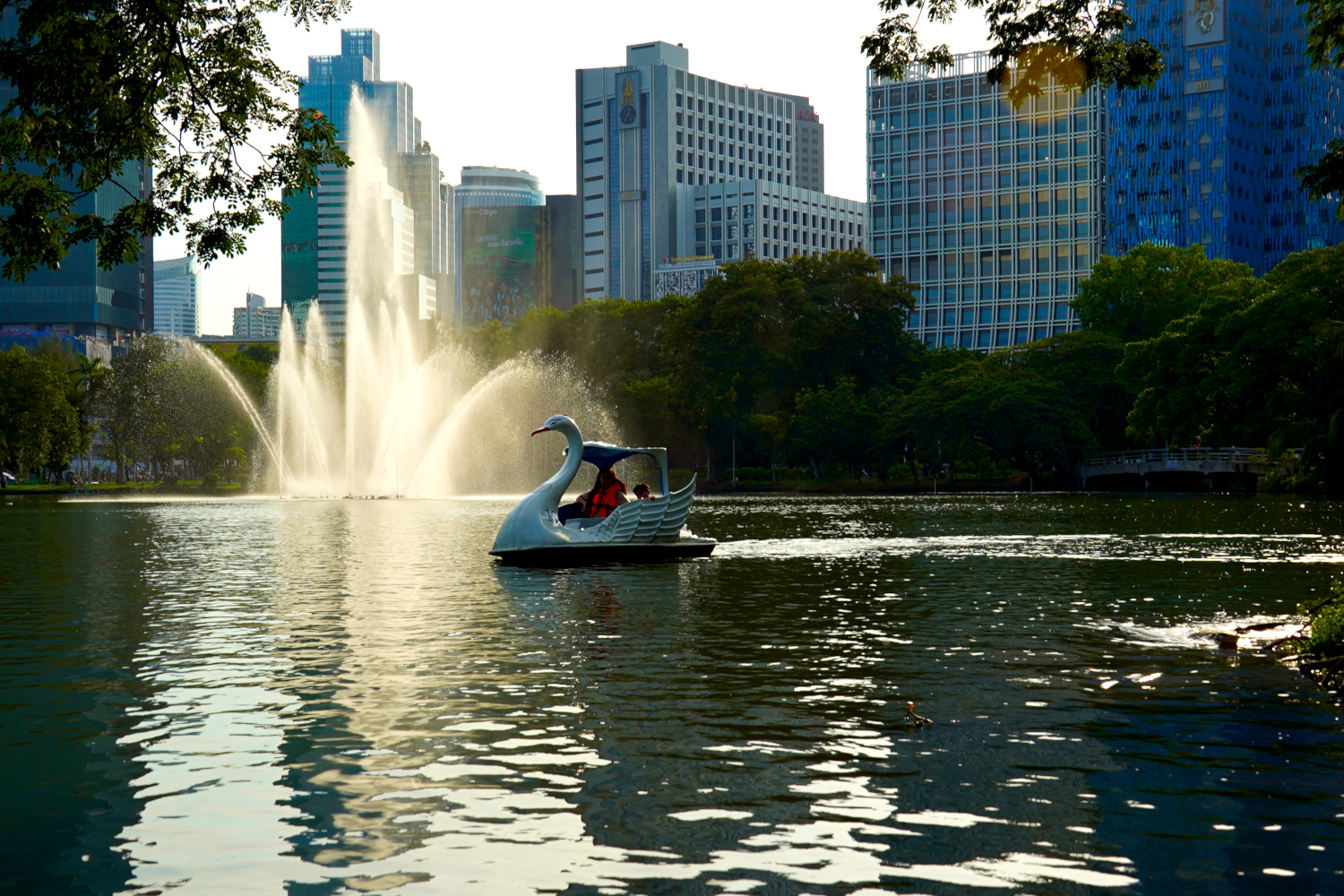
Our destination is Lumphini Park, the first public park in Bangkok, dating back to 1925. It’s a favorite jogging and strolling spot for all ages, and features a number of sports facilities, including a swimming pool. It also contains an aquarium, and a public library, the first one that opened in Bangkok. And best of all, it has paddleboats. On a little lagoon, you can obtain a paddleboat, shaped like either a swan or a duck, at no charge, and paddle around for a while. Which of course we do.


While navigating these waters, we notice a long reptile on the bank that resembles an alligator, except with a smaller and less formidable looking snout. Soon we see another one. Then more and more and more. These are monitor lizards, a rather broad class that includes the Komodo dragon, which has been known to attack humans on occasion. These Bangkok monitors, however, are smaller and less fierce, and don’t pose a threat.


Still, they have an unsavory image in Thai folk tradition. As they have been known to hang around cemeteries, they have come to be regarded as symbols of bad luck, rather like black cats. A vernacular word for them is hia, which has come to be used as a swear word and vulgar insult. So it’s probably something you shouldn’t yell in the middle of a crowd in Bangkok.


These huge lizards are just about the last thing we expected to see in the middle of a major city. But then they probably didn’t expect to see us, either. Another serendipitous find for both of us.


9/25-28/2024



Leave a Reply to Ishita EdwardsCancel reply