

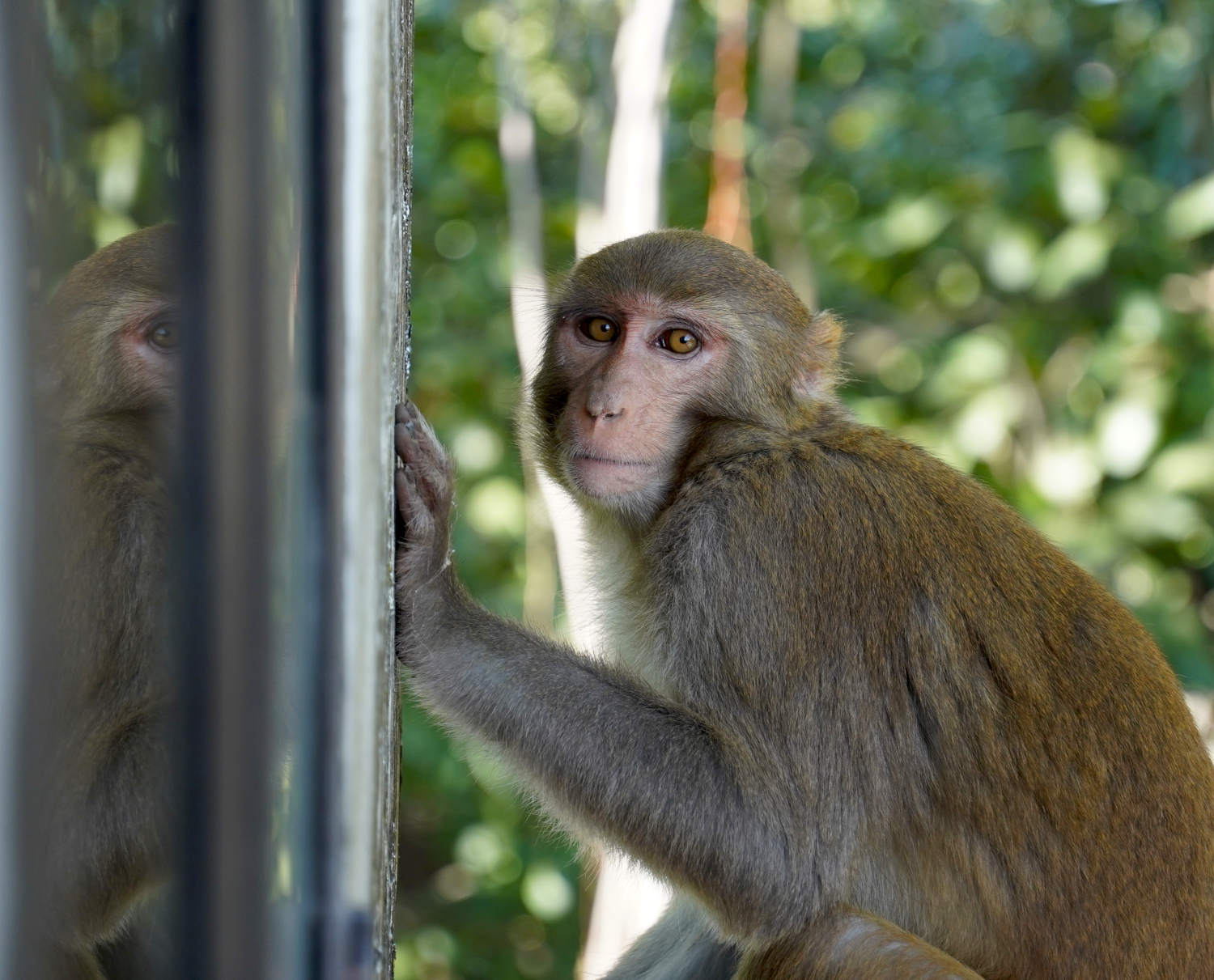
On our second day in the village of Raiwala, we were ready to hit the ground running at Maa Amandmayee Memorial School in our new volunteer positions through WorkAway. The school, founded in 1985, was named after a renowned mystic and teacher (her name is spelled in at least a couple of different ways) who used to hold discourses under the big majestic tree next to our living quarters and across the road from the school — the tree that is now a favored hangout for the local monkey population..
MONDAY
First thing in the morning, we meet the principal for the first time at the gate, and she seems surprised that we didn’t recognize her when we saw her. She takes us into her office and asks for our passports and photos. We knew we were supposed to bring passports, because we had been notified in advance. But no one had said anything about photos.
So we go back to the apartment to retrieve some photos (we always keep a small stash of them for such purposes) and bring them back. But the person in the office to whom we give them simply takes photos of the photos and then hands them back to us. Um… couldn’t he just have taken a photo of us in the flesh? Just a thought.
Then we sit back down with the principal to go over our schedule, which at this point seems quite murky. She does tell Dennis that he will be teaching English Literature to 12th Grade later in the day, and gives him a textbook. And she tells Kimberly that she will go to the “Junior Campus” to teach the younger students beginning the next day. We also inquire about where to get drinking water — which nobody has bothered to inform us about — and where to find a broom and mop. To the former question she never gives a straight answer; to the latter she replies that she will send the cleaning lady over. Which wasn’t what we wanted; we much prefer to clean our own apartment.
So we go back to the apartment for a while, and when Dennis goes back to teach his class, the principal informs him that Kimberly needs to go to the other campus today after all; and he rushes back to inform her, and both of us are scrambling to make it to our classes on time.
KIMBERLY: Meeting with the Head of the Junior Wing and a couple of teachers discussing the plans for my involvement for the next two months.
DENNIS: There is no marker or eraser in the classroom; evidently, they are in short supply, and you have to guard them with your life. So rather than write on the board, I end up having to write things in my notebook in large letters and pass it around. The story we study today is a nonfiction account by an American Indian woman of the Nineteenth Century who was forced to go to a Christian school and adopt a white lifestyle. It deals, in other words, with forced cultural assimilation, which is something the Indians of India have been quite familiar with.
This afternoon we have an appointment at 3:00 to meet with the school director. But when we arrive at his office. we learn that he is attending a forum with a large group of parents (some of whom, we gather, are quite miffed about something or other) in the auditorium down the hall. So we sit in the meeting room and wait. And wait and wait and wait. Finally, after two full hours have passed, we give it up and go home.
TUESDAY
We start settling into our regular schedule. Except not really, because at the present time, some classes are being scuttled so students can rehearse for an upcoming special event: Founders Day, the anniversary of the founding of the school.
KIMBERLY; At this point, I’m mostly just observing, taking notes on the presentation style; There is a good deal of rote learning, but the teachers are engaging, and the students have a good time with the songs and games and other activities.
DENNIS: The principal tells me to assist one particular teacher in rehearsing a small group of students for a Founders Day skit. Which I certainly am eager to do. But later, when I meet with the teacher and talk it over, it turns out that there’s really not much I can do with the skit, as it’s in Hindi. And nobody has a script of it that I can try to get translated. So that puts me in a quandary: do I go back and tell the principal that my help is not really needed, and risk causing friction between her and the teacher; or do I say nothing to the principal and risk having her think that I’m just slacking?


WEDNESDAY
KIMBERLY: We take a field trip to the post office. The kids go in groups, at different times, crossing the busy road and walking about 4 blocks to the post office, accompanied by female aides in blue. The students are all crammed into a back room and a post office employee speaks to them in Hindi, so I don’t follow much of what is going on. At the end, the students are rewarded for their attention with a sweet treat.


DENNIS: I have Grade 12 again, and then Grade 11. I was expecting they would be studying the same material, but I learn at the last minute that Grade 11 has a different textbook (as one would expect, but nobody bothered giving giving me a copy of it, or even telling me what it is.) I spend most of the class just getting acquainted with the students.
After classes, we take a walk into the village, and find a grocery store called R & R Market, which will turn out to be our go-to shopping place in the local community, even though their selection is somewhat limited.
THURSDAY
KIMBERLY: The cat got out of the bag that today is my birthday, and the students give me cards and candy. Instead of classes, we spend most of the morning at the main campus rehearsing on the outdoor stage for the Founders Day celebration. I help with a couple of dances, mostly working on timing and cleaning up choreography and encouraging expression. And I help the emcees with their English.


FRIDAY
No classes today for either of us, so we decide to attempt the excursion into Rishikesh that we’d been wanting to make ever since we arrived here. We walk the two miles to the main road, and then try to catch a tuk-tuk into the city. It’s difficult to arrange, because the drivers want to charge 500 rupees to take just the two of us. But we’ve learned that there are certain tuk-tuks that are accustomed to taking a load of passengers into either Rishikesh or Haridwar for 30 rupees each. Finally, we hook up with one of these, and even though the vehicle is crammed like clothes in a wringer, we’re willing to put up with it for half an hour to get a better fare.


Rishikesh turns out to be, on this particular outing, a disappointment. We had it pegged as a touristy town, which it is; but what we see today doesn’t look touristy at all — just another bustling, ragtag city. (As it turns out, we were just in the non-touristy part of town.)


After withdrawing some funds from an ATM, we browse in several stores for sandals and clothes, but end up only with some pants for Kimberly. Our last stop is a produce stand; and there are far more produce stands here than in the village, and with a wider selection. For the first time, we see avocados and broccoli. A little boy hanging out by the produce marketplace hits us up for money very aggressively — we spot his mother nearby, putting him up to it — and we almost never dissuade him.


Getting a ride back to Raiwala is just as daunting. We can’t find a tuk-tuk that is taking a load, and the driver we ask about taking just the two of us wants to charge us 500. When we start walking away, he starts bargaining, and ultimately agrees to 200. And this is just a ride back to Raiwala Junction, on the major road that passes the town. From there, we still have to walk two miles home — or dicker with another driver to avoid paying a fare specially inflated for foreigners.
This hassle getting back and forth between Raiwala and Rishikesh is especially disappointing, because one factor in choosing to volunteer in Raiwala is its proximity to Rishikesh — where later Kimberly will be undergoing training as a yoga instructor.
SATURDAY
Well, the cleaning lady tried to warn us. She warned us in Hindi, but it was clear what she meant: beware of the “bandeer” (monkeys) who will come through the window if you give them the chance. This morning, we get careless anyway and leave the kitchen window open for a few minutes, while we’re out of the room. Next thing you know, we hear a commotion in the kitchen that can only mean one thing. So we rush in, to find the culprit as he is fleeing, but has left quite a bit of chaos in his wake, which we’ll spend half the morning cleaning up. Peering out the window to the ground below, we spot the villain with his booty — a package of noodles, apparently the only thing left on the counter amid the dried lentils and soy protein chunks, which he could readily sink his teeth into.


The monkeys really make their presence known around here. It seems that about 90 percent of the local monkey population prefers to hang out in an area the size of 3 or 4 city blocks. And that happens to be where the school, and our apartment, are situated. In particular, they really love that big, beautiful tree. They’re also rather fond of the balconies on our building.


In the afternoon we take a stroll into the village, but find that most businesses are closed because the Durga Puja festival is going on this weekend — random festivals are not an uncommon occurrence in India. One exception, however, is a pharmacy, and we are in need of certain pharmaceutical items.


Pharmacies in India are not like those in the U.S.; you don’t enter the store and browse. Instead, the establishments tend to be tiny storefronts, at which you come up to the window and tell the attendant what you want. And that was the case here; nonetheless, the two attendants did invite us inside to look around. Not only that, but they served us cups of chai (spiced tea with steamed milk), a common Indian gesture of hospitality. Yes, even in a pharmacy.


This is definitely a different world for us, and we find it enthralling.
10/7-12/2024



Leave a Reply to Ishita EdwardsCancel reply