

Normally, the volunteer work we do in various countries involves teaching English — and perhaps theatre or other subjects as well. And that was what we were expecting to do when we came to the tiny village of Shri Timli, in the Himalayan foothills. But it just so happened that the school where we were to volunteer would be closed for a couple of weeks for winter break. So we’ve been helping out in any way we can at the community center where we’ve been living — landscaping, harvesting marigolds, and general maintenance. But now there is something else we can help with that sounds quite intriguing: a “Winter Skill Development Camp” for girls, which has just gotten underway at a temple just up the hill in the village of Dabral.


Dagadiya: Day 1
On our first day, we are escorted up to the site by one of the participants, a 14-year-old girl who lives nearby, in the same village we are visiting. There we are introduced to the amazing facilitators of the Winter Camp. There is Neeraja, who grew up in the area and has 40 years of teaching in Hong Kong under her belt, and is one of the coordinators of the program. And there’s Madhu Sudan (Madhu) who is a native of this community, and is retired from the Indian Air Force, and now lives mostly in Delhi. We are invited to partake of a breakfast of chapati and some kind of dish with garbanzos. It looks enticing, but we’ve already eaten breakfast, being normally early breakfasters.
Madhu opens the day’s session with a set of breathing exercises from yogic tradition. He later leads the girls in a session of “Vedic math”, which is a system of mental computation introduced to the public about a century ago, when it allegedly was rediscovered lurking in ancient Indian texts. The girls are shown how to use the Vedic shortcuts to perform multiplication; but it can also be used for complex operations like square roots. It’s been applied not only to arithmetic and algebra, but also to geometry, and even calculus!


But this Winter Camp isn’t just about meditation, yoga, literacy and numeracy. Neeraja also teaches English and coaches the girls in matters of health and general life skills. She’s teaching them a song in English (not their native tongue). A little after noon, we conclude the session, and head back to down the hill for lunch.
This is the kind of camp that would benefit a great many girls — and boys — all over the world. We learn that the non-profit NGO “Dagadiya” is run entirely by local elders with a vision to preserve local heritage, enhance education and promote sustainable tourism. There are plans to include archery camp for the youth as well!
New WorkAway Volunteers Arrive at Shri Timli
Later in the afternoon, in fact just about sunset, a new pair of volunteers arrive. They are Sebastian, from the Netherlands, and Renee, from New Zealand. They’re an interesting pair; and like many of the other volunteers who come here, she is fresh from studying yoga in Rishikesh — just as Kimberly was. We’d been looking forward to their arrival, because we had relayed word to them ahead of time that we were in need of certain supplies from Rishikesh, which cannot be obtained locally. Especially oatmeal, which is Kimberly’s sacred breakfast every morning (Dennis sometimes has it too, but he’s been abstaining lately to make certain our limited supply is sufficient for the oatmeal addict in the family.) And lo and behold, they do indeed deliver us some! In fact, it’s quite amazing that, in addition to their full complement of baggage, they manage to tote along a supply of foodstuffs for not only themselves but a couple of other volunteers.


Sebastian turns out to be an early riser like Dennis — but even earlier on most mornings, often getting up around 4:30. Whereas previously Dennis savored the solitude in the communal dining room every morning while having tea, reading and writing, he starts to arrive and find that Sebastian is already there, also sipping tea while working on his computer or artwork.


Dagadiya: Day 2 – Never Stop Dreaming
On our second day of Winter Camp, we are thrilled to be presented with commemorative sweatshirts, such as those the girls themselves have been wearing. These are comfortable and cozy, heavy-duty blue sweats that come in quite handy in this chilly weather. While there is some variation, most have the words “Never Stop Dreaming” on the back; and on the front, “Dagadiya” an expression in Pauri/Garwhali, the local regional languages, meaning “friends forever”. We are honored to by the gesture, and are made to feel welcomed by this group. During this session, we also get to try our own hand at Vedic math.


Dennis’s Great Egg-scape
At the conclusion of our session, Dennis walks on into the village of Devikhet, being already halfway there. Even so, it’s a strenuous trek — another mile or so — on a steep, winding uphill road. He browses in half a dozen little shops in search of more provisions, but with little success. Only one little stand sells any produce at all, and the stock is sorely limited. By making the rounds, he does manage to come up with cashews, almonds and raisins. But no paneer (cheese), even though he has some of the locals ask around for him. And he also purchases 10 eggs, which is they way they’re sold here rather than by the dozen.
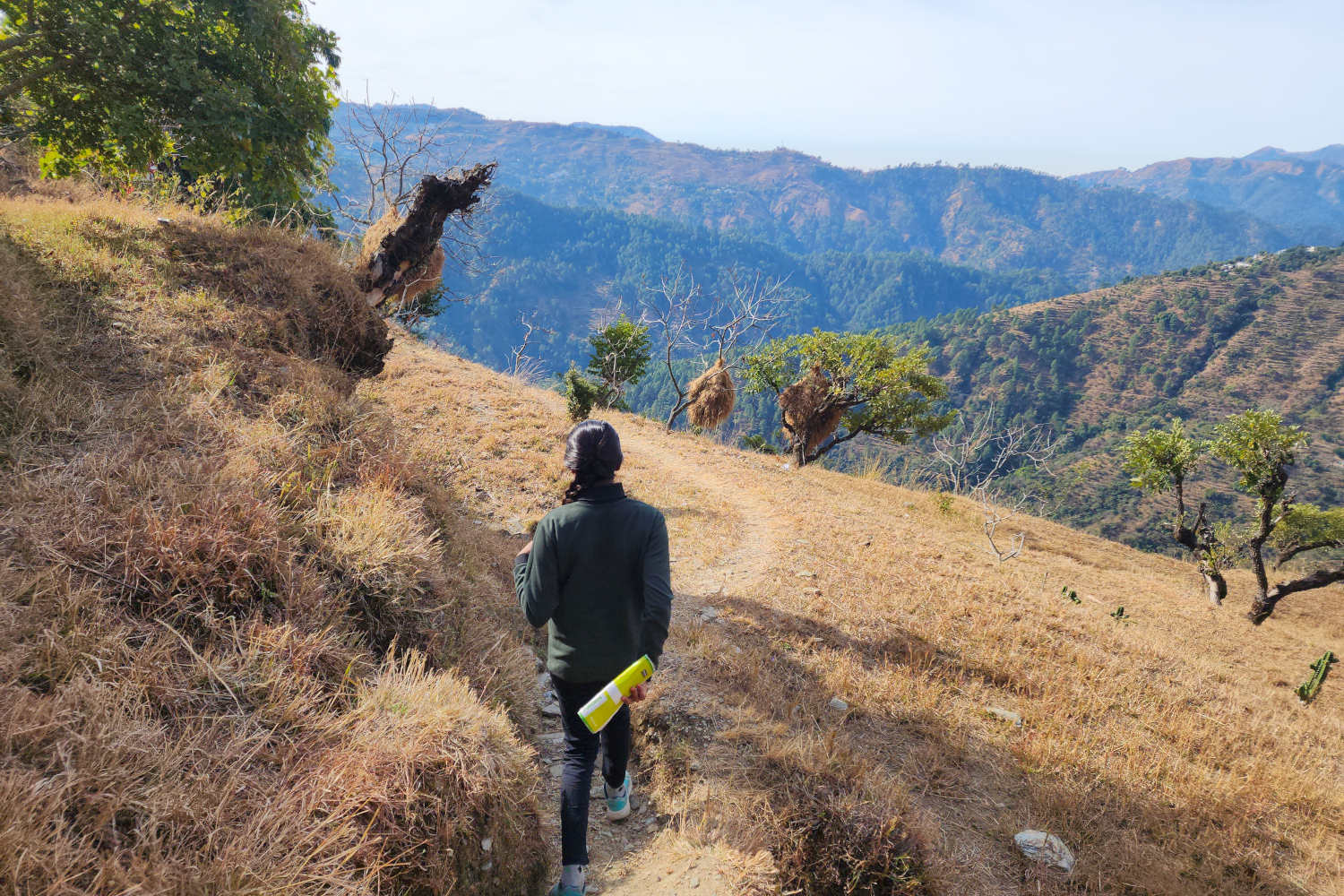
The walk back home, of course, is much easier, being down a steep grade rather than up it. But it’s still, to quote the Beatles, a long and winding road; so he decides to try a shortcut. There is a standard shortcut that a lot of people use, but since he can’t find it, he resolves to just create his own. This entails clambering down the terraces — the agricultural terraces that have ringed these hills for more centuries than anyone can count — in spots that are sufficiently eroded to provide a bit of a pathway.
All goes well for most of the way, but then he slips and loses his footing, and slides about 20 feet (or 6.096 meters, as they say here), sustaining only a minor scrape and sooty clothes — a great deal of the vegetation in this area has been burned recently. Miraculously, all of the eggs survive intact. Ultimately, he comes to the road at a place where there are no terraces, but only a rocky hillside; and at the very end, he has to leap down about 6 feet to reach level ground again.
Perhaps it wasn’t the best idea to attempt that whole route, risking injury and with no cell service to call for help. But when he arrives back at home, dirty and disheveled but jubilant, he relates his misadventure to Kimberly with a laugh and adds, “I wouldn’t mind doing that again.” After all, this kind of thing doesn’t happen every day.


In the evening, Kimberly introduces a couple of local kids to Boggle, one of her favorite games. Well, at least to a simplified version of the game, considering that they are kids whose native language is not English. She brought along her Boggle game because it’s often a useful tool in helping to teach kids English.
Dagadiya Day 3: Adding Performing Arts to the Program
It is on our third day at the Winter Camp that we really start to feel most useful. We teach the girls some theatre games, and even introduce them to Simon Says. Dennis, who has a background in music, helps coach them in singing the song that Neeraja wants to teach them: “Do Re Mi” from The Sound Of Music. And Kimberly, the dancer in the family, shows them some terpsichorean maneuvers, which they pick up quite nicely.


What began as a simple plan to teach English in a remote village has transformed into a far richer experience, one colored by unexpected challenges, from singing show tunes in a temple to slipping down ancient terraces with a package of eggs. (And not breaking any!) With a new year charging out of the gate, as we continue on this winding path of service and discovery, we’re reminded that sometimes the best journeys are the ones we never saw coming.


Events occurred: 1/3-5/2025

Leave a Reply to Hiking with a Side of Meditation – world travel with a theatrical flairCancel reply