

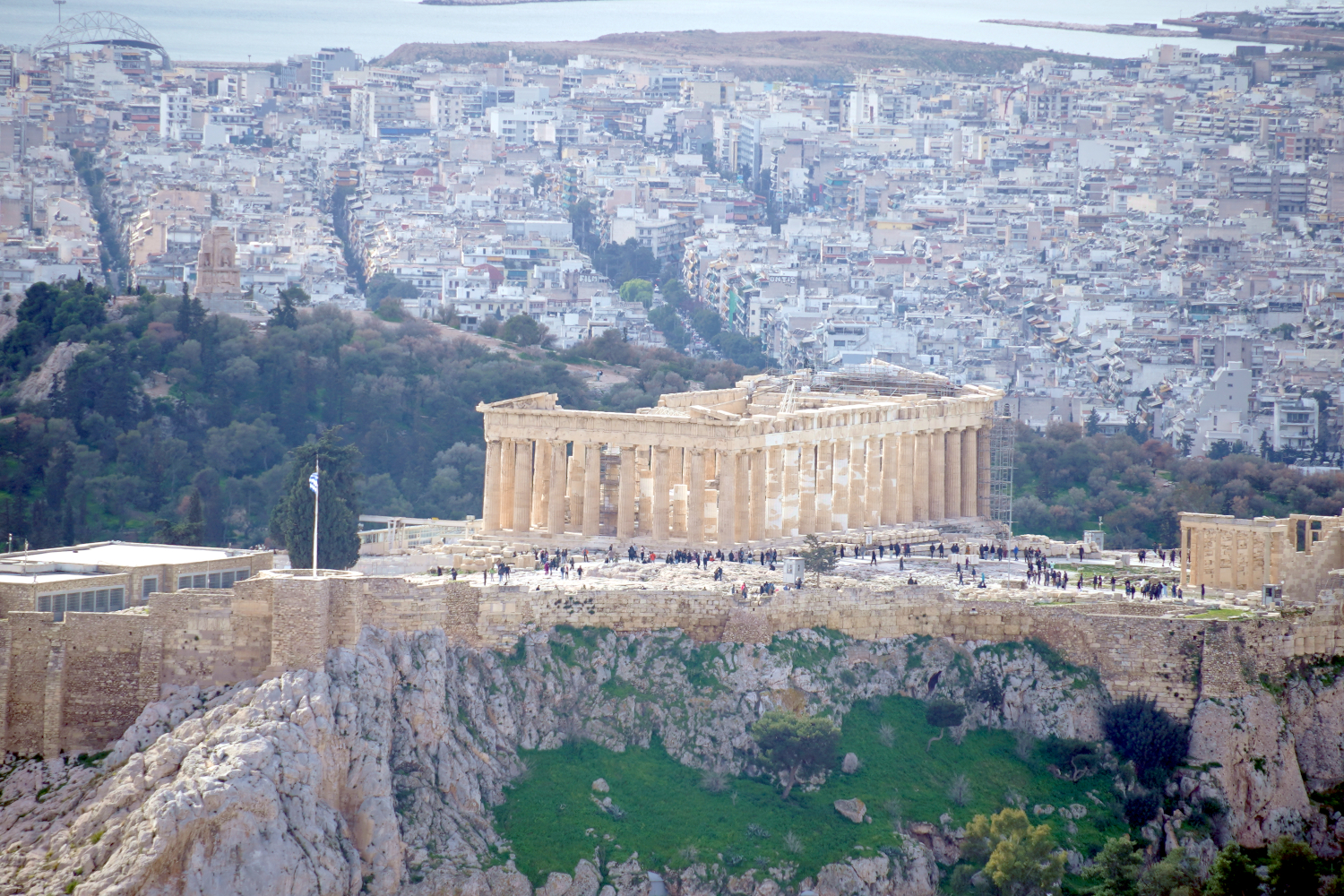
If you’re gonna be in Athens, you gotta go to the Acropolis. There’s no getting around it. So it was number one on our list of priorities. Except that before we got to number one, we felt we should hit number One-A, the Acropolis Museum, which sits at the base of the Acropolis, and prepares you for your visit to the Big Enchilada up the hill. And before we did number One-A, we felt that an even more urgent priority was to take a day to rest up and get Athens-ated.
So we spend a day exploring our neighborhood, discovering an excellent supermarket and an excellent bakery nearby, as well as a place to buy warm wool socks (which Dennis has been needing). We also see that a couple of streets are surprisingly heavy with graffiti (though it’s a quiet and safe neighborhood) and there’s even a homeless guy camped out on a sidewalk. This is quite surprising, since the weather has been so frigging frigid. If you expect that the Mediterranean region is going to be predictably balmy if not downright hot, you’re in for a rude awakening when you arrive in Athens in February.
Then the next day, we’re all set for the museum. When we get there and go up to the cashier, she asks where we are from, to see if we qualify for a discount afforded to residents of some places. We tell her the U.S., and then promptly add that we did NOT vote for the Convicted Criminal, which elicits an appreciative grin. (In Greece, as in many countries we visit, people are especially sympathetic toward, and alarmed by, what America is going through, because they’ve had their own struggles with autocracy and authoritarianism.) And it occurs to us that we should do this more often; being global goodwill ambassadors of a sort, maybe we have a duty to let people out there know that there are plenty of Americans who do not live in the alternate universe of the Fox bubble, and do not support the kakistocracy. And it seems altogether fitting that this should occur to us while standing in the very birthplace of democracy.


Still, we get no discount, and have to shell out 20 euros each. And then we’re good to see the second most popular attraction in Athens, after the Acropolis itself.
The museum is a repository of artifacts found on the Acropolis; this particular facility is fairly new, having opened in 2009. But prior to that, there was for many years an older museum on the hill itself. But the problem with artifacts is that they keep getting themselves uncovered, discovered and recovered. So the older museum eventually shrank too small.
There are three stories to explore, with one section featuring a slanted floor mimicking the slope of the Acropolis hill itself, with some of the artifacts showcased under the floor, with windows for viewing, so you get the hint of the experience of an archaeologist stumbling upon them for the first time.


Some of the items on display here date back 5000 years. But the best known among them is “only” about half that age. It’s the Moschophorous, meaning “calf bearer”, because it depicts a boy with a calf draped around his shoulders. Maybe that was the fashion back then. We have to settle for pulling a photo of it from online, because there is no photography permitted in that section of the museum, and there is a laser-eyed guard on hand to crack the whip on anyone she sees threatening the sculpture with a camera.

The exhibits include quite a number of kore, which are figures of young females of various sizes — sort of like the Barbie of the era, it seems. There is also an informative exhibit about the Elgin Marbles, a group of statues removed from the Acropolis (mostly the Parthenon) at the beginning of the 19th Century at the behest of a British bandit — oops, nobleman — known as Lord Elgin. These pieces are on display at the British Museum in London, but the legality of their removal has always been contested; and the Greeks have made it known that they wouldn’t mind having them back.
One of the most intriguing exhibits as far as we’re concerned is the coin collection. There’s a display case in which quite a number of coins, mostly gold, are affixed, and are visible from both sides. The museum curators are quite the numismatists.


When lunchtime comes, we retrieve our bags from the lockers in the lobby and search in vain for a suitable spot to munch the apples and roasted garbanzos we’ve brought along. (Our tickets are only good for one entry, so we can’t go out for lunch and then come back.) Finally we just ease into the busy cafeteria on the ground floor, find an inconspicuous table, and sit down to savor our gourmet repast. Just about the time we’re finishing, along comes an attendant to tell us that we can’t eat our own food there. That’s no big surprise, as it’s not at all an unusual rule; we just don’t know what else we should have done under the circumstances except declare a fast.
Once we’re finished inside the museum, there’s still more to see on the outside. Because the structure is built atop an archaeological site (which pretty much describes the whole city, we suppose). And you can walk underneath it to view the excavations of former dwellings of Athenians. These houses were pretty expansive by standards of the times, so they were no doubt also rather expensive. Which is to say, these were the homes of the rich — now crumbled into dust just like the homes of the poor. It somehow brings to mind the sonnet “Ozymanidas” by the English poet Percy Shelley (who railed against the tyranny of King George III, against whom the colonists had revolted a few years earlier) , a poem about how the lofty are eventually brought down by history just like the rest of us. “Look on my works, ye mighty, and despair.”
The museum and the dig site are an excellent orientation for the main event, just a few yards up the hill. It was our original plan to scale the heights on the day after our museum visit. But because the weather is scheduled to be rather shivery and windy, we decide to postpone it a day, since the day after the day after is slated to be warmer, and it can get quite breezy up there at that altitude. So instead, we devote the intervening day to some general meandering, which affords us some time to do some warming up on the metro and whatever businesses we duck into.
One thing we nose out is a large-ish bookstore called Books Plus, which we’d envisioned as being akin to Barnes & Noble. But not quite. And it has only a very limited selection of books by Haruki Murakami, whose works Dennis is always on the lookout for. Also, it has no bathroom, which is a big letdown.
After that, our itinerary for the next hour or so is determined by prospects for a WC. At last we find them readily available in a large, rather posh department store. And then we can breathe, and walk, more freely.
Our next find is a street lined with a number of interesting little shops. Among them is what seems to be a military surplus store. And what catches our eye is a pair of blue galoshes. It’s not every day that you see blue galoshes, so of course they stand out. In fact we hadn’t seen galoshes of any hue or stripe after looking in several countries. Dennis has been craving some, because with the foot woes he’s been experiencing, his shoes are uncomfortable, and he’s just been wearing sandals. That can leave some chilly little piggies in this type of weather, which is why he was glad to locate some warm wool socks. But even they won’t do the trick when it’s raining, and thus the need for galoshes.


The attendant at this shop speaks only a few syllables of English, but when Dennis tells him “big”, he brings out a pair, and repeats “big”. And indeed they are the biggest available, but they still won’t go on over the sandals. At least not when they’re being worn. But the man instructs him to remove a sandal, and then he demonstrates that the galosh will indeed squeeze over it with some effort. The man then talks to the cashier, who tells us in English that if we leave the sandals inside the galoshes overnight, the latter will stretch to fit more easily. So we take them, at a cost of 14 euros.
Thus equipped for a deluge, we decide to take a hike up Lycabettus Hill, since the wind and weather have turned out to be not as strong as we feared when we postponed a trip to the Acropolis. On the way, we pass several policemen in riot gear, though they seem, strangely enough, to be guarding a group of maintenance workers working on buried cables. A most puzzling sight that we never do quite make sense of.


The hike up the hill is somewhat strenuous, but not exhausting. At the top is a little chapel called Agios Georgios, which dates back to the end of the Nineteenth Century, though a much older church was on the site before that. Next to it is a restaurant called Orizontes, which offers diners a fisheye and bird’s eye view of the city and the sea from the highest point in central Athens. But you don’t have to buy lunch or attend church to enjoy that “wow” view.


Lycabettus, according to legend, was once the home of wolves (the name is derived from the word for wolf), and according to myth was formed when the goddess Athena dropped a mountain (don’t you hate it when that happens?) she was carting for the construction of the Acropolis. So thanks be to Athena for this comprehensive panorama of her city, even if she didn’t intend to create it. We’ve just about reached the conclusion, however, that there’s no such thing as a bad view in this town.


And now that we’ve taken in the whole thing in one sweep, we’re ready for the crown jewel on the hilltop. Acropolis, here we come.
Events occurred: 2/9-10/2025
Leave a Reply