

Krakow is a fascinating city on many levels. Including levels to be found underground. There is, for example, the dragon’s cave, which we swear we’re going to explore one of these days during the season when it’s actually open. And there are the buried archaeological treasures, including buried humans, found and exhibited under Cloth Hall (which we’ll be seeing later). And deepest of all, there is the Wieliczka Salt Mine, which was a major producer of salt for 7 centuries until its closure in 1996, and is now another UNESCO World Heritage Site.
Okay, so technically it’s not really in Krakow, but in Wieliczka (pronounced vee-LEECH-ka, almost like “village”), which is about a 30-minute bus ride to the north. But it’s close enough that everyone will forgive the major city of Krakow for laying claim to it, at least in its listings of city attractions.
We thought it prudent to book our tickets in advance, since the Salt Mine website indicates that tours often sell out. And we’d already been shut out of touring Auschwitz this time around. On our first visit to Krakow 9 years earlier, we’d just taken a train to Auschwitz, and that was that. This time, all tours were booked solid about 6 weeks in advance. We don’t know if that’s a rare occurrence, or if it’s routine these days; but we suppose we should be encouraged that apparently more folks are learning about what went on there.


With reservations on our phones and our phones in our hands, we grab the bus, which has awkward backward-facing seats, and half an hour later get off in Wieliczka. It’s a short walk to the mine, where an eager horde of would-be mine spelunkers have already assembled. But it’s still more than an hour before our scheduled tour time. It’s a good thing we each have a thermos of hot tea to take off the winter bite, because there is really no convenient place to wait inside. There is a very small gift shop, but it’s not at all conducive to loitering. Other than that the only warming nook is the spacious antechamber of the bathrooms — and of course we take advantage of the facilities with a two-hour tour ahead of us. And fortunately for Kimberly, she gets in just ahead of the female tsunami getting off a bus.
Finally, the time comes for our expedition of about 25 English speakers to embark and descend into the innards of the earth. Our guide, a woman named Barbara, does not articulate English very well, and speaks too quickly and softly — we overhear other guides at various times who are considerably louder. So it’s hard for us to follow what she’s saying much of the time.
Trudging down 54 flights of stairs — yes, on foot — to the starting point, we at first notice smatterings of graffiti on the walls, and they grow thicker as we go down farther. At various times, we will have to open and close sets of double doors between corridors, in order to prevent the subterranean wind from building up too strong — yes, that’s really a thing down here hundreds of feet below the surface. In fact, we are told that if someone should forget to close a door, it would be slammed shut in short order by Mother Nature’s automated portal closing service.
The itinerary encompasses only the first 3 of 9 levels, about ONE percent of the total mine complex going down more than 1000 feet and stretching out 178 miles if the tunnels were laid end to end. But it isn’t all just tunnels and shafts; there are also cavernous rooms designed for various purposes, including 4 surviving chapels, out of about 40 the miners constructed — they prayed every day, and you can hardly blame them.


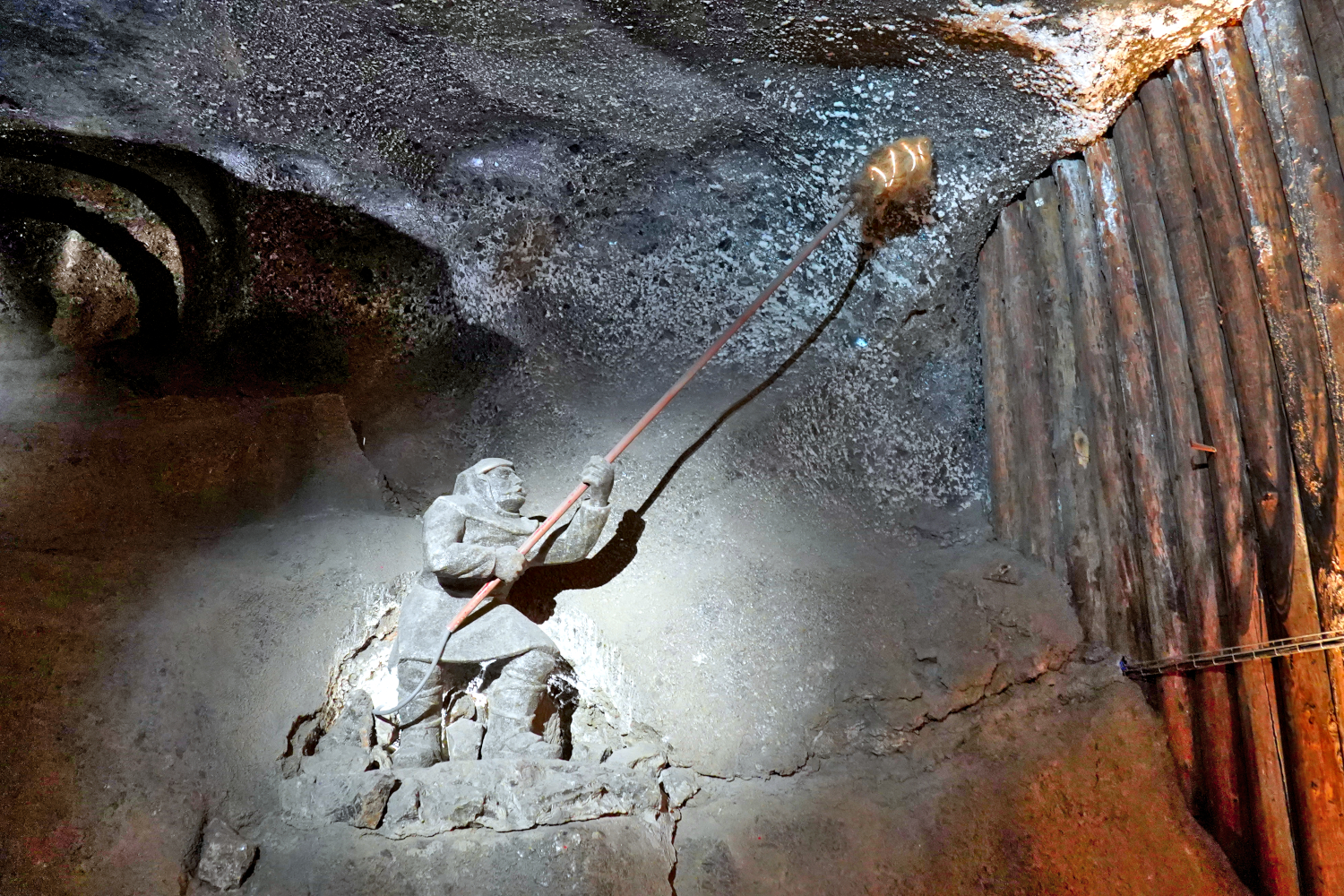
Along our itinerary we encounter quite a few sculptures crafted from rock salt, or more appropriately, salt rock, since it’s much harder than you might think — and a good thing, too, since you’re surrounded by the stuff in every direction. But despite its dependable firmness, you can still shine a light through it, which creates a really cool effect.
Some of the statues on display portray a few of many the celebrities who have toured the mines, both before and after they officially opened to the public in 1774. The honor roll of visitors has boasted, among many others, Copernicus, Goethe, Chopin, Pope John Paul II, and Bill Clinton.


While many of the statues depict kings and other such hoity-toities, there’s also one of local boy Nicolaus Copernicus, erected in 1973 for his 500th birthday. Some of the sculptures were created by laborers who had no training in art, nor any education at all; they possessed not only the rough touch of being able to extract huge crude lumps from the earth, but also the subtle touch of being able to etch it into delicate lines. Quite a combination.


In addition to the stone/ salt pieces, there are more realistic sculptures made from other materials, intended to give you a glimpse of how laborers in the mines labored in the mines centuries ago. (And for good measure, there are also a few whimsical representations of fairy tale dwarfs, though who can say just how realistic they are.) In other words, the mines function as a museum, exhibiting not only human figures, but figures of the horses that operated some of the heavy machinery. And the machinery itself. The horses, who lived and worked underground for long stretches of time, were lowered down into the pit in harnesses attached to heavy ropes, the same ropes used to pull up the large cylinders of salt from the mines.


Like any museum worth its salt, this one has restrooms and concession stands. Not only at the end and beginning of the tour, but about halfway through it. So we take a break of about 15 minutes here, during which time we whip out the snacks we brought along and snack on them.
Just past this little hiatus is a museum-ish touch that is less kitschy than it may sound, and in fact rather nice. At a little lagoon, the guide turns out the lights, and then colored mood lights slowly come up, illuminating picturesque features in the rocky walls, accompanied by the placid sound of a nocturne composed by — who else — Poland’s native composer Fryderyk Chopin. Gradually, the lights illuminate the precarious ladders along a corner, as if someone is scaling to a summit, with the possibility of plunging into the abyss at the slightest misstep — which the buoyant music seems to guarantee would not happen.
Perhaps the crowning glory of the tour, at least as far as elaborate and exquisite craftsmanship, is the largest of the chapels, which is still in use today. It’s called St. Kinga’s Chapel, named after the patron saint of… would you believe… salt miners. It’s approximately 39 feet high (or at least would be if they did feet here) with floor space of about 60 by 180. So you could fit more than half a football stadium into it.


The most impressive thing about this imposing and ornate chamber is that everything is made of — what else — rock salt. Everything but everything. The floor, the walls, the ceiling. The large altar adorned with statuary. The intricate figures of saints and biblical scenes, including the Last Supper and the Nativity. Even, we kid you not, the chandeliers.
It is perhaps a bit ironic to encounter such a grand house of worship 331 feet below the surface. In traditional religious cosmogony, the realm of the divine is in the stars, while the realm underground represents evil and decay. Builders of religious structures have aspired toward the heavens with Babelesque steeples, minarets, domes and towers. But here, headed in the other direction, is a sacred chamber that can hold its own with the lofty, and is more or less just as inspiring — just as uplifting, if you will — as many of the topside cathedrals we’ve visited.
At the final stop of the tour. we are subjected to yet another gift shop (still underground, mind you), although a rather unique and interesting one that also is sort of part of the whole museum experience. There are chocolates for sale, chocolates containing salt, that are quite tempting to the palate, but the price tag is not so tempting to the bohemian pocketbook.


On display is a statue of a legendary character called The Treasure, who was rather like the Grim Reaper, and whose appearance foreshadowed disaster. The sculpture also features a broken timber and another figure offering him a coin as if to appease him and avert tragedy.
At the conclusion of the tour, we have… well another tour, a mini-tour of a little museum with 5 chambers. In it is a record in Latin of salt having been discovered at this location in 1251. There is a little model, with lights, of the various layers of the mine, resembling an electronic diagram or the plastic framework of some model kit. The guide informs us that no forced labor was ever used in all the centuries of salt mining (this excludes, of course the Nazis with their munitions factory).


After emerging from the realm of the mole people, we stroll about Wielizcka a bit and then catch a bus back home. It’s extremely crowded, and we have to stand. Until the driver makes a sudden stop, and Dennis tumbles into another guy, almost knocking him over. After that, someone offers us seats. And we accept, even though we normally don’t play the Old Folks Card — since we don’t think of ourselves as Old Folks.
So the Wieliczka Mines are behind us and below us. But it was such a fun outing that we decide we have to do it again — right away. But next time we’ll take a different itinerary. In addition to the tour we took, which is called the Tourist Route, there is another tour available called the Miners’ Route, which is supposed to offer more of a view of what a miner’s life was like. Sign us up. And stay tuned.
Events occurred: 2/22/2025

Leave a Reply