

After a month of volunteering at a school in Valašské Klobouky, Czechia, our time there ended with a bang. Or at least with a theatrical flourish. Make that a double theatrical flourish. Because not only did our students perform in a theatre for an audience, presenting the stories we’d taught them, but a couple of days later, we traveled with them on a bus to see a performance of a professional theatrical production for young audiences — not unlike the ones we presented ourselves in our past life.

On the day of the school performance, we catch a ride to the theatre with a car full of kids, costumes and props. The students’ parents have gone all out in putting these together, even coming up with some nice faux fur outfits for the wolf and the sheep in “Boy Who Cried Wolf.”
The props include a cardboard “cake” that we were going to use in one scene to smash into someone’s face. But one of the candles breaks off before the show, and the girl who brought the prop says that her mom, who made it, wants to get it back intact when we’re done with it. Which makes us think it inadvisable to go ahead and use it, because it could get totally obliterated. So, reluctantly, we nix it from the show, sacrificing a great comic bit.
We end up having to use a laptop belonging to the theatre to run the music for the show, because that’s the only way we can grok with the speakers. And since the battery is running flat, we also have to borrow their power cord. Other little last minute adjustments also are on the table. Dennis has to fill in as narrator in one story, and when he gets onstage he screws up the order of the scenes. The kids recover like pros.
The performance of the stories goes off capitally; we’re especially pleased to see a couple of the older boys, who’d been very reticent about participating in the whole thing, exuding an “I’m too cool for this stuff” air, nonetheless really come through onstage when the chips are down, and shine splendidly.


After the stories, we cap off the event by having the students perform our American folk-ish dance to the old song “Cotton-Eyed Joe”. The audience is ecstatic, clapping along as if they are at a barn dance. In fact, we do an encore and the audience gets in on the hoedown too. This dance has become our international calling card; we leave the locals with the memory of it — and the knowledge of how to do it themselves — most everywhere we go.
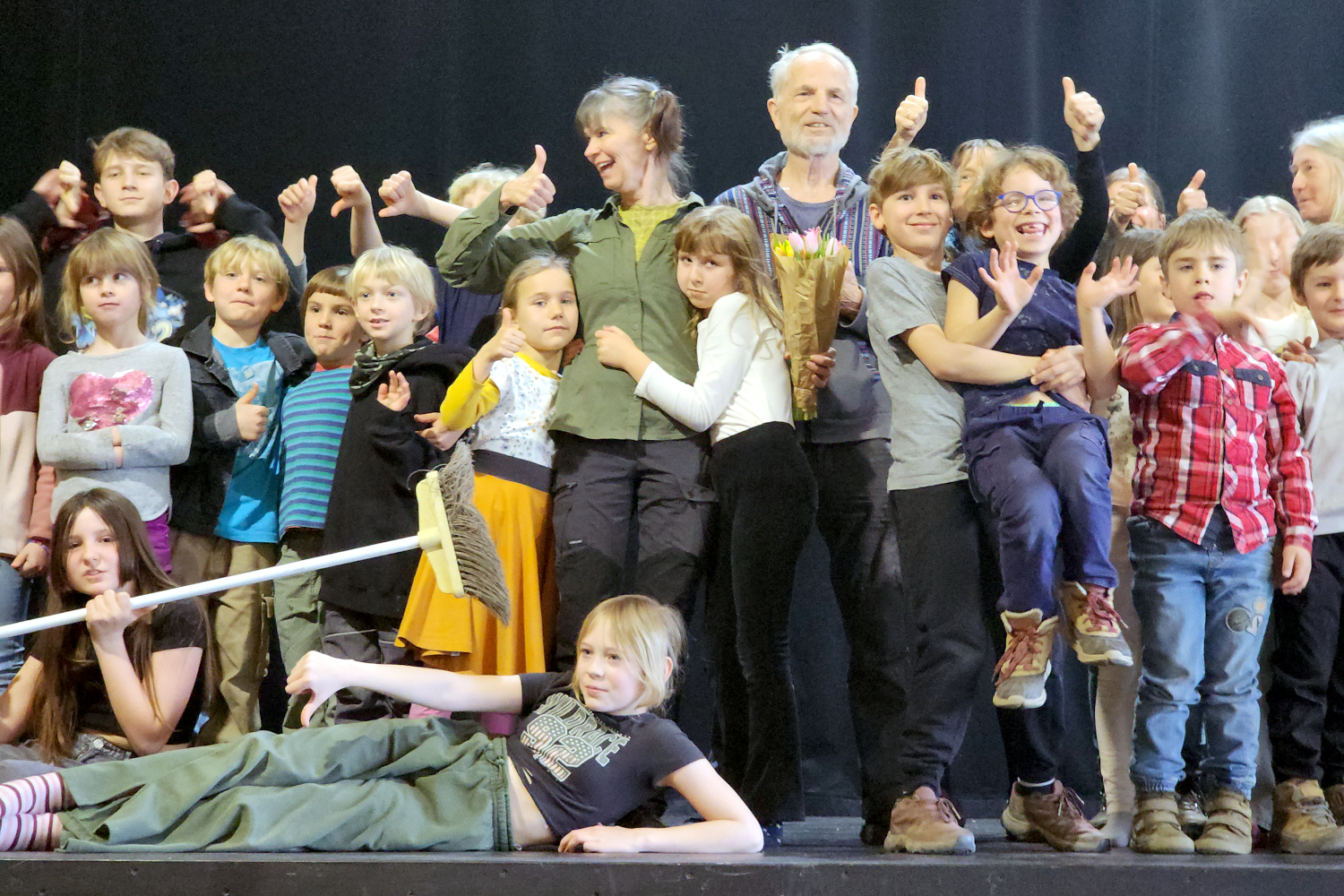
At the curtain call, we are called up to the curtain to be presented with tokens of esteem and appreciation: tulips for Kimberly and a jar of homemade plum jam for Dennis (which of course he’ll be spreading around, as it were). And some of the girls give us homemade Thank You cards. We all pose for photos on the stage, with many of the students giving either a thumbs up or an ironic thumbs down, an allusion to a character in one of the stories who gets the gesture wrong.


On Friday, our last day at the school (or at least our last day on a school day), we have no classes. Instead we have a field trip, starting with a bus ride of about one hour to the city of Zlin. A city of about 75,000, Zlin was once a center for shoe manufacturing, but is now the center of Czech filmmaking. (It’s also the birthplace of prominent playwright Tom Stoppard and prominent socialite and gold digger Ivana Trump.) Our purpose today is to attend a performance by a theatre company.
Getting off at the bus terminal, we all walk a short distance to the center of town, where there is a park for the kids to romp around in for a while, as we have some time to kill. There are also coffee shops nearby, where the adults can fetch some fortification. One of the teachers relates an amusing anecdote about when her husband tried espresso for the first time while visiting Italy and, not realizing how concentrated it was, consumed several cups.
After a while, we walk on a few more blocks, passing the enormous and impressive symphony hall/ opera house. Which is not our destination; we’re headed to the City Theatre Of Zlin, still a couple of blocks away, and we pass more school groups coming from that direction — apparently there is more than one performance scheduled today.


The theatre building from the street on which we approach it appears nondescript, more like an office building than a theatre. But then we go around to the side to enter, and we suddenly find ourselves in a spacious and elegant multi-story arts complex. The theatre, at least the one we are headed to, is downstairs, and the lobby is already packed. The students check their coats and backpacks, and the check counter does not issue any kind of ticket — the attendants just rely on their own memories and the eyes of the patrons.
The performance we are going to see is based on O pejskovi a kočičce (“Dog and Cat Stories” ) by Josef Čapek, though from what we can tell there’s more emphasis on crows/ ravens than on felines or canines. The three actors — two male and one female, seemingly in their forties or fifties — supplement their minimalist costumes with black caps having bills that resemble the beaks of the birds.
Their setup is simple: basically a ladder and a couple of big wooden spools such as you’ll see at construction sites. The performers run their own sound cues, from a laptop somewhat concealed onstage. It’s a very capable cast, who all move well, act well and sing well. At one point, one of the performers loses his bird cap, and he promptly and seamlessly covers for the loss by pulling his cloak up over his head until someone else delivers a line, at which time he subtly retrieves the cap.


The script, however, seems a bit weak from what we can tell (it’s all in Czech, with no subtitles). And the duration is 90 minutes with no intermission, which is rather long for young audiences to hold up without getting restless. Still, it’s overall an enjoyable show.
After we catch a crowded bus back home, a mother meets us at the drop-off in Valašské Klobouky, telling us that she wants to give us a loaf of home backed bread. She regularly bakes loaves of hearty grain bread, which she sells — but she’s offering us one for free.
So we accompany her the short distance to her home, which is beside the other campus of the school. She lives in the historic wooden house built in 1771 that is now a bit of a museum piece. But despite its antiquarian structure and decor, when she walks in the door she says, “Google, lights on”, and the lights come on.


After we sit and have tea and talk with her for about an hour — marveling at both the amazing interior of this ancient homestead and her son’s extensive collection of Legos — we head back home, lugging the loaf of bread with us. Now we have something suitable to spread the plum jam on.
At home, there is a note the school director left for us, along with the sum of 1500 crowns. She’d waited around for a bit hoping to say goodbye to us, but had to leave. She’s also left a guestbook, in which we and other volunteers can write about our experiences volunteering here.
Two theatrical productions, Cotton-Eyed Joe, a loaf of bread, tulips, and a jar of plum jam. And many gestures of appreciation for our efforts. It’s been a memorable last week. We’ll never forget it, or the wonderful community in Czechia where it all happened.
Events occurred: 3/26-28/2025

Leave a Reply