
If you enjoy train rides, as we certainly do, Amtrak’s California Zephyr is hard to beat among American rail excursions. Just about any segment of the route between Oakland and Chicago is an atmospheric eyeful, from purple mountain majesties to the fruited plains (are plains really fruited?) to towering cities. One or more of us has ridden the Zephyr so many times that we decided to name our son after it. (And wouldn’t you know it, he fell in love with trains as soon as he knew what they were.) And now here we are, after spending some time in Reno during our break from global volunteering and teaching, retracing our tracks and the train’s as we make our way toward the San Francisco Bay Area.
This time we actually enter the Reno station, which we’ve never done before — this is the first time we’ve actually departed from Reno. And when the train pulls through Reno on its way to somewhere else, it only stops long enough for boarding and discharging. Which is understandable, as otherwise the lure of the nearby casinos just might cause some passengers to get themselves left behind.
So this our first glimpse of the august century-old water fountain displayed in the middle of the waiting room. Commissioned in 1908 by the Red Cross and the Women’s Christian Temperance Union, the fountain originally stood on the street downtown, and was intended to provide a source of free drinking water to deter people from entering saloons. It also supplied water for horses and dogs — did they have a drinking problem too? Dedicated to the veterans of the Spanish-American war, this handsome cast iron structure stands some 15 feet tall, and is engraved with emblems including crossed swords and the number 1, commemorating the First Cavalry Volunteers of Nevada.


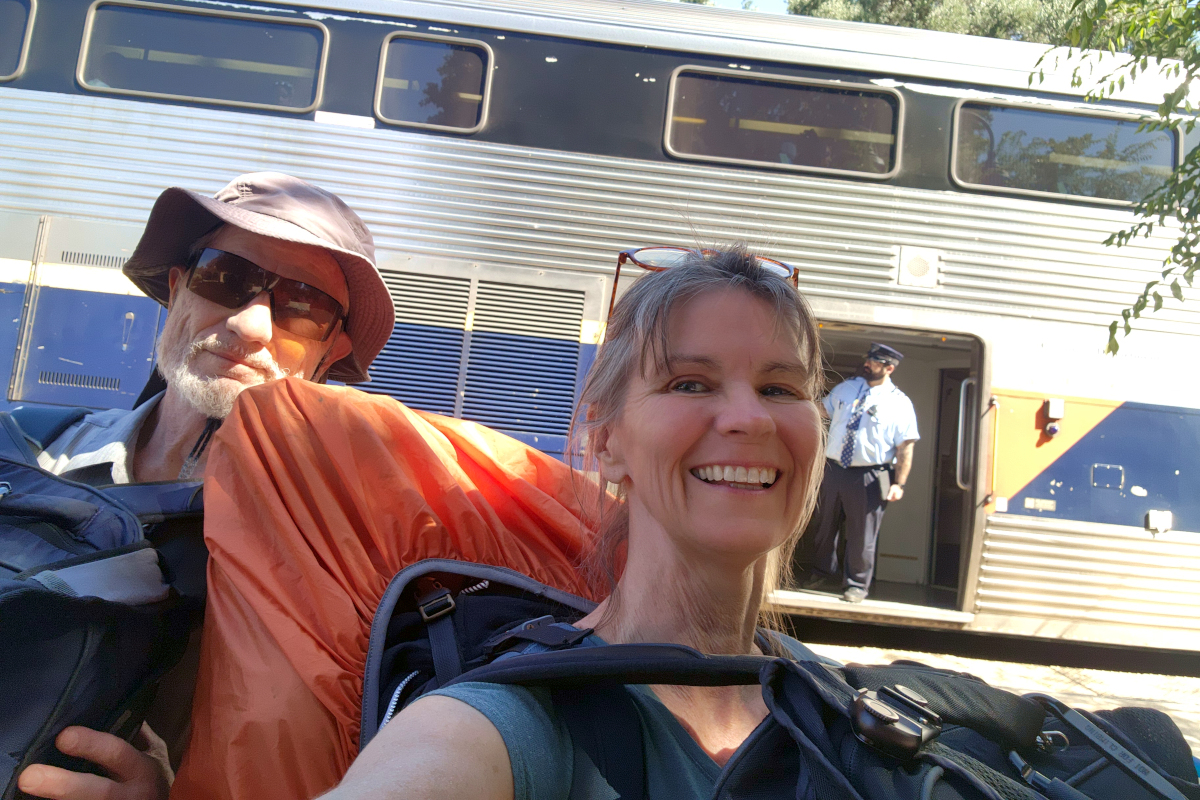
When the train begins its approach and we go out to the platform to rendezvous with it, we encounter another couple who also are loaded down with backpacks. Turns out they are just now about to embark on their own extended worldwide travel jaunt, with the first destination being Santiago, Chile. We compare notes, and they seem to be pretty savvy for novices. It was only 4 years ago that we were in their shoes, but now we feel as if we’ve been at it our whole lives. We almost envy them for being at the very beginning of their big adventure.
After the train pulls out of Reno, you soon find yourself slipping past Truckee Meadows, and you’ll quite likely spot a few wild mustangs. Nevada is home to nearly half the wild horses in the United States, and a surprising number of them can be found clustered around Reno and Sparks.


At times, the choo-choo follows alongside the Truckee River as if challenging it to a race. But before long it will switch over to the other side of the river and even lose it behind some hills, as if they are playing tag. Sometimes it’s difficult to decide which side of the train to sit on to get the best view. So we find ourselves changing seats several times, even after we move to the observation car.
Although Amtrak is to Eurail as Donner Lake is to Lake Tahoe, it’s not bad at all, especially considering how various government officials have been trying for decades to pull the plug on it. It’s even made some improvements in the years since Dennis used to ride on it across country — such as, for instances, providing outlets for devices that didn’t exist back then.
The train passes through the deja vu town of Truckee, which is perhaps best known as the setting for Charlie Chaplin’s 1925 film The Gold Rush. He chose the area because it still looked much like it did in Gold Rush days. And if you squint, it still does.


And on you go, slithering through the Sierras, which are beautiful any time of year, and past Donner Lake, which of course was named after a notorious group of pioneers who made the neighborhood their winter resort. (It was originally called the Donner-Reed Party, but after the way the party turned out, Mr. Reed was probably happy that his name was removed from the marquee.) When Dennis first rode through here on the Zephyr eons ago, he mistook Donner Lake for Lake Tahoe. But of course Donner is a mere tadpole of a lake, achieving a depth of “only” 238 feet. It’s here in part to get you in the mood for its even bigger and grander brother of Lake Tahoe once you get your feet wet, as it were. But don’t put it down; it has plenty of charm of its own, just on a smaller scale.
Our rail voyage back to the Bay is in two segments. We first stop over for a couple of days in Davis to meet up with some of Kimberly’s relatives — her uncle Larry, aunt Linda and cousin Lori. They are the brother, sister and niece of her late birth mom whom she located only a few years ago, so they’re all still doing some catching up. To that end, they brought along some photo albums, some of which contain some very old pictures. Some of them are of Kimberly’s great-grandmother, who was — would you believe — an amateur actress. There are even photos of her as a young woman (she appears to be about 20) performing in a show. So it looks like the theatre bug might be genetic.


Davis is the home of a campus of the University Of California, so it features a vibrant intellectual and artistic community. Thanks to Uncle Larry’s connections, we’re able to tour the studio of local sculptor Jord Nelsen and see him at work. Jord wears a brace on one leg, and explains that it’s the result of a stroke he had 19 years earlier (which, by our estimation, makes him an awfully young stroke victim). Unable to use his left hand to hold his chisel, he switched to an electric chisel, and the show goes on. He’s still turning out some wonderful, highly imaginative pieces of art.
Not far away from his studio is perhaps the most iconic sculpture in town, the Shovel Gateway — an arch constructed of 440 shovels collected from the community. It leads to a peaceful shaded walkway along the creek populated by botanical specimens installed by the UC Davis Arboretum.
After our brief layover in Davis (which includes a meetup with Kimberly’s old friend Deborah, a classmate throughout school days), it’s back to the train station to resume our trek westward. The station, incidentally, is, like many other train stations, a site of historic interest itself. Built in 1914 in the Mission Revival style, it’s listed on the National Register Of Historic Places. Though damaged in a recent fire, it still survives just fine, another quaint specimen of railroad history.
There’s something inherently nostalgic about trains, isn’t there? These relics of the era of Manifest Destiny still evoke images of “iron horses” chugging along on their tracks like giant zippers fastening the states together into one big quilt. A ride on even one of the ultra-modern models has a way of summoning up the most pleasant memories.


And so it is with us as we make our way back toward our roots in the Bay Area, past the farmlands with almond trees near Vacaville, on to San Pablo Bay and the Carquinez Strait, where you can get a glimpse of a true study in nostalgia: the Suisun Bay Reserve Fleet, aka the “mothball fleet”. These are retired naval ships dating back to the Cold War and even World War II. Their numbers have greatly diminished — only a few are anchored there now, whereas at one time there were more than 300. But they’re still standing at the ready, on the off chance that they might be needed some time in the future.
Fittingly, our rail route ends in San Leandro, almost directly across the Bay from San Francisco. San Leandro was the headquarters of the theatre company that we both performed for when we met in 1988. The Director of that company, Sue Ellen, still lives there, and is still an active and capable award-winning theatrical director. We are able to spend some time visiting her and her husband Ron. And we are able to visit the local Lakeshore Learning store to pick up some school supplies that will come in handy when we go back to Cambodia soon and resume teaching.


The San Leandro Library was instrumental in our performing careers after we started our own theatre company. Not only did we perform there numerous times during our 32 years in business, but it also hosted a showcase for library entertainers that we participated in during our first year that introduced us to many, many other librarians. While we’re in town we drop in at the library and happen to see the children’s librarian. She tells us how much she loved our performances, and considered us unique. And it’s very gratifying to hear that our work was appreciated.
In a way, we’ve come full circle. But it’s been a very big circle indeed — all the way around the world — and has taken a very long time. And we still have more circles left to make. You can bet that part of those circles will be traveled on trains, in whatever countries we possibly can.
Events occurred 6/16-22/2025


Leave a Reply