

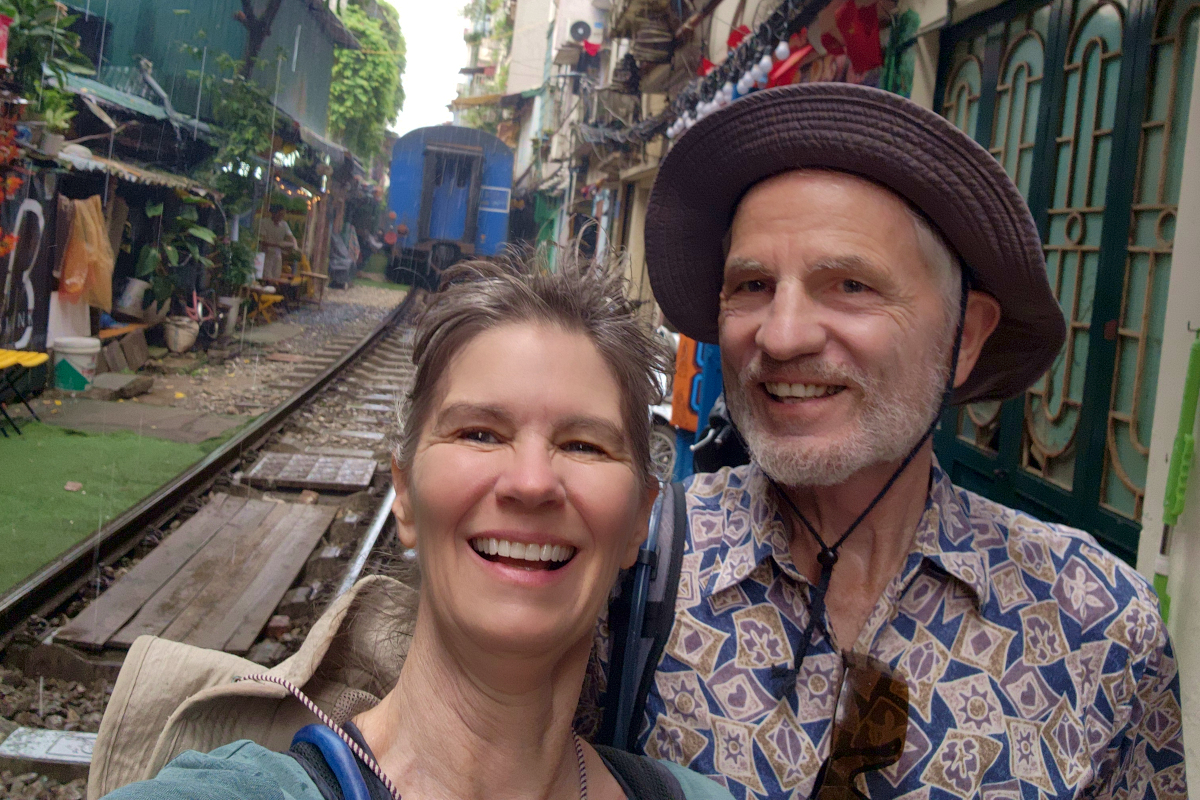
Hanoi’s “Train Street” is like no other street in the world. Because it’s a street where the only non-pedestrian traffic is… well, a train. Actually, several of them, passing throughout the day. The narrow thoroughfare consists of a railroad track with shops, restaurants, cafes and homes lining either side, almost close enough for someone to reach out a window and touch the train as it zips past. Indeed, bystanders in the street have to squeeze back against the wall to allow the trains plenty of clearance. If that sounds hazardous, it is. Several close calls prompted authorities to close the street in 2019. But amid public outcry (and more important, the loss of tourist revenue), it was reopened in 2023. Which means that we were able to enjoy it during our own visit to Hanoi — in fact, we went three times.


On our way to our first witnessing of a train invading a street’s turf, or vice versa. we come a tiny sidewalk shop where a man is selling clothes, and one particular item catches our eye. It’s a cargo vest, similar to what hunters, fisherpersons, hikers, and pretentious macho man cosplayers might wear, except very lightweight. Which means it could fit into the backpack of one us us quite readily. And as it happens, one of us had been fancying such an addition to his wardrobe, because he always has his pockets bulging, as if trying to imitate Batman with his utility belt, and sometimes this causes us a bit of a delay when unpacking pockets at security lines, to the annoyance of the other of us. So, at a price equivalent to about 15 dollars, it seems like too good a deal to pass up. So we don’t.


When we arrive at Train Street, we still have plenty of time before the first train invades the street; we’d looked up the schedule in advance, and many of the businesses here also post it on chalkboards in front of their shops. So while Kimberly scouts out and stakes out the optimal viewing spot, Dennis prowls the neighborhood in quest of a WC. (Public toilets are usually plentiful in Vietnam, and unlike many other countries we visit, they are always free — it seems a communist system does have its good points, at least for those with an active bladder.) He doesn’t find one this time, but he does get a a taste of Hanoi life off the beaten path, including a meat vendor whose wares include roast dog. Yes that really is a thing, especially in the northern part of the country, though the tradition is reportedly dying out.
Soon the other gawkers come trickling in and amassing alongside the tracks. Our selected ringside seat — or rather ringside stand — is on the inside of a slight curve, next to a shop selling drinks of some sort, operated by a mother and young daughter. They have some kind of friendly little mammal with long claws in a cage, which they set on the tracks; we gather that this is so it can feel the vibrations and alert them when the train is coming. Other business owners have birds in cages, apparently for the same reason. The little tables and chairs in front of the cafes, at which customers are seated, are practically on top of the tracks.


Finally, the witching hour draws near, and merchants start putting tables and chairs away as the train approaches. A couple behind us, in what is under preparations to become another storefront, urge us to step back, into their space, because we’ve been standing in a spot that could be precarious. And it turns out they have a good point. When the train does come — not cautiously edging along, but barreling through heedless of anyone or anything in its path, it feels so close that it could almost trim our eyebrows.
The next day we return for another gander, catching a bus with the most annoying horn ever. And we view the swiftly zipping choo-choo from a different angle. Our plan is to catch the 8:55, but one comes along at 8:50. Having gotten our train fix for the day, or actually for three days, we start to leave. And then a lady at a shop informs us that another one will be along shortly. It turns out that the one we just saw was actually the 8:30, masquerading as an early 8:55. But the real 8:55 is still on its way, and on schedule. Sure enough, we stick around and soon get an encore.


Train Street, with its paper lanterns and other decorations, and colored lights, must be quite a spectacle at night, we think. And we also wonder what it must look like from the other side of the looking glass- what do passengers on the train see when they go zooming through? Well, as it turns out, we were going to get a chance to satisfy our curiosity about both of those things in just a few days, when we’d be catching an overnight train from Hanoi to Da Nang that would follow this very route.
After finishing with Train Street, we walk to another of our gotta-see sights in Hanoi, the Temple Of Literature. Originally constructed in the year 1070 (and subsequently refurbished a time or two or three), it’s a temple dedicated to Confucius and other sages. From 1076 to 1779, it was home to The Imperial Academy, the nation’s first national university.
The complex is laid out in five courtyards, representing the five stages of learning. These are accessed via three gates: the biggest and most ornate one in the center for royalty to pass through, and a less ostentatious gate on either side for ordinary folk. On this occasion, we make like royalty.


The center gate is one of the most photogenic sites at the temple, but it takes a back seat to the ornate red and white Khue Van Cac Pavilion. It’s one of the most photographed sites in the city, and indeed in all of Vietnam. It has been made the official symbol of Hanoi.
Ducking into the structures on the side (a maneuver we timed perfectly to get out of the rain), we encounter what might be considered the centerpiece, the main temple with its statue of Confucius. The interior features ornate red lacquer and gold leaf details, and ancient relics of devotion, including bronze bells, gongs, and incense burners.


In the temple you’ll see metal cranes (the birds, not the machinery) standing on the backs of turtles. This represents the pairing of yin and yang, earth and sky. According to legend, these two critters were buddies; during times of drought, the turtle would dig down to find water for the crane, and during times of flooding the crane would carry the turtle to safety. By the way, if you look closely at the sculptures you’ll see that the necks of both animals are a lighter color, a result of having been touched by so many human hands — which is reputed to bring good luck.
Because of their longevity, turtles are also considered symbols of wisdom. So a group of stone turtles serve as the mounts for tablets honoring great scholars from 300 years ago or so, a collection of monuments known as the Doctoral Steles. These turtle steles, 82 of them, surround a square pool called The Well Of Heavenly Souls, which was believed to purify the souls of students — just in time for them to go sit on their bottoms for lengthy periods undergoing rigorous exams that probably got their souls all cluttered up again.


During certain times of the year, particularly during Tet (the Vietnamese new year celebration), visitors hang colorful slips of paper inscribed with their wishes for success, often in academic pursuits. During Tet, calligraphers are also on hand to create a more artistic version of the wish scroll for visitors to take as a home decoration.
Finishing up out tour of the Temple Of Literature, we catch a bus back to our apartment, and this time the horn on the bus is one of the more pleasant we’ve ever heard, gently fading out at the end like a hit song from the Fifties. Quite fitting that on the way to the temple the horn was raucous and discordant, and on the way back from it, the horn is mellow and pleasant.
That wraps up our initial sally into Hanoi — though we’ll be back briefly to catch a train after spending three days cruising Ha Long Bay. It was quite an introduction. As we start assembling our belongings, we look out the window and are fascinated by the sight of a fellow on the balcony of an apartment across the way, fixing his clothesline while standing precariously on the railing on the 4th or 5th floor. After the sun set, we look down upon the courtyard of a little temple, and see several women practicing a traditional dance. Somehow the juxtaposition of these two contrasting images seems to embody the spirit of modern Hanoi.


Events occurred 7/5-7/2025

Leave a Reply