

After a few days laying low in Da Nang, during which time we didn’t really do much because Kimberly was bedridden much of the time with some kind of bug or other, we were off to return to the enchanting little city of Hoi An, where we had volunteered three years earlier.
We catch the local bus to the train station, where we have a rather long wait until our bus to Hoi An arrives. We’re again the only ones on the bus, and this time the driver has no assistant, so he has to take our payment and make change himself.
While we’re waiting in the station, a man tries to hustle us with a car ride to Hoi An. He shows us a black notebook with messages of appreciation from previous passengers (one young woman, oddly enough, even had her picture in there), but the most recent is 2018. We politely decline his sales pitch, and wait for the bus for which we’ve already paid.


Another fellow also strikes up a conversation with us, a younger guy, but he’s just being friendly. His name is Bao (“like bow-wow”, he clarifies), and although he was born in Vietnam, he’s now an American citizen, having lived there for several years. He went to school in Alaska, but now is teaching in Las Vegas — formerly he taught science, but then he switched to P.E., which he says he finds much less stressful. So he’s had both extremes of American weather — though he says he much prefers the dry heat of Vegas to the humid heat of Da Nang. Because we have such a long wait, one of the clerks at the station apparently becomes concerned that we have missed or will miss a train, so she comes and asks Bao (in Vietnamese) about it, and he explains (in Vietnamese) that we are waiting for a bus instead.
Our “bus” turns out to be a large van. At first we’re the only passengers, but it worms its way through Da Nang picking up more until it’s packed. (Seems we have a habit of being the first ones picked up.) En route, we get a good view of the famous Dragon Bridge, which we’ve attended up close and personal in a past visit.
After we arrive in Hoi An, we have to change over to a different van, even though there is only a short distance to go. This second vehicle deposits us in the neighborhood where we’ll be staying a few days; our Airbnb is just a couple of blocks away in an alley.
Our host family is a couple with an 11-year-old daughter. The mother is a seamstress, running a clothing shop in the front. Our room is upstairs, a tiny chamber with a tiny balcony, leaving us little room to hang our clothes after we wash them by hand. And there is no table or chair (though there is a TV, which everyone in the world but us seems to regard as a necessity). At least it’s air-conditioned.
The only thing about our new digs that really causes us some consternation is a giant cockroach that seems to want to evict us from our room and occupy it all by himself. Searching in the nearby shops, we are unable to find any kind of trap to give him a new home. But we improvise by putting down a strip of packing tape, sticky side up, in front of the door at night. And in the morning, he has indeed become trapped on it. (The gross thing is that he was trying to exit, meaning that he spent the night in the room with us.)
Our first order of business upon arrival, however, is to snag some groceries. And we know just the place for that: a sort of health food store called Moon Milk, which we discovered and delighted in during our previous stay in town. It’s small, and not terribly economical, but packed with a number of items that we have a hard time finding anywhere else. (And that name! You just can’t beat it.) Finally Kimberly gets to stock up on her precious chia seeds, which she’s been searching for in vain.


For lunch, however, we decide to try a restaurant called Chickpea Eatery. It’s vegan and we admire its philosophy and approach. But the food, while adequate, is not outstanding.
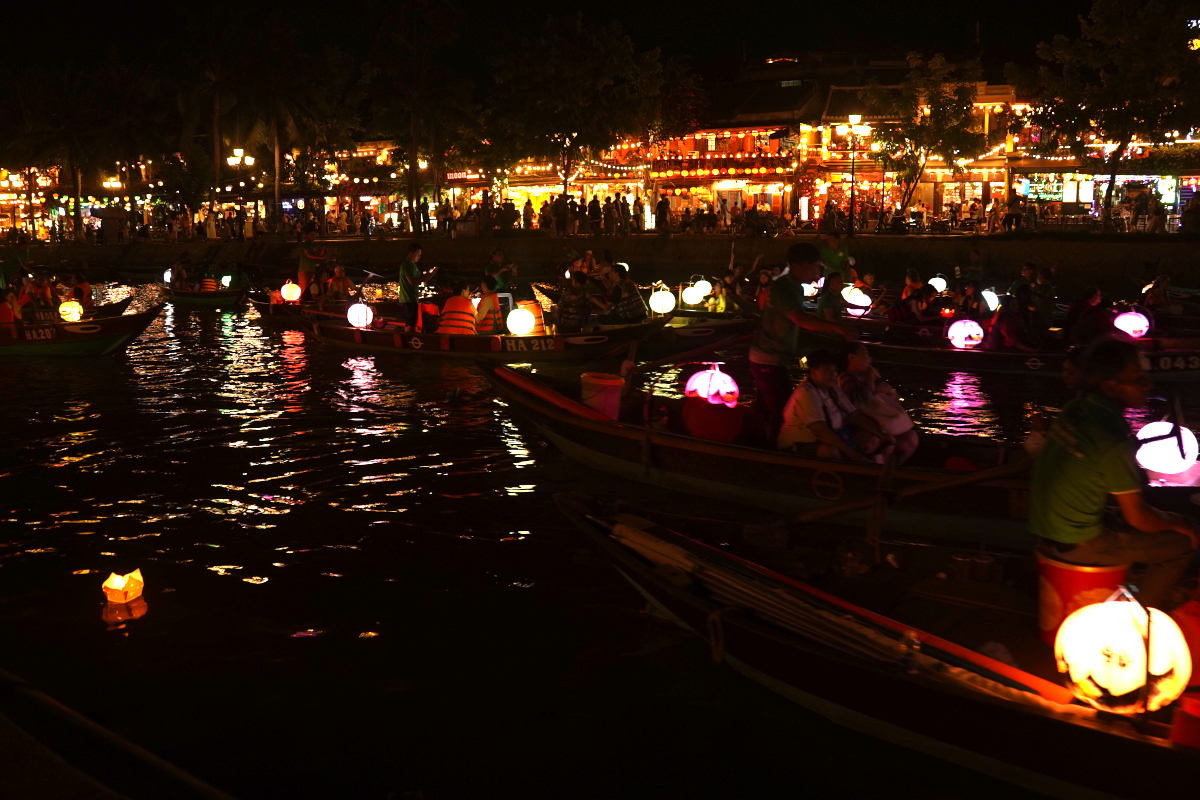
In the evening, we take a stroll to savor the sights of Hoi An lit up in its customary fairy tale finery, with brightly colored silk lanterns on the river, in the trees, and wherever. A well-preserved trading port established in the Fifteenth Century, Hoi An boasts a blend of Chinese, Japanese and native cultures. Its celebrated Old Town is limited to pedestrians — well, except for the bicycle rickshaws hauling tourists, whose drivers alert people to their approach by saying “beep beep” instead of beeping a horn. Fascinating town; if only there weren’t so many tourists!
The next morning, Dennis seeks out the local marketplace to buy some fresh produce. Along the way he encounters a British chap about his age who is looking for a bridge to go across the river and back to his hotel. He says he does have Google Maps on his phone, but… doesn’t know how to use it. Dennis offers his assistance, amused to find someone even more tech challenged than he is.
After lunch, we go seek out a store that sells electronics and furniture, a store we looked up online, so Dennis can buy a new phone. His old phone (and it wasn’t that old) suddenly went belly-up the day before, without a peep of warning. Our gadgets have really been in a conspiracy lately: he just recently bought a new laptop when we were in the States, and Kimberly herself bought a new phone not long ago. (And within a few weeks, she’d be buying a new laptop too!)
This store turned out to be a bit of a carnival-goer’s nightmare, with hordes of sales clerks swarming around you and hawking their wares and trying to get you to buy this or that. And none of them speak much English. (How dare they not — we’ve been in Vietnam two weeks already!) Plus, they have neither a reasonable selection nor very reasonable prices. So, our first choice of an emporium for the purchase doesn’t pan out.


Fortunately, we have another option up our sleeves. On the way to that midway of a store, we passed a smaller, less ostentatious gadget outlet that looked promising. So we go back to it and, lo and behold, the personnel are friendly and non-aggressive. And they even speak English. Furthermore, the prices and selection are much more customer-friendly. Dennis finds just what he wants/ needs at a very reasonable price. But the only one they have in stock is pink, which is not exactly his favorite hue (not that it matters a whole lot, since it’s going to be covered by a cover anyway).
The saleslady asks what color he’d prefer, and he replies green (he’s tempted to say chartreus as he often does half facetiously, just because he enjoys having the sound of it roll off his tongue). She asks him to wait ten minutes, while she hops on a motorbike and speeds away; then she returns ten minutes later with the phone model in glorious green.
If we were in Cambodia already, we could purchase the phone on our ABA (Advanced Bank of Asia) account using a QR code. Instead, since we do not have enough cash on hand, we have to use a credit/debit card. Which entails paying a fee to the bank for a foreign transaction. Except no, it doesn’t. Because we now have added a Charles Schwab account to our repertoire, and Schwab does not charge such fees. So we leave the store happy on all counts.
In the evening we again walk down to the river, which again is quite bewitching. And quite crowded. One shop we pass has a sign on the front saying “air conditional”, which makes us wonder exactly what you have to do in order to be permitted to breathe inside. We again run into the British fellow, who says that he has gone to get a massage (which he recommends) and spent all the money he had on him. (Considering the lack of tech savvy he’s shown, he probably pays for everything in cash). This town at night has an atmosphere unlike any we’ve seen anywhere else.


The next day, Dennis is really feeling out of sorts. He seems to have picked up, perhaps, the bug that Kimberly entertained in Da Nang, and has now recovered from. So while he takes a two-hour nap (as rare as a total eclipse of Venus for him), she goes out exploring the town on her own.
She’s been very tempted in the past to have a dress made at one of the local tailor shops. Hoi An is famous for these seamstresses and seamsters, dozens of them producing high-quality garments at a very low cost in 24 to 48 hours. Ultimately, she decided that she wouldn’t get enough mileage out of such a wardrobe item to justify its taking up precious cargo space. But she can still go gaga over the merchandise on display.


She can also take in the rickshaws out in force. And the ladies vending produce, snacks and souvenirs — and some in traditional attire posed as vendors so they can hustle tourists to pay for a photo with them. And the river ripe with boats shuttling passengers back and forth a short distance just so the passengers can say they’ve done it. And a plethora of silk lanterns, as if there has been a lantern storm falling from the sky. And people using special poles with little baskets on the end for placing floating candles on the water. And everything else that makes Hoi An so thoroughly Hoi An.


Events occurred 7/16 – 19/2025

Leave a Reply