

Silk Island, which is located in the Mekong River just a few miles outside Phnom Penh, has been a major hub of silk production for centuries. The industry was almost wiped out during the genocide under the Khmer Rouge, But it has revived and is prospering; today the local silk-producing community welcomes visitors and gives them tours. In recent months, we have been able to partake of three such visits.


Actually, it was only Kimberly who partook the first time. She along with a couple of teachers from the school where we’ve been teaching, were playing tour guides for a couple of volunteers from Australia. The 5 of them hopped into the school van along with the driver and all 6 headed off for uncharted territory. No one knew exactly how to get there or what to expect, which is the best part of an adventure! Once we got there the sewing geek in both Kimberly and one of the guest volunteers was fully activated by the fascinating process of making silk from a tiny cocoon.


Then the second time, we went to the island with fellow teacher Tami and her sister Natalie, who was visiting from the States (Seattle). While the usual way to get around here is by tuk-tuk, one of them would not have enough room for 4 passengers, at least not if they all want to breathe. So instead we settled on a romork, which is basically an enclosed cart pulled behind a motorcycle. It has two seats, each big enough for at least a couple of people, as opposed to only one seat in a tuk-tuk.
So we sent for one and when it arrived outside our apartment building, we explained to the driver that we wanted his services for taking us to the island island, then bringing us back. He agreed on a day rate, but then we had to cancel the ride we’d booked with him on the app. In order to do that, he had to drive a few yards away, so that the app would not detect him still in our vicinity. Ah, technology.
So then we headed to the apartment building where Tami lives and picked up her and Natalie, who turned out to be just as gregarious and riotous as her sibling, and off we went. After a ferry ride and a lengthy drive through a rustic neighborhood, our driver stopped at our first destination.
It was not the destination we’d had in mind — we were targeting the same facility that the teacher delegation had visited, the main hive of activity on the island. Instead, the driver brought us at a much smaller, family-run establishment. Which was interesting enough, and both Tami and Natalie bought a couple of silk items there. (The friendly lady in charge, half-jokingly said to the two of us “Next time you buy” as we were leaving.)


Then it was on to the main attraction, which the driver found with our expert guidance. It’s called the Community Center, and it’s a park where a number of silksters ply their trade and sell their wares. In order to enter, we paid the princely sum of 2000 riel (50 cents) each, and a compulsory “volunteer” guide began to escort us around. (And at the end of the tour, the guide *subtly* hints that they’d appreciate a tip, sometimes even *subtly* suggesting an amount.)
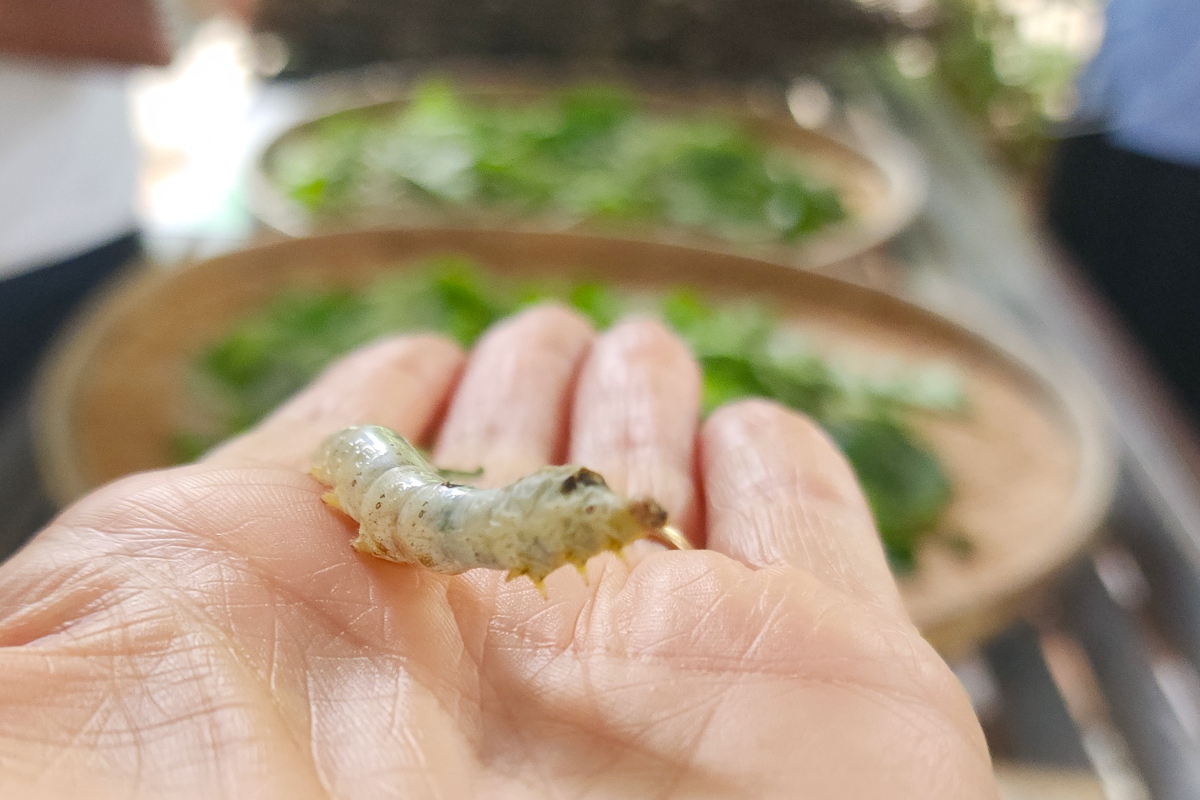
After pausing at a little tank to get a murky glimpse of an oarfish from the Amazon (these serpentine suckers can grow up to about 25 feet long), we stopped at the first station, where the silkworms (which are actually larvae) were munching on mulberry leaves and pooping up a storm. And then another container had them cocooned in the silken threads that they spit out, a salivary excretion that gets magically converted into expensive clothing. We were allowed to hold the silkworms in our hands, and have our palms tickled by their crawling around; fortunately they don’t poop on us.


There was another station where a woman was unspinning the cocoons that the silkworms have so laboriously spun, creating long single silk threads. These are a golden color naturally, but some are dyed in various rich shades, using extracts of plants. The spinning apparatus is clearly homemade, as it incorporates a bicycle wheel. The cocoons are placed in a pot of hot water, enabling the strands to untangle more readily.
Up next was a series of looms, where women spend their days weaving the naturally-died colored threads into cloth with a pattern on it. Each pattern is unique to that weaver — not just among all weavers here, but among all human beings anywhere on the planet. A pattern is a family treasure handed down among generations of mothers and daughters, so you won’t see one of these in any other place but right here — and on the cloth produced by it, wherever it may end up in the world. Family heirlooms for family heir looms. We were invited to place our phones underneath the loom and take a photo of the image being produced by the pattern of threads on top. So of course we accepted the invitation. The weaving ladies, by the way, were wearing silk dresses themselves, presumably homemade from silk created on these premises.


In addition to the silk trade, the Community Center offers glimpses of other aspects of Khmer culture, including some of the little houses on stilts that are traditional dwelling places.
Needless to say, the tour culminated in the gift shop, where we had the opportunity to purchase all manner of silk scarves, dresses, ties, and purses that were not really made out of sow’s ears. Tami and Natalie again gave in to the temptation to leave with more than they came with, but we again managed to pass.
Our third excursion to Silk Island came not long afterward when we were joined by more visitors from back in the States: Kimberly’s niece Jenny and her boyfriend David (from Reno) and their friend Jose (from Colorado). Again we took a romork, though the driver informed us that we had to pay extra for the fifth butt in the seats, since it was company policy to accommodate only four. That was not a problem for us, but what was a problem was the excruciatingly slow pace at which he was driving. We finally decided to cancel the ride and try our luck with another romork. We again had to pay extra; but while the driver wouldn’t have qualified for the Bonneville Flats, he was considerably speedier than the first.


We had a different guide this time, and he spent more time telling us about the history of the island and the silk industry. After we examined the worms and the cocoons, and moved on to the spinning station, there was no one there working. So the guide invited Jenny to fill in for her, giving Jenny a taste of life in the silk world, and giving the rest of us an excuse to keep the shutters clicking.


Once again, we finished up at the gift shop, this time Kimberly bought a scarf to be transported back to her mother — she’d been thinking ever since the last visit that she probably should have done that.
The official part of our tour concluded, our guide conducts us down to the river where there are some swings for folks to cool their heels in, which we folks did. He pointed out some construction going on nearby, where a restaurant is being built. Which we sort of have mixed feelings about; while it might seem convenient to have dining options onsite, it also sort of spoils the folksy ambience of the place. Already, there is other construction in the park that raises a judicious eyebrow: a Tube Coffee franchise will be opening here in the near future.


Previously, the Center had featured a small zoo. But some people complained about the conditions for the animals — the crocodiles in particular were kept in cages too small. Ultimately, the zoo closed, and now its remnants are left like not-so-ancient ruins. So when it comes to new modern business ventures like the coffee shop and the restaurant, there are two fears one might have: (a) that they will fail, and (b) that they will succeed.
Whatever happens, we trust that Silk Island will still be an informative and fun place to visit. Hey, we’d be game for going a fourth time.
Events occurred in March, May and August, 2026

Leave a Reply