

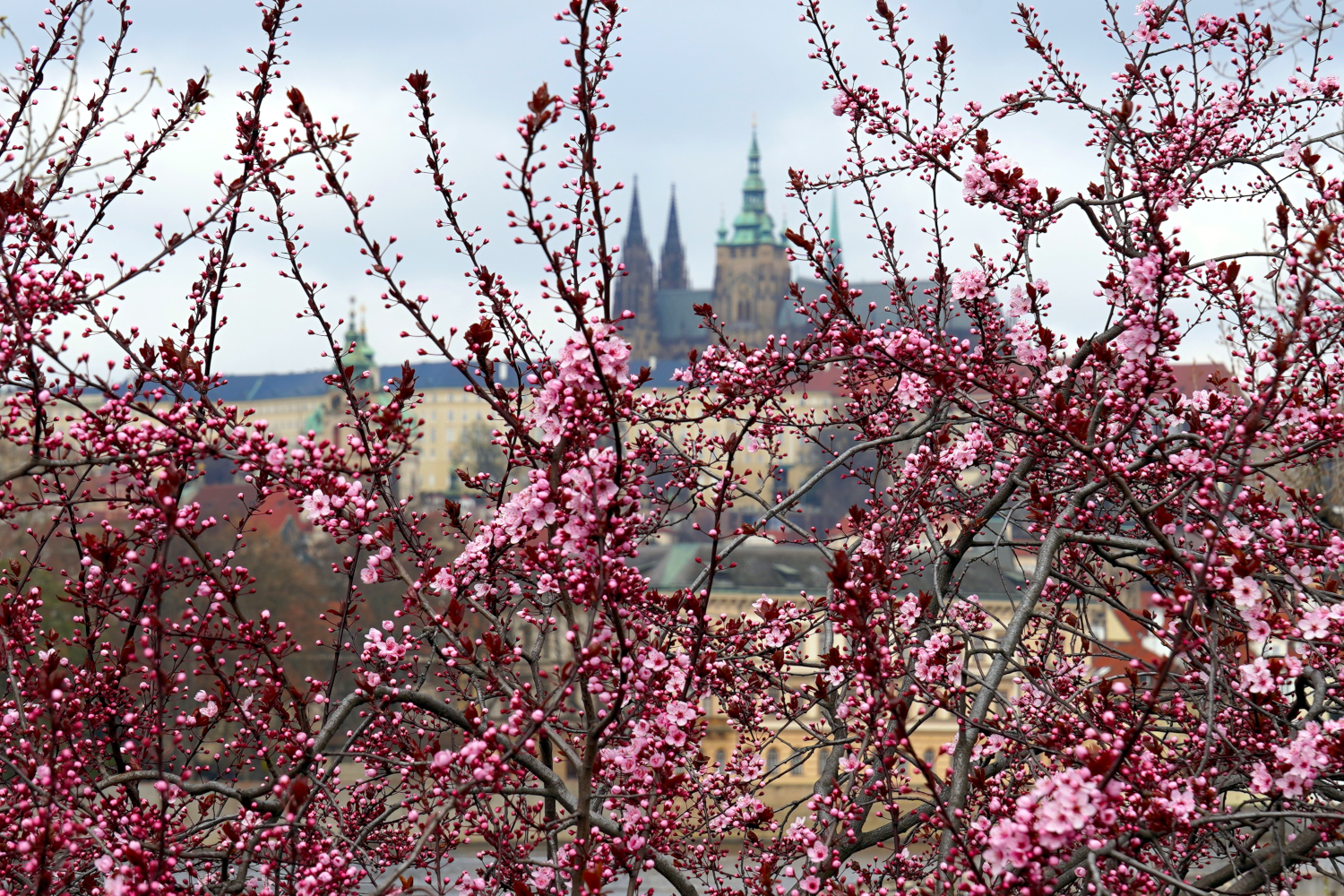
The city of Prague, which the natives call Praha, is the capital of the Czech Republic and the historic capital of Bohemia. It’s also the nation’s largest metropolis, with a population of 1.4 million, and a treasure trove of Medieval, Romanesque, Renaissance, Gothic and Baroque architecture, all cohabiting peacefully. It has been invaded and conquered by both Nazis and communists, and was the site of the famous Velvet Revolution to establish its liberation. The city has long been on our backpacking bucket list, and now here we were in the middle of it.
On our first day in town, we take a walking tour to get an overview, after riding a tram into Old Town. Before checking out the historical points of interest, we investigate a much more modern one: the “Dancing House” (Tančící dům in Czech) which is so called because it appears to be… well, dancing. In fact, famed architect Frank Gehry, who had a hand in its design, initially called it Ginger and Fred.


The location is of historical value. Although the original building on the site was destroyed by American bombs in 1945, a building next door was the childhood home of Václav Havel, future poet and playwright who also became the last president of Czechoslovakia and the first president of The Czech Republic.
Construction of the present structure, a twisting, almost spiraling little tower, was completed in 1996. It immediately started drawing criticism from those who felt that its “deconstructivist” style was a sore thumb and a black eye in a city so loaded with classic architecture.
Hogwash, say we. It complements, rather than detracts from, its elderly companions. Like them, it was designed with imagination and pizazz, which are all too frequently lacking in modern architecture. Our only complaint is that it’s a challenge for us to get a good shot of it because the adjoining building is encased in scaffolding and netting for renovation.
Naturally, you can’t go to Prague without walking across Charles Bridge, a majestic stone span across the Vltava River that measures 1700 feet and nearly 700 years. The Gothic tower on the east end of the bridge is an especially striking feature of the city skyline.


As you might expect, the bridge is quite busy, with the tourists as thick as billionaires on Epstein Island, doing so much gawking and selfie-ing that it’s difficult for us to gawk and selfie ourselves. There are also several portrait and caricature artists who have set up shop on the bridge, as well as hawkers of boat tours wearing cute sailor outfits. And there are buskers, including a swinging five piece musical combo. With all the hustlers of various kinds stationed on the span, it would have been crowded enough even without the pedestrians trying to worm their way across.
Up next is Old Town Square, which dates back to the Eleventh Century, and features many fine examples of Gothic and Baroque architectures, including some historically significant buildings. It also features many examples of overpriced shopping and dining, if those are your thing. The skyline of Old Town is dominated by the very distinctive towers of Old Town Hall and Tyn Church. The latter in particular really stands out with its numerous little spires, making it something of a porcupine among cathedrals, a building that would be quite at home in a Bosch painting.


We don’t go inside Tyn, but we do go into the Church Of St. Nicholas (Kostel svatého Mikuláše), one of two churches in Praha to bear that name. Though its exterior isn’t as arresting as that of Tyn, its innards are overpowering enough, with an ornate Baroque decor featuring a massive crystal chandelier and a stained glass window of Saint Nicholas, among other salient details. A relative newcomer built between 1732–1737, it is one of the city’s most famous Baroque churches and often hosts classical concerts in the evenings.


But the real cherry on top of the Old Town Square landscape is Old Town Hall. Established in 1338, it sustained some damage during World War II, but is still standing strong.
And the highlight of Old Town Hall is the Astronomical Clock — which, built in 1410, is the oldest operating astronomical clock on the planet. It would be intriguing enough to look at even if it didn’t still operate. Its face features astronomical rings depicting the earth and its spatial environs, and next to it are medieval figures representing death, greed, vanity and earthly pleasures. But as a bonus, the mechanisms do indeed move; and every hour on the hour, little doors pop open, and instead of bird cuckooing out, figures of the biblical apostles appear.
As with any worthwhile spectacle, though, we aren’t the only ones who have heard about this, and so a crowd has gathered, phones in hand. From among them, a handful of young men spontaneously (wink wink) begin doing acrobatic stunts, snowballing into a full-blown performance suitable for sharing, liking, subscribing, following and viralizing.
Then the main event starts. It’s shorter and less flashy than the street theatre, but still awe-inspiring. In addition to the mechanized figures we’ve heard about there is one that comes out and strikes the bell with a mallet. There are twelve strikes, giving us plenty of time to take it in. By our own clocks, it’s already one in the afternoon, with the recent entry into the strange world of daylight savings time. And we’re grateful that the ancient clockworks can not be (or at least have not been) adjusted to accommodate the shift. We would have felt quite cheated with only a single clang.


We remember reading somewhere that centuries ago when a clock was first introduced into a public square — we don’t recall what century, what square or what city — the citizens vandalized it and practically rioted. The concept of having time measured and reported by a contraption was just too outrageous for them to bear; what would be next — books printed by movable type instead of copied by hand? But within a few days, they were all synching their lives to the clock’s rhythms, as humans have done ever since.
Of course, now we no longer have to make our way to the town square or listen for bells to chime; our phones send us an alert whenever we have an appointment or commitment looming. So now we’ve completed the circle, as it were, standing here marveling, as our ancestors did, at a clunky but intricate gizmo that was once state-of-the-art, but is now a quaint historical relic. Not to mention a dazzling work of art.
A little farther away, on a narrow cobblestone street, we take in the last of the local landmarks for the day. But we have to look overhead to see it. It first appears to be a man hanging from a flagpole, perhaps about to drop to the street. But it’s actually a lifelike sculpture of … would you believe… Sigmund Freud. Called “Man Hanging Out” it’s the work of popular Czech sculptor David Černý.
No doubt Freud would be quite understanding and even appreciative of how a big crowd gathered to admire the workings of an antiquated timepiece. But we really have to wonder what he would make of this depiction of himself suspended high above the streets of Prague.
Events occurred: 4/1-2/2025

Leave a Reply