

Our first time in Hong Kong! With a population of 7.5 million plus a whole bunch of visitors at any given time, Hong Kong, a special administrative district of China, is one of the world’s busiest, most affluent, and most prestigious cities. It’s also one of the most expensive. So for the budget traveler, it pays to stay outside the main part of the city. And that’s what we’ve done, settling in at an Airbnb in the island town of Mui Wo.. From there, the heart of the city is only a short ferry ride away.
For us, it’s convenient indeed, as our accommodation is in the little town of Mui Wo, right next to the ferry terminal. What we don’t realize at first, however, is that there are fast boats and not so fast boats; and one costs more than the other — twice as much, in fact. We’d intended to take the slower and cheaper edition, but mistakenly get on the fast one instead.


Arriving Hong Kong
When we arrive in the city and get off at the Central Terminal, the first two things we see are things you’d see in a lot of big cities: a ferris wheel, and a tent for Cirque de Soleil. But it doesn’t take long for us to find ourselves in territory that has its own unique Hong Kong flavor. Our ultimate destination for the day is Victoria Peak, the top of one of the mountains overlooking the city. But we’re going to take our time and do a lot of meandering en route.


A good portion of the trek up the hill is on the Central-Mid Level Escalator, a series of escalators and moving walkways half a mile long that take you a total of 440 feet higher in elevation. It’s the world’s longest outdoor covered escalator system, and it pulls you up past a touristy gauntlet of restaurants, cafes, bars, shops, and so on. One of them is called Cuz Barber Shop, and the sign in front touts “Free Beer”. One would hope, however, that the barber himself doesn’t partake — at least not heavily.


Also on the route we pass some specimens of graffiti, including one that says… um, Graffiti. Just in case you’re confused.
To get to the final leg of the trek to the top, you can take a bus if you are inclined, but hiking is more invigorating and more interesting. Especially since you have a chance to see a worthwhile attraction that is easily overlooked: a free zoo.


We were not aware it existed, but we stumble upon it after we stop and sit on a bench to have lunch, and then go in quest of a bathroom. There are indeed bathrooms available, and they happen to be at the Hong Kong Zoological and Botanical Gardens, founded in 1864 and thus the oldest park in Hong Kong and one of the oldest outdoor flora and fauna collections in the world.
Comprising about 14 acres, the park is not huge, but it has a great deal of variety in a compact, tranquil space. There are more than 1000 varieties of plants to give the facility a bit of a Tarzan vibe, but it’s the animals that really grab your attention. Mammals and reptiles and birds, oh my. The species include many that you don’t see every day, or at least we certainly don’t.
Among them are the two-toed sloth, the ring-tailed lemur, the gibbon, the golden lion tamarin, the black-and-white ruffled lemur, the white-faced saki, the African spurred tortoise, the Chinese alligator, and the Burmese python. Maybe soon they’ll have a partridge in a pear tree. It’s worth stopping by to take a peek at these critters, especially since there’s no charge Oh, and those bathrooms? They have numbered stalls. But we don’t think any reservations are required.
From the mini zoo/ jungle there’s a bit of a walk to get to our next point, the tramway station that will sport us up the rest of the way to the peak. In fact, we have to go back downhill, because we’ve walked up past it a bit. There’s a Disney character photo op out front, which is very much in line with the Disneyfication of the tramway and of the entire Victoria Peak experience. It’s clear that Disney has a tremendous stake in the property, as if Walt himself discovered the peak. Well, we suppose it isn’t surprising since Hong Kong Disneyland is nearby, situated on the northeast side of Lantau Island. Which is the same island where the airport and our current dwelling place are located.


On the ride up to the top, we’re serenaded with Disney tunes on the tram. And once we get up there, we see Disney branding and merch in quite a few places. The commercialism is actually kind of endearing.
The peak is crowned by the Peak Tower, a “shopping and entertainment complex” (i.e., a mall) but it’s a fun one, with lots of kitsch that doesn’t take itself too seriously, and even a couple of little museum type exhibits. And the building itself has a very distinctive design, which really makes it stand out — it looks like half a UFO perched on a launch pad.


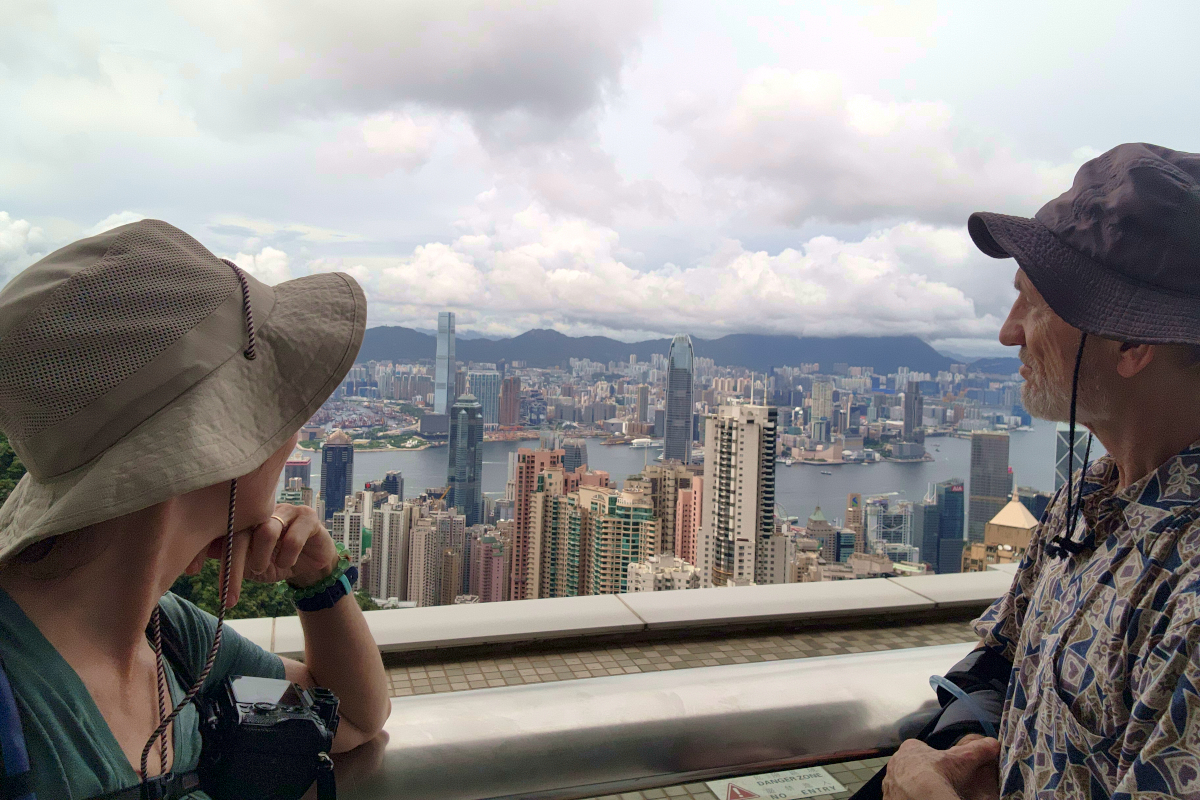
The real attraction up here though, is the view, of course. That’s why we came up here to begin with. Hong Kong has a very distinctive harbor, with a jungle of majestic skyscrapers on all sides out-Babeling Babel. It’s interesting, and surprising, that the hilly terrain makes the towers appear to tower even higher than they really do. You’d think that skyscrapers would appear taller on flat terrain such Chicago or Manhattan. But nope; the opposite appears to be the case, at least to our eye.
When you’re standing on a flat plane, your eye can’t take in the full sweep of a building’s height, and the sky doesn’t give you anything for perspective. From a hillside, however, you can get a better sense of scale, and the surrounding terrain provides a sort of measuring stick.
The tallest structure in the city, the International Commerce Center, seems to be even taller than the World Trade Center in New York. But is it? Depends on how you measure. It is indeed about 200 feet taller than the rooftop of the WTC; but the latter cheats by tacking a spire onto the roof that gives it an extra 400 feet.
The buildings on shore were once a mere side show, because Victoria Harbor, as it’s called, boasts a vibrant natural splendor with its rolling hills and bustling waters throbbing with boats and ships of all kinds. But in recent years, the towers have taken over the spotlight; but they still haven’t spoiled the view. In fact, they’ve pretty much enhanced it, at least so far. Hong Kong is proof that hills and forests and ocean waves can peacefully coexist with steel and glass. By they way, you can get a slightly higher vantage point by going to the rooftop observation deck of that half-spaceship building. But it requires paying admission, and it’s really unnecessary, as the view is quite regal from a slightly lower level.


Once our eyes have gorged on the scenery, we catch the tram back down the hill to its terminus, and then walk the rest of the way back toward the ferry terminal — not nearly so taxing, of course, as climbing up the hill.
Along the way, we pass a plaza where a few of the locals — who appear to have ended a day’s work, or are taking a break in the middle of it — are lounging with snacks, beer and cigarettes. This seems to be the norm, apparently made possible by a rather more lax attitude among city authorities than you’d find in the U.S. (We don’t know of a single place in the States where public drinking is tolerated.) It’s Hong Kongers being Hong Kongese to the fullest.
For the ferry voyage back home, we are careful this time to select the more economical option. It’s worth more, as far as we’re concerned, because it gives you more time to savor the sights of this incredible harbor. There’s an old song extolling the charms of a proposed “slow boat to China”. Well, we’re here to tell you that there’s also a lot to be said for a slow boat in China. Especially the Hong Kong part of it.
Events occurred 6/28/2025
Leave a Reply