

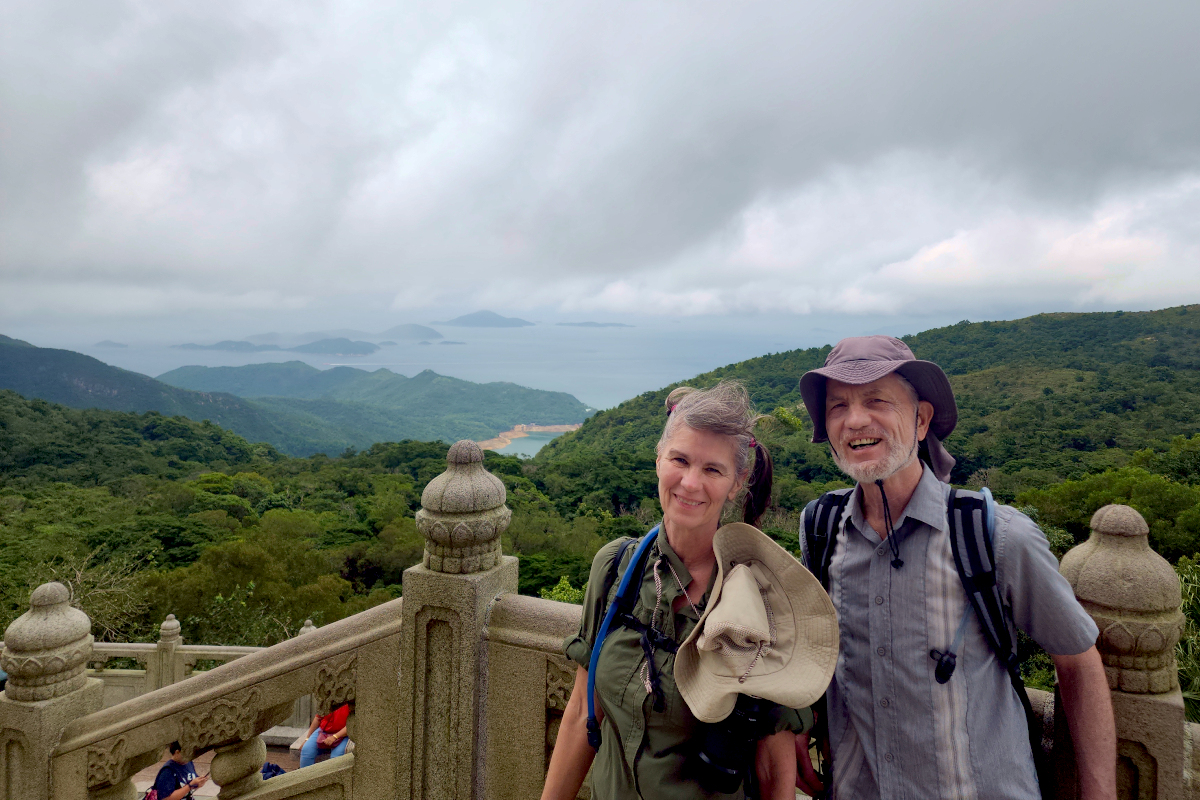
Hong Kong’s Lantau Island is not only a short ferry leap away from the heart of the city and an economical and tranquil place to stay, it has plenty of points of interest in its own right. One of them is the Tian Tan Buddha, better known as The Big Buddha. Erected in 1993, it’s one of the 5 oversized Buddha statues in China. So, since we’re staying on Lantau, naturally we have to devote the better part of a day to paying the Buddha a house call.
After an early morning stroll taking in the sights of Mui Wo, including water buffalo and the beach, we have breakfast and then hop on the Number 2 bus, which takes us over the mountain to the other side of the island where Buddha is waiting impatiently for our arrival.


The Buddha is next to Po Lin Monastery, which was founded in 1906. But the place where you arrive certainly doesn’t look like a monastery. It looks more like Disney Main Street — which is not too surprising, considering that Disneyland has one of it’s homes on this very island. (Though they don’t make it easy to get there — you almost have to stay at a Disney resort on the property, to which you go directly from the airport.) You pass through an ornate archway and come to a quaint faux “village” with a thoroughfare lined with shops, including a 7-11. And Coca-Cola is very much in evidence.
But so is the Buddha, towering 112 feet high — the second largest outdoor sitting Buddha in the world. And the fog in the mountains gives the whole place a mystical aura despite the best efforts of the commercial interests to spoil it. The path leading up to it is lined with statues of Twelve Divine Generals, sporting various kinds of weapons. Each general corresponds to a sign of the zodiac; but while Dennis locates his okay, Kimberly is unable to find hers.
The Buddha seems even loftier than it really is, because it’s perched on a hill; and there are 268 steps leading up to it. Hey, the climb is supposed to demonstrate that you are serious in seeking out the master’s wisdom. But don’t worry — if you have mobility problems, there are also discreet little side roads for small service vehicles to reach the top.


The statue is facing North, which is rather unusual; most of his brother Buddhas face South. It sits atop a three-floor platform patterned after the Tian Tan (altar of heaven) in Beijing. As you walk around the platform at the base, you see 6 devas (which may be thought of as something like Asian angels) offering gifts to the Buddha: flowers, incense, light, ointment, fruit, and music. These symbolize the “six perfections”: generosity, morality, patience, zeal, meditation, and wisdom.
The statue himself is made of bronze, weighing over 250 metric tons, and assembled from 202 separate pieces. The Buddha sits on a throne shaped like a lotus, a recurring spiritual symbol in Buddhism. Although there’s no charge for the privilege of trudging up all those steps to get close to the feet of the Buddha, there is a small fee to go inside and climb up a little more for a slightly better view. The inside has a spiral staircase, somewhat like the inside of the Statue Of Liberty, except of course not nearly as high or as crowded. Along the walls are some fascinating displays about the history of Buddhism. At least they look fascinating. We wouldn’t know for certain because there’s no English translation. And there’s no photography allowed — which is all too often the case at an attraction’s most interesting points.


Having finished with the Buddha, we descend the steps back down to the plaza, and the rain begins to fall, as rain has been known to do. And only one of us had the foresight to bring along an umbrella. Incidentally, the weather can greatly reduce visibility around the Buddha and pretty much spoil your visit, so it’s wise to plan accordingly. But it doesn’t happen to us — in fact, the rain soon clears off.
After hiking a short distance through a wooded area, we come to the Wisdom Path, which we wanted to include on our itinerary. But alas it’s closed, even blocked off with a bulldozer. So we guess we’ll have to remain foolish. The Wisdom Path, installed in 2002, features 38 wooden columns arranged in an infinity shape (a figure 8 sleeping on the job), each about 25 to 35 feet tall, designed to look like ancient bamboo tiles, and adorned with calligraphy. Right beside the trail leading to it is what appears to be an old hostel (perhaps it was a monks’ dormitory) it obviously has not been used in years, as the wood is crumbling and the bed frames are rusty. But in one room there is a package of plastic cups, so it looks like somebody has been using it for something.


Next we make our way to the Grand Hall Of Ten Thousand Buddhas, which has such a festively exquisite exterior, dragons and all, that the interior has its work cut out for it to keep up. And it does, in grand fashion. Bright, burnished, intricate details everywhere you look. We’re especially intrigued by the displays of miniature scenes accompanied by poems in Chinese with English translations. At a few tables, people are being served tea in what appears to be some kind of ceremony.


So are there really 10,000 Buddhas in the hall? Well, our Buddha calculator doesn’t run up that high, but there certainly are a lot of them, tucked into every nook and cranny and niche and corner. Some very conspicuous, and some more like Hidden Mickey Buddhas.
After finishing with the monastery, we consider taking the much-vaunted Ngong Ping cable car- an aerial tramway rather like a ski lift, except the gondolas are enclosed, and some even have glass bottoms. It sounds like a nifty thing to do, and it should offer some pretty good views. But we decide against doing it for three reasons. First, there are some very long lines to board it, especially if you don’t book in advance — which we didn’t. Second, it doesn’t go in the direction we need to go to get back home. So we’d have to either ride it roundtrip or catch a series of buses to return. Third it’s quite pricey: a minimum of about 40 dollars each, one way. That does it. We’re un-sold. So the upshot is that we retrace our steps, or rather our tire tracks, to get back home.


And speaking of Disney — which we were, you’ll recall — there is an odd Disney photo op spot near where we catch the bus, a little plaza with figures of Disney characters, a scale cutout replica of Cinderella’s character, and a big brightly colored outline of Mickey’s head, positioned so that it can frame the nearby Big Buddha on the hilltop. It’s a bizarre, yet somehow appropriate juxtaposition that epitomizes the character and variety of Lantau Island quite nicely.
Events occurred 6/29/2025
Leave a Reply