

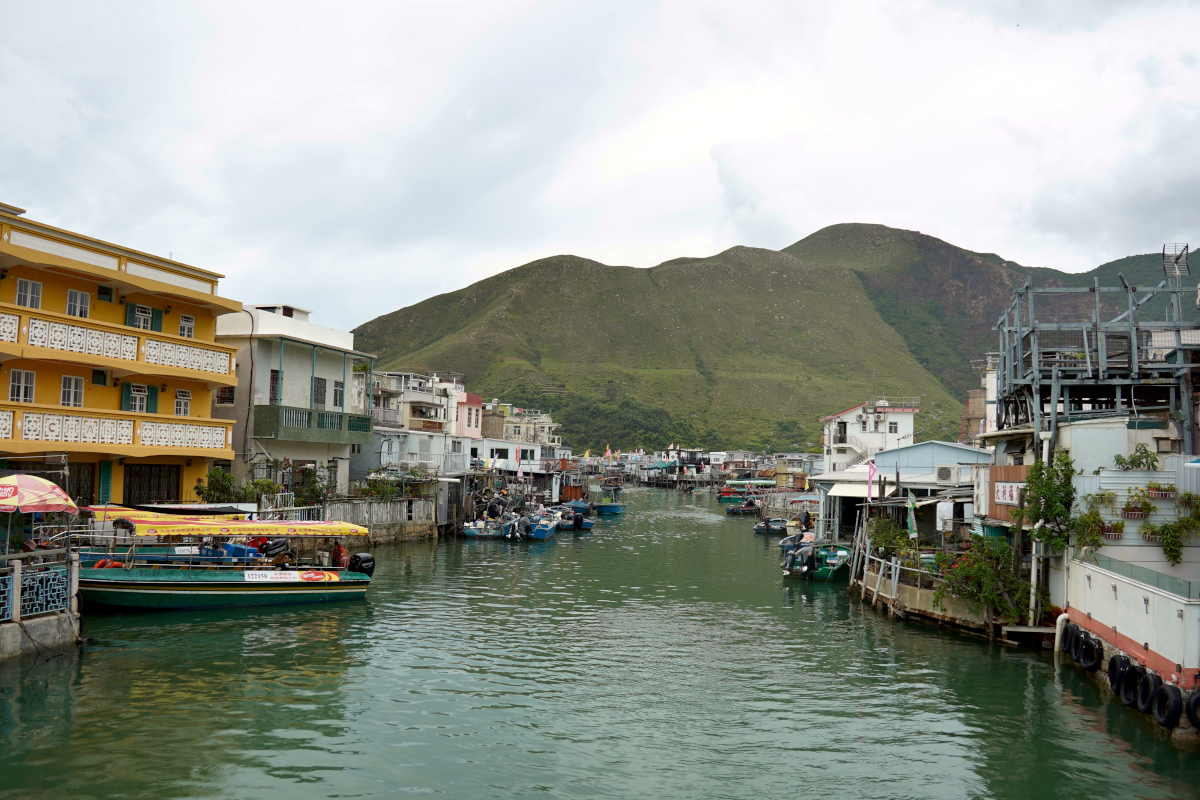
Staying on Hong Kong’s Lantau Island, we had an opportunity to visit the little fishing village of Tai-O, sometimes called “the Venice of Hong Kong” or even “the Venice of the East”. Though a large part of it was destroyed by fire in 2000, and fishing as a sustainable occupation is dying out in the village –so now tourism is becoming the big industry instead — it’s still a chance to catch a glimpse of, and immerse yourself in, the culture of a Chinese fishing village some three centuries old.
Starting out from where we are staying in Mui Wo, which is pretty much directly on the other side of the island, we check the balance on our “Octopus Card” for local transit. Yeah, yeah, we gave in and bought one, despite our initial misgivings. It’s practically impossible to get around without one. And we had used it the day before. Now we discover that it actually has a negative balance on it — the transit system spotted us a ride in advance, which sounds kind of generous of them; but on the other hand, we paid a deposit on the card, so they’re still not going to lose any money. Anyway, we top up, and we’re off.


Winding up over the hills on the way to Tai-O, we pass a reservoir and a prison — which perhaps could be thought of as a reservoir of wasted, or poorly used, human potential. At least the inmates have some gorgeous scenery, so things could be worse for them.
When we say that Tai-O is on Lantau Island, it’s only half true. Or even less. Most of Tai-O village is actually located on a separate island called (drum roll please) Tai-O Island. But it’s a tiny island, nestled up against Lantau like a piglet nursing, and separated from it by a channel no more than 50 feet across. So you could be forgiven if you just assigned the whole thing to Lantau.
But it’s really after you walk across the little Tai Chung Bridge onto the little island that you get to the heart of the village. Here you’ll stroll down narrow little streets (sorry, it’s hard not to use the word “little” in describing this place) lined with colorful little shops, and a few temples, including one that dates back to the 1600’s. One of the delicacies you’ll see displayed and sold aplenty is dried fish, a local specialty that people come here to buy and rave about. It doesn’t exactly float our boat, as it were, but hey. There are also the houses of the residents, built on stilts and covered with tin. The stilts help keep the homes cool, but we don’t see how the tin could help matters any.


As we walk down the thin passageways, we pass a small procession that includes half a dozen or so individuals wearing identical T-shirts, and a roast pig on a cart wearing no T-shirt. They seem to be headed toward a little temple for some kind of ceremony or other, which will probably involve feasting at some point.


The signs we see are in Chinese, of course, but some are accompanied by English translations. One that catches our eye is on a bench. It says “No beating guests” and “No farting”. We have to wonder just how big a problem those infractions are. And what the penalties are if caught.
It’s a must when visiting Tai-O to take one of the short (45 minutes or so) cruises on a little boat in an effort to spot some of the fabled Chinese Pink Dolphins that are endangered, but reportedly inhabit the waters around here. So we start looking for such a boat, and there are actually several to choose from. The first one we pass, at the entrance to the village, has a fare of 50 Hong Kong dollars (about $6.50 U.S.) so we continue farther into the village hoping that the next fare we’ll see will be different. Well, it is. It’s 60 Hong Kong dollars. So ultimately we end up going back to the first. And after we’ve waited for about half an hour (the boat doesn’t leave until it rounds up a sufficient quantity of passengers), we’re off. Alas, the dolphins are shy today, and we don’t see a single one. But we know they really exist, because we’ve seen photos. And photos never lie, do they? Guess we may have to return and try it again sometime.


After our unsuccessful tour — well, at least unsuccessful in the sense that we didn’t accomplish what we set out to, but we did have a nice little cruise in the harbor, so you can’t knock that — we strolled some more in the village, going to its outskirts, and up to a small pavilion overlooking the bay, where someone had abandoned, or deposited for safekeeping, a barbell (7.5 kilos). We encounter a man who points out that across the water in the distance, we can catch a glimpse of Macau. And indeed we can.


Then it’s back through the village, where we succumb to the temptation to sample something called “ginger bean curd”, which we’ve seen advertised on the front of a little (sorry, there’s that word again) restaurant. So we’re ushered through to a little patio out back where we are served the treat. It turns out to be a bit disappointing — basically it’s just tofu, on which you can pour a sweet sauce containing ginger. But we can savor the view of the canal, the stilt houses that line it, and the boats that navigate it.


Back outside, we see another pig involuntarily parading through the streets. And some of his escorts enter a little temple, which we also peek into, where they burn sticks of joss (incense). And then we come upon a little courtyard, where another group of celebrants are preparing to devour another pig (or maybe it’s the same one we saw earlier), now that it has fulfilled its ceremonial duties.


These porcine pets are called into service on any of a number of special occasions, public and private. One of them, which we just missed, was the Dragon Boat Water Parade (Tuen Ng Festival), which involves parading dragon boats towing sampans (serving as “god boats”) bearing sacred statues from the village’s four historic temples. And there are other festivities, culminating in a good-old fashioned dragon boat race. This festival is intended to pacify water ghosts and honor local deities. And just contribute to community unity and good vibes. Sounds like a winner. It just might give us another excuse to revisit Tai-O in the future. (Hold the pig, please.)


Events occurred 6/30/2025

Leave a Reply