

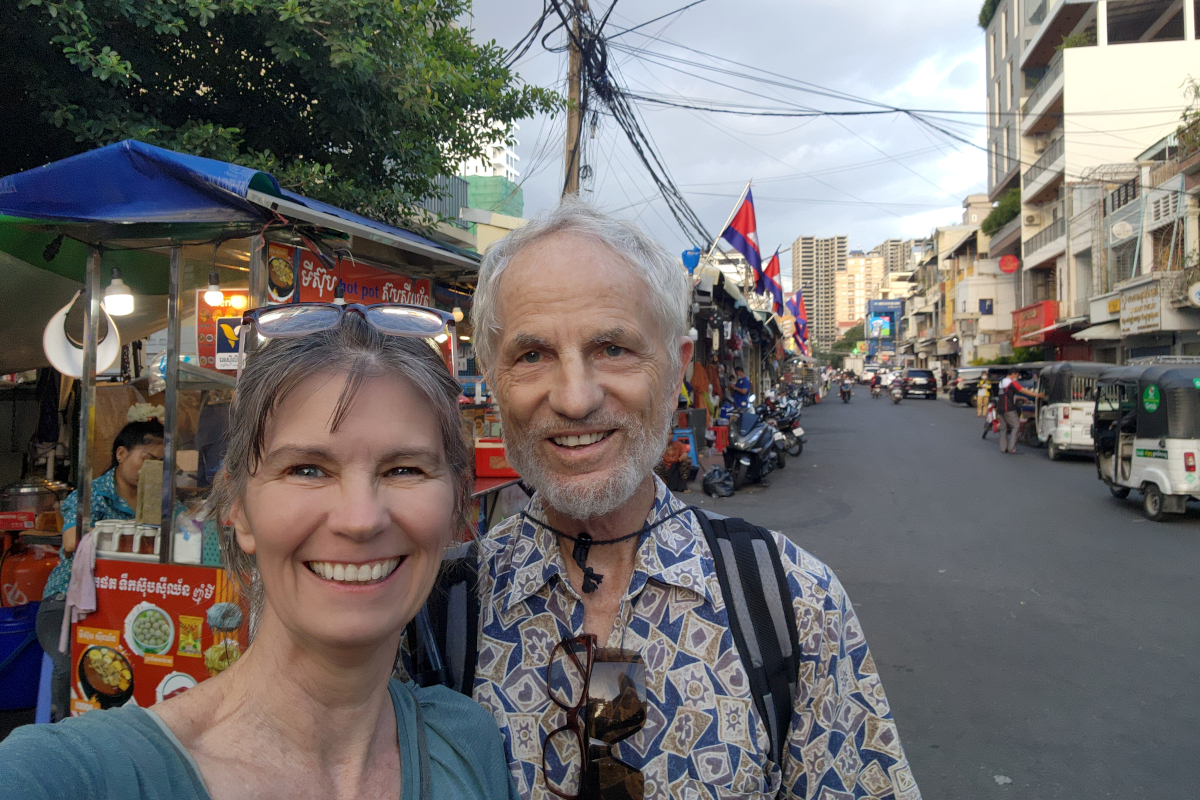
In the past few years, we’ve become global wanderers, but we’ve also become something else: regular school teachers in Phnom Penh — that is, in every other year. And so, having finished another year of traveling to many other countries (and volunteering at schools in some of them), we’re headed back to Cambodia for another year in the classroom.
Our last layover before Phnom Penh is for a couple of days in Ho Chi Minh City, which we’ve spent more time in on a previous visit. The largest city in Vietnam (population about 14 million, nearly two Big Apples), Ho Chi Minh was formerly known, of course, as Saigon. Sometimes it still is. In fact, that’s the name that appears on the train station as we pull in after an overnight ride from Hoi An.
We don’t play tourist much in HCM/ Saigon this time around. We do get down to check out “Book Street’, which as its name implies is a short pedestrian street totally lined with bookshops. And we make it to the Saigon (former) Post Office, a French colonial building constructed in the Nineteenth Century, which now serves as a sort of museum. But it’s also still a functioning post office. There are booths selling lots and lots of vintage postcards (a couple of which we buy) that you can mail to friends and family back where you came from (which we do).


During our meandering through a local marketplace, Dennis finally stumbles upon several vendors selling Vietnamese coffee makers (known as a phin). He’d been searching high and low and in between ever since we breezed into Vietnam, but none of the stores he checked had them. And now here they are in abundance. He approaches one vendor and learns that the price is about 5 dollars, but he talks her down to 4. Bingo, a new coffee maker and a bargain to boot. Then the very next day he goes to a supermarket to get some grub, and lo and behold they are also on the shelf there. For a price of about… one dollar. Just goes to show you something or other.
And one other outing we undertake is dinner at a vegetarian restaurant called Hum Garden. It’s in an intriguing building that looks like an old house (a big house), with a gift shop on the ground floor and the restaurant upstairs. Very rustic decor throughout. The menu is enthralling and puzzling, and although the prices are about twice as high as we’re accustomed to paying in this part of the world, it still isn’t that expensive. The server brings us baskets to put our personal items in while we eat — a good idea, as we’ve been known to leave a belonging or two behind. The restrooms have some curious signs on the doors — a flower for the women’s and a pepper for the men’s. And inside, mouthwash is available free in some curious flavors.
The most interesting thing about Hum, however, is the exterior. It looks as if it can’t make up its mind whether to be a building or a forest. The front is heavily but tastefully covered in vegetation, and the front steps have an organic, storybook design. Somehow the whole thing reminds us of Into The Woods.
And that’s our last day in Saigon and our last day in Vietnam. The next morning, we catch a bus, which, to our relief (as it were) has a toilet aboard, and we’re off to Phnom Penh. (Ironically, we take an Uber to the bus terminal, then the bus drives around in the city for 90 minutes picking up other passengers, passing at one point the location where we caught the Uber.) It is, as always, a drive full of charming sights. Not only sights of sites, but sometimes even the sights of the traffic passing the sites. In this case, we drive for some time alongside a truck loaded down (in that extreme Asian manner that defies the laws of physics) with an enormous and strikingly handsome hardwood furniture piece.


The border stop at Mộc Bài (Vietnam) and Bavet (Cambodia) is about as smooth and painless as can be hoped for. It’s a short and quick line to get our passports stamped for exit. Though there is a bit of confusion when we go out the door and another agent checks them — he does not see Kimberly’s stamp at first and sends her back inside. After this is cleared up, we are in the No Man’s Land between borders. Our tour bus has also come inside and picks us up to drive us about 100 yards (which of course we easily could have walked) to the Cambodia entry border. Which is also a short and quick line.
Sometime after we enter Cambodia, and are on our way, we witness a motorcycle accident. One bike pulls onto the highway from a side road right in front of another bike barreling along that collides with him. The pilot of the side road bike is thrown to the pavement face down; and for as long as we can see, he’s still there. Ouch.
Arriving in Phnom Penh without a hitch, we make our way to our Airbnb, where we’ll be staying until we find an apartment. It’s in our old neighborhood, Tuol Tom Poung — our favorite neighborhood in the city. It’s a good mix of native culture and barang (western) culture, as many expats live there. It has supermarkets and shops that offer western-style items (e.g. oatmeal) that are hard to find elsewhere, at least at a good price. And the neighborhood is also shadier than most. No no, we don’t mean more dishonest or suspicious; we mean literally it has more trees. So taking a stroll in hot weather is more pleasant than elsewhere.


Tuol Tom Poung is actually the name of a marketplace, one of the city’s major markets; but the name also has become attached to the neighborhood around it. It’s also known as Russian Market, although there’s nothing Russian about it — the name comes from the fact that many Russians settled in the neighborhood in the Eighties.
One of our first items of business is to obtain SIM cards so we can have a local phone number. Fortunately, there’s a Metfone outlet in Tuol Tom Poung, so taking care of that is fairly easy — and cheap. What proves to be much more problematic, however, is becoming functional on our accounts with Telegram, the messenger app used by about 90 percent of the people hereabouts. (Most of the rest use WhatsApp. Many folks have both.) But finally we succeed.


To celebrate our return to “Gombujia” (as the natives call their country), we decide to eat dinner at a neighborhood restaurant. Our first choice is one that we discovered late in our previous stay: Golden Pumpkin, which has a good many enticing vegetarian options, many of them made with — you guessed it – Cinderella’s favorite vegetable. But the restaurant is closed — apparently, we’re chagrined to see, permanently. (In fact, the owners lost their lease at this location and are searching for a new spot. Fortunately, they still have another place in Siem Reap, but that’s much too far to travel for dinner.)
So we settle for our second choice: Sacred Lotus, which we discovered early during our previous residency and patronized every week for a long time — at least until we discovered Golden Pumpkin. The menu is more limited, but the food is tasty, the servings generous, and the prices quite agreeable.
On the way there, we walk past the marketplace, with its beehive of vendors hawking fruits, vegetables, sweets, roast fish, roast meat, raw meat dripping with blood, live fish thrashing around while waiting to be invited to dinner, and all manner of other things people might want to eat, cook, or fertilize the crops with — including some things we can’t identify.
About a block away from the restaurant, a tuk-tuk pulls up with a passenger who seems to be American. He asks us if we know where the Sacred Lotus is. Evidently both he and the driver, despite access to the latest technology, are unable to locate it — it is indeed a bit inconspicuous. He’s planning to stay there — there is a hostel on the premises as well as a restaurant. So we tell him to follow us. Just like locals. Which we have been. And are about to be again.
Events occurred: 7/30 – 8/4/2025

Leave a Reply