

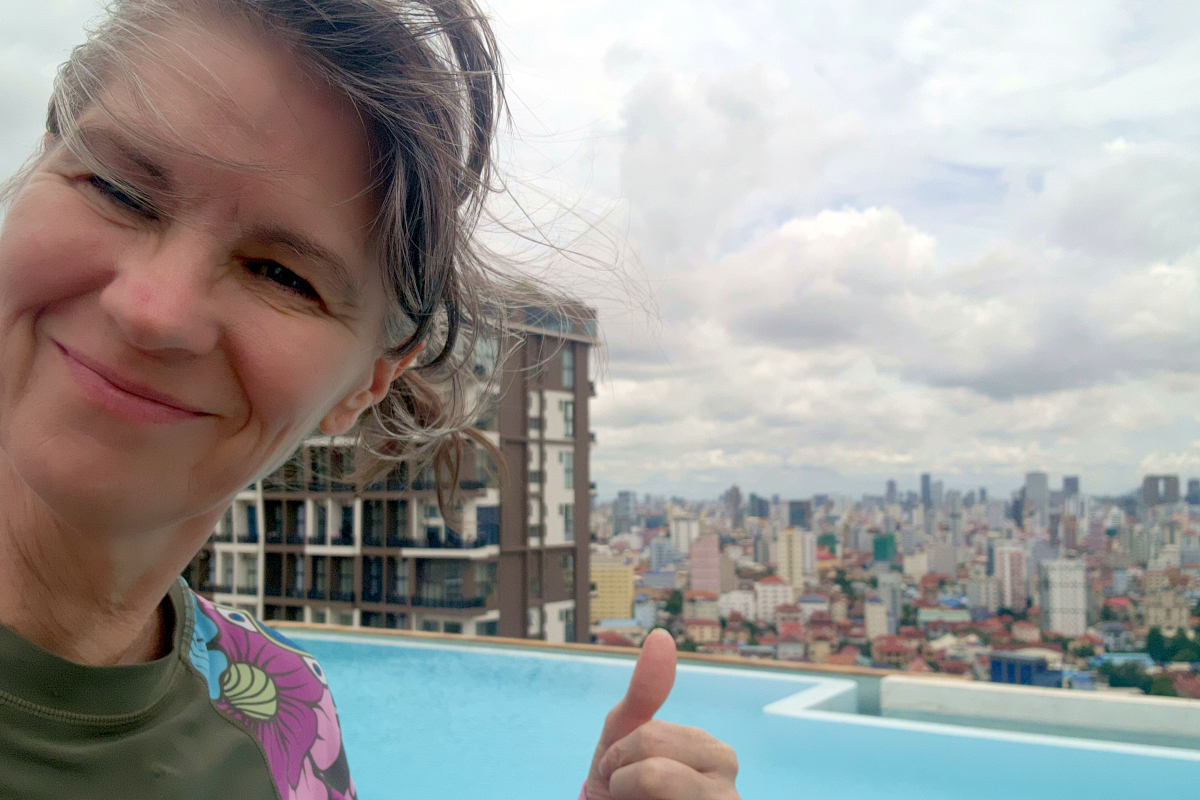
Having arrived back in Phnom Penh to settle in for a year of teaching school, we had to find long-term housing. Amazingly, we landed on the perfect apartment on our second day in town, and on our first day of searching. And we discovered other things in the city that would make our lives more agreeable during the coming year.
In our quest for lodging, we started out by just walking around in the Tuol Tom Puong neighborhood, which was our first choice of community. We found FOR RENT signs, we collected numbers, we inspected apartments. But they were all either more than we wanted to pay, or unsuited to our needs and desires for some reason or other. Many of these were priced at around 400 dollars or more per month; in the U.S., that would be a steal in such a major city. But in Cambodia, it’s a bit upscale.


Finally, despite misgivings that Dennis had, we contacted an agency that we located online, to see what they had to offer. Despite his suspicions that an agency’s rental rates would be higher than what we would find on our own, the first apartment the agent showed us turned out to be just the ticket. It’s in the Mean Cheay district, only about a 10-minute walk to our school and a 20-minute walk to Tuol Tom Puong. It’s also about a 10-minute walk to a produce marketplace, and about the same to Chip Mong Mall. Which is not the greatest of malls, but it does have a supermarket, a pharmacy, and a Japanese import store (selling many household products among other things) so we can conveniently acquire many of the items we’ll be needing.
The good supermarkets, though — the ones with a wide range of products catering to us “barang” (westerners) are in Tuol Tom Puong, so it’s convenient enough to still go there to do shopping on occasion. We soon discovered, however, that some of our favorite products are in scant stock because they come from Thailand, and the supply lines have been disrupted because of the border conflict. So some items eventually disappeared from the shelves altogether — including, alas, our favorite brand of soy milk. All because some supposedly adult folks can’t agree on where to draw a line in the dirt.
Our new one-bedroom apartment was on 13th floor. Yes, they really have those here. (Although, as we’d later discover, this building skips from floor 23 to floor 25.) It’s a corner unit, so we have an excellent view of the city on two sides, and some especially cinematic sunsets. There’s even a little balcony with a washing machine on it.


The place is furnished, though we did some rearranging to get it to our liking. And that included nixing the TV. While most folks these days seem to regard a TV as mandatory survival gear, we never touch the stuff. During our previous year in Phnom Penh, we had one in an apartment for an entire year and never turned it on once. The only practical use it provided was a place to hang wet laundry if it was raining on the balcony — and as a temporary perch for a pigeon that flew in one day through the open balcony door. So this time, we just had the landlord remove the TV, so we could use the wall for more vital stuff like posting our original artwork.
And the price tag for this cozy mini penthouse? A staggering 250 bucks a month — the same as our previous apartment, which wasn’t nearly as good. There would be additional for utilities, Internet and maintenance fee, bringing the total to just over 300 monthly. Oh, and the building also has a gym and a rooftop pool, each of which (or both of which) can be accessed for two dollars per visit. The pool quickly became a hit with us, especially with its sweeping view of the concrete jungle below.


There are new towers like this one springing up in the city all the time. Many of which, including the one containing our current home, are built with Chinese bucks. Our landlord is himself Chinese, a very likeable fellow who urged us to visit his country sometime, and showed us photos of some of its exquisite scenery. In the building’s office, he guided us through the paperwork, which we “signed” with a thumbprint, and presto, we were official residents of the residence tower. So we got our “keys”, which are actually little plastic tags with chips in them, and every time we swipe them at our door, we’re greeted by the sound of a cheery female voice welcoming us (we assume) in Chinese.
Then we set out rounding up the supplies and gear we needed, such as utensils for the kitchen. One thing we had a hard time locating was sheets for the bed — especially a top sheet, which is all but unheard of in Asia. Ultimately, we had to order the sheets from a little shop we found about a mile away, run by a lady with a daughter whom she was interested in enrolling in our school, perhaps. She was a very friendly and likeable single mom who told us that she might have to travel to France to take a DNA test to prove that she’s the girl’s mother. Evidently she’s been tangled in some very perturbing red tape.
Meanwhile, Dennis paid a visit to one of the little shops in Tuol Tom Puong to acquire something he’s been thinking about ever since our prior stint here: a traditional Cambodian musical instrument called a tro. This is a two-stringed viol tuned in fifths, with the bow strings actually placed between the two strings. (The opening in the bottom shell is covered with snakeskin.) When it’s played properly, it has a dulcet, plaintive sound like the wind through a forest. If you don’t know what you’re doing, it sounds like an asthmatic camel giving birth. Unable to find any instruction on how to play it, he resorted to trial and error, so it mostly ended up with a tone in the camel camp.


He also signed up for classes in Aikido, a martial art he’d been wanting to learn for years. And now that we’d be in one place for a whole year, it seemed like the opportune opportunity. So twice a week he’d be going to get his weight thrown around — and do the same to others. One of his fellow students was also American, a retired Marine Corps colonel from L.A. named Frank.
Although our old favorite local restaurant, Golden Pumpkin, is now closed, we soon found a new favorite, Magnolia Veggie — indeed, we’ve crowned it our favorite restaurant in the whole world. The food is not only delicious but imaginative; and unlike other vegetarian restaurants, which usually have only a handful of entrees to pick from, this one has a dizzying variety on its menu — and new options keep being added. (The fractured English on the menu is minimal; and a “mean course” has nothing mean about it.) Most selections are around four dollars each, so it suits our pocketbook as well as our bellies. We’ve made it a ritual to eat dinner there every Sunday night; the reason we chose Sunday is so that Kimberly can order an extra selection to take out and have it for lunch at school the next day or two. We’ve introduced many friends and colleagues to this restaurant, most of them carnivores, and they’ve all loved it too.


Another restaurant we’ve hit on occasion is Bong Bonlai (“Brother/ Sister Vegetable”), which has decent food at a pretty good price, but not nearly as wide a selection. It also has a dining area in a nice little courtyard under a huge tree, serenaded by geckos. But it isn’t mainly the food or the atmosphere that we go for; it’s the books. Bong Bonlai is in the lobby of a hostel to which travelers from all over the world come, leaving behind books (mostly in English) like a trail of bread crumbs. These have been assembled into a sizable lending library; anyone can go there and borrow up to 5 books for two months at no charge. With public libraries and decent bookstores hard to come by in Cambodia (we know of only one bookstore in the whole city in the same league as Barnes & Noble, and we’re not aware of any libraries at all), this place has been a godsend to supply us with reading material — and sometimes even resources for teaching.
So given all these things, we were set up rather well to make our home in Phnom Penh for a while. Our only real complaint about our new home was the noise pollution we sometimes had to deal with. For the most part, it’s a quiet neighborhood, especially 13 stories above the ground. But sometimes folks down below there have parties; and when they do, they generally crank up the amps for the benefit of our own eardrums. Fortunately, these parties usually wind up by 10:00 p,m. or so.
But the biggest offender is the wat (temple) about half a mile away. We’ve already previously voiced our pet gripe about the obnoxious din often emanating from temples, churches, mosques, etc. For a couple of weeks, beginning about a week after we moved in, the wat (and a magnificent wat it is) was conducting ceremonies every day, almost nonstop, starting as early as 4:30 a.m. and going as late as 9:00 p.m. This included monks chanting monotonously (heavily amplified for all to hear, of course), two of them blaring together at discordant pitches, nearly all day long, seemingly without ever pausing to take a breath. Actually, when you went down near the temple, it didn’t sound so loud; but up where we were, we apparently caught the soundwaves as they bounced off other buildings and picked up steam until they assaulted our ears like an auditory freight train.
Fortunately, it didn’t last forever. This particular series of ceremonial days evidently led up to Pchum Ben, a major Buddhist holiday (peculiar to Cambodia) honoring ancestors and departed loved ones. Once that was past, the temple celebrations were sporadic and not of such marathon length — and seemingly not even at such a high decibel level. So they became not only tolerable, but an integral component of the whole cultural immersion thing.
It was the height of rainy season when we arrived, and the street in front of our building, being lower than the surrounding streets, got flooded quickly, sometimes to a depth of 18 inches or more. Sometimes we’d see motorcycles or tuk-tuks struggling to get through it. Once in a while we’d see children swimming in it. One day we even spotted a man fishing in a vacant lot — though what he possibly could hope to catch or why anyone would dare to consume it, is anybody’s guess. All just part of the weird, wacky, wonderful mosaic of street life in Phnom Penh.


For our part, we’d soon have access to bicycles that would allow us to navigate the low seas just fine. And much of the time, we’d be looking down on it from our lofty lookout, with ringside seats to the thunderstorms, a display of celestial pyrotechnics seemingly made to order just for us.
Events occurred: August 2025

Leave a Reply