

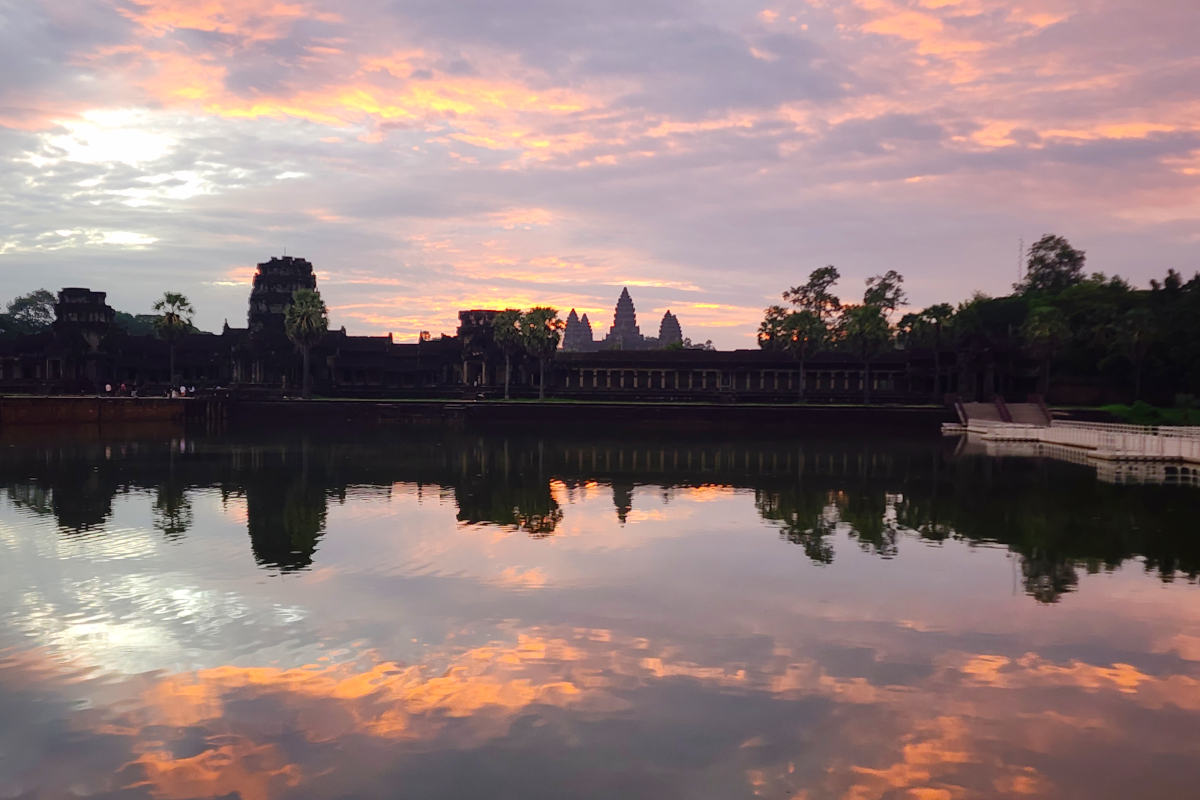
Angor Wat was on our bucket list for many years, but we’d finally crossed it off — three times, no less. But one thing that was still on the list was Angor Wat at sunrise. Well, we finally were able to hit that one too, as we visited the celebrated landmark recently with three guests from the States: Jenny, David and Jose.
We left our homestay in Siem Reap at 5:00 a.m. to be there in plenty of time. Our driver dropped us at Angkor and went to round up some coffee. Staking out a spot on a little wall on the other side of the moat from the temple, we were able to witness the sun drench the landscape in gold right from the beginning of its dance.
Golden Sunrise at Angkor Wat
Our vantage point was excellent for a panoramic view, but we figured that maybe next time (if there is a next time, which is entirely possible) we might try the other side of the moat, viewing it up close and personal, and see how that angle from up closer suits us and our camera.
In particular, we might want to return during the vernal or autumnal equinox, when the sun rises directly over the big dome, resembling (so we hear) a light bulb sitting atop the building. (A 100 wat bulb? Ouch.) It seems like too much of a coincidence that the sun would be in such perfect alignment during those two times, so unless somebody is moving the sun into just the right position, the ancient architects must have positioned the temple very deliberately.


Once the sun was fully illuminating the premises, we began checking out Angkor Wat itself– the fourth time for us. But there’s still so much to see, so many little details carved into the walls all around it, just waiting for you to coax them out to play. It would be possible to come here and spend an entire day examining the carvings in just one little section of wall. We always notice something new every time we come. In fact, this time we spotted what appears to be a depiction of a soldier giving someone the bird. Nine hundred years ago.


Banteay Kdei
Up next was Banteay Kdei, a temple dating from the Thirteenth Century, of the Buddhist flavor — in fact it was still used by Buddhist monks until 1960. One of the most distinctive features of Banteay Kdei was a pool on the grounds used for bathing exclusively by the king and his wives.


Preah Khan
Then it was Preah Khan, another Buddhist temple, completed in the 12th Century. It was rather like a city within a city, encompassing not only a temple but a Buddhist university. There were about 98,000 attendants who came and went here, including 1000 teachers and an equal number of dancers. Yes, dancers. Today, the main inhabitants of the area are termites, but fortunately they can’t devour the temple itself.


For lunch we went back into town and ate at The Golden Pumpkin, which used to have a sister restaurant and namesake in Phnom Penh, and we loved to eat there. Unfortunately, it closed. So we were delighted to learn of the existence of this one in Siem Reap, and knew we’d have to patronize it when we had an opportunity. Four of our party of five are vegetarians; and while Golden Pumpkin isn’t an exclusively vegetarian restaurant, most items on its menu do come in vegetarian mutations. As the name suggests, many offerings on its menu (though not all of them) are concocted from pumpkin, including an enticing pumpkin dessert, which we gave in to and shared.
Neak Poan
Then it was back to the park for an afternoon of touring some lesser known structures, including Neak Poan, which is small but especially curious. It was built on a little artificial island (the lotus blossoms in the water were erupting in full pinkiness) in the Twelfth Century, during a Hindu phase, and was essentially a hospital, or at least a sanitorium/ spa.


There are four pools, representing the “four elements” of antiquity, in which the afflicted or seekers of better health bathed. The structures are undergoing heavy restoration, perhaps more than any other temple in the park. (David and Jose, who are very good at doing on-the-spot research on their phones, helped dig up some tidbits about this and the other sites we visited.)
East Mebon
Chief on our afternoon’s agenda was East Mebon, though it took us a while to figure out its name. We just remembered it as the “elephant temple”, because its terrace features a very realistic statue of an elephant on each of its four corners. Finally, we tracked it down, with the aid of our driver.


Constructed in the 10th Century — a full two centuries before Angkor Wat– East Mebon was dedicated to the Hindu god Shiva. Like Neak Poan, it was placed on an artificial island; but unlike Neak Poan, the reservoir around it is now dry.
East Mebon also stands out because it is one of the structures in the park where brick is in evidence. Brick was actually used extensively in some of the earlier temples before sandstone became the chic material, but the brick walls were covered with stucco, so in most places they are not so conspicuous. Here, they bare their innards for the world to see. And not only was there some restoration going on here, but there appeared to be some sifting through the soil — we were apparently watching a real Cambodian Indiana Jones at work.
And that wrapped up our second day of our three-day pass. The following day, we’d have only the morning available before our visitors hightailed it to the airport to zoom back to Bangkok, and thence back to the U.S. But in that half day, we would discover two “new” temples we’d never seen before, and they would be very much worth the effort to get to their more remote locations –just as it was worth the effort to drag ourselves out of bed in order to observe the unique spectacle of the sunrise over Angkor.
Events occurred 8/12/2026
Leave a Reply