

For the better part of two days, we’d romped among the ruins of Angkor Archaeological Park — our fourth time for us, and the first time for our American visitors Jenny, Jose and David. And now the three of them were leaving, making their way back home. But their flight was not until late afternoon, so that left us another half day of archaeology. Since the three foreigners had to book a car anyway to take them back to the airport, we decided to use it to transport us to out of the way temples that we hadn’t seen before — especially since the latter of which would put us closer to the airport.
We booked the services of the driver from our homestay, whom we’d been using already, for the day. This came to 65 dollars, which might be a good deal in the U.S., but in Cambodia it sounds rather steep. Anyway, the driver is a good dude, and it was convenient to engage him, so there we are.
Angkor Archaeological Park is a sprawling complex spanning over 150 square miles. Most of the tourist traffic is concentrated in one little cluster of ruins that include the better known landmarks like Angkor Wat, Bayon and Ta Prohm. But if you have the time and the will, there are also overlooked treasures off the beaten track; they just require a few more miles of driving. And that’s what we were up to on this final day.
Bantaey Srei – Pink Palace
Up first was Banteay Srei, roughly 20 miles north of the popular hub. Banteay Srei is a very small, almost miniature, Hindu temple constructed in the 10th Century. What makes it so distinctive is that it’s composed of red sandstone, which boasts the double punch of being highly carvable and highly durable. So it was inscribed with a great deal of detail, and that detail has stood up quite well over the past millennium. There are intricacies and depth of relief in these walls that we have not seen anywhere else. And, owing to the variety wrought by weathering, original material and restoration material, there is even some breadth of color. (This is the one temple, by the way, where we spotted a handicapped accessible sign — and someone taking advantage of it.)


Jenny, the artist in our group, had been especially keen to visit this temple. Ironically, she wasn’t able to savor it fully because she was severely suffering from food poisoning. (When she got to the airport later, attendants noticed how out of sorts she was and whisked her off to the airport hospital — who knew there was such a thing, right? Where they gave her an IV to replenish her fluids and electrolytes. For a time, there was some doubt that she’d be able to make the flight. But not only did they all get aboard on time, but they were given an upgrade. So there’s your handy travel tip for the day: to obtain a free upgrade, just eat something putrid and let nature take its course. You heard it here first.) But she soldiered on and ambled through the site along with the rest of us.


Prasat Beng Mealea
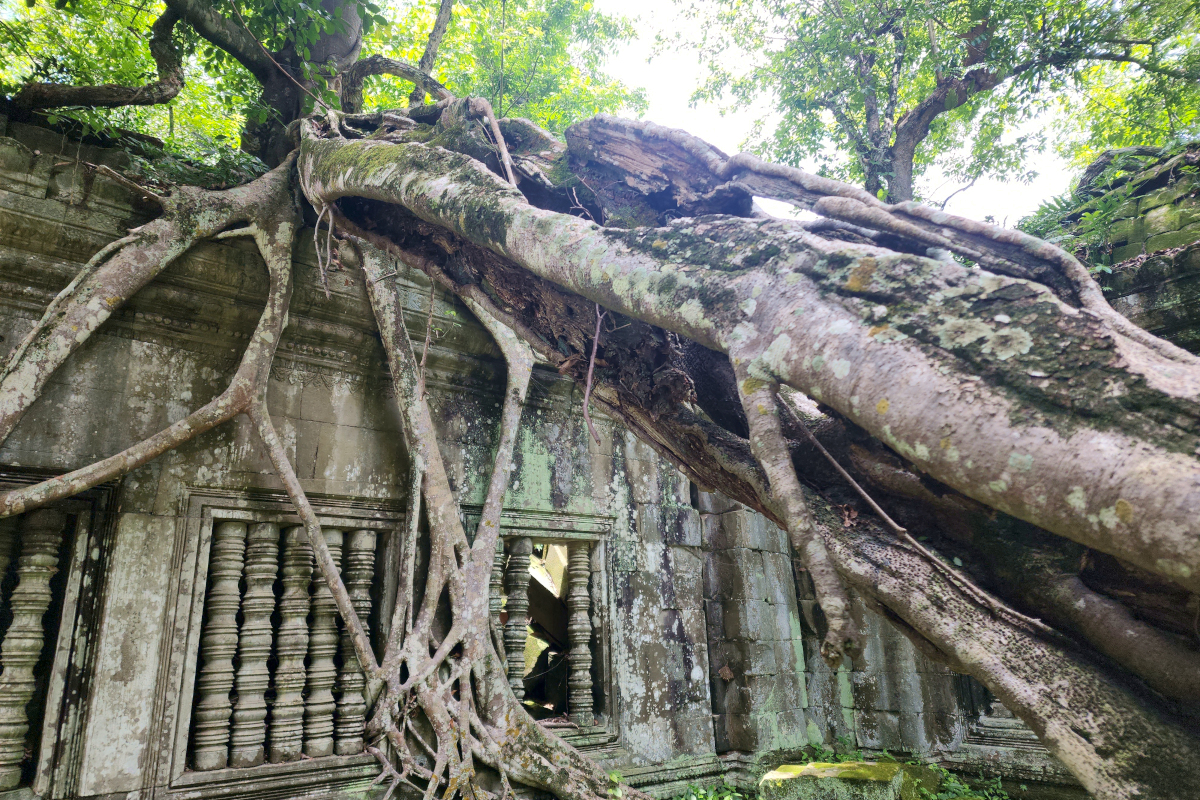
Finally, we drove another 10 to 15 miles to Prasat Beng Mealea, another first. Little is known about its history, but because of its architectural style it is believed to have been constructed around the same time as Angkor Wat, i.e., in the 12th Century. It was quite astonishing to see, because unlike the other temples, there has been little effort made to restore it. About half of it is still standing, and the other half is a pile of rubble, some assembly required. After seeing temples dedicated to gods like Shiva, Brahma and Vishnu, it was quite a switch to find one dedicated to the god Ikea.
It has been left mostly the way it was found in order to give visitors an idea what these ruins looked like when first discovered; and it’s an effective objective. When we walked down the wooded path and came upon its entrance surrounded by a mass of chaos, we felt like archaeologists discovering the site for the first time. Well, at least until we went around to the side and ascended the wooden stairs to the overpasses that give you a view from above. Still, the effect was stunning and gave a sense of the battle between human endeavors and Father Time, with the latter getting the upper hand. What a fantastic way to wind up our fourth tour of Angkor.


After that it was off to the airport to deposit our three companions, one of whom was barely standing. And back to the homestay for us, where we stayed for another night to get a fresh start back home in the morning. Being the penny pinchers we are, we opted not to fly back to Phnom Penh, but to undergo a 7-hour bus ride instead. And “bus” is here a euphemism for a packed minivan with dysfunctional AC.


But it was worth all the inconvenience for having made the rounds of Angkor once again, and showing it to some folks from back in the States. And for having discovered the two extraordinary temples on the last day, both of which we decided we had to add to our list of favorites. We just might feel compelled to see them again whenever we have a fifth tour of Angkor.
Events occurred 8/13/2026



Leave a Reply