

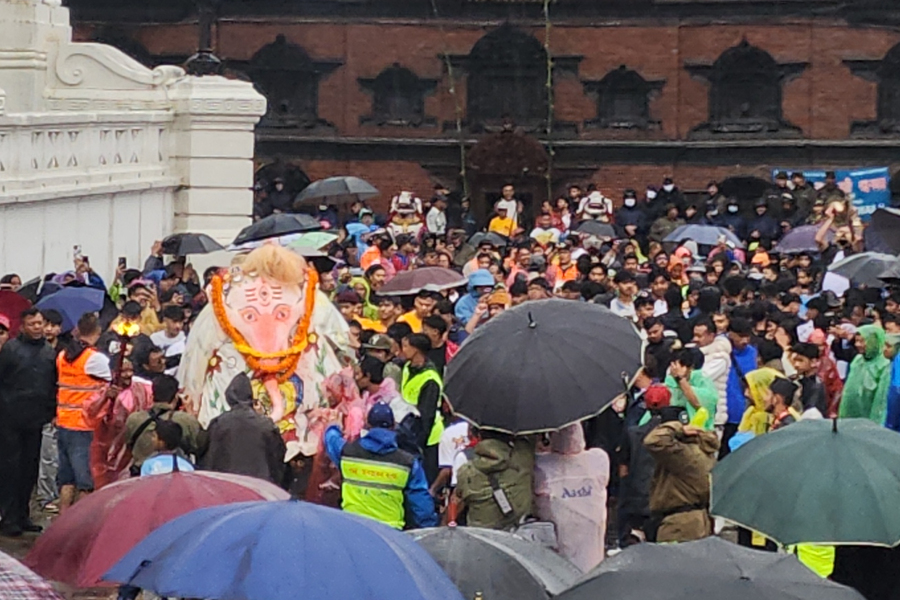
After finishing up our Workaway volunteer teaching assignment in Bhaktapur, we went back to nearby Kathmandu, where we hoped to witness part of Indra Jatra, an eight-day autumn festival of the Newar people. Celebrated in the Kathmandu Valley since the city of Kathmandu was founded in the 10th Century, it combines tributes to Lord Indra (god of rain and heaven), the harvest season, ancestors, and the Kumari (“living goddess”). We’d already sampled a foretaste of it in Bhaktapur, but Kathmandu is the real epicenter of the occasion.
Arriving in town in the morning, we checked into a nice little apartment for a couple of days. Well, perhaps “little” is a bit misleading, because it was a two-bedroom apartment, each with two beds. First time that’s ever happened. (We gladly would have traded one of those bedrooms for hot water in the shower.)


Then we headed on over to Durbar Square, the ancient heart of the city, to catch the festivities. Since Durbar Square is a UNESCO World Heritage Site, admission is charged for foreigners to get in. And we already had obtained passes from our previous visit a couple of weeks earlier. Except…. we didn’t know we’d be returning (the decision to cut our stay in Bhaktapur short and spend more time in Kathmandu was rather spontaneous) so Dennis apparently had disposed of his pass.
But we decided to wing it anyway; many times, if one of us flashed a pass, nobody would ask to see the other one. And if we did get called on it, we would tell them we were on our way to the office to see if we could get the pass replaced. As it turned out, there was no cause for concern, because with all the people coming and going for the event, nobody even bothered to check for tickets.
When we entered the square, a group of journalists had already staked out their privileged viewing spot on the steps of an old pagoda, but it was clear that nothing would be happening anytime soon. From what we could determine by searching online, everything would kick off at about 1:00. But when it comes to scheduling in Nepal, all bets are off (as we’d be confirming soon enough).
Swet Bhairav


Swet Bhairav concealed and revealed
A couple of centerpieces had already been brought out of their hiding places and put on display. Both are ferocious looking masks representing Lord Shiva. In fact, one of them, called Swet Bhairav, has such a terrifying aspect (perhaps it depicts Shiva after he’d gotten up on the wrong side of a cloud) that it’s only revealed in full on this special occasion. The rest of the time this mask, which dates back to 1795, is concealed in a temple, only partially visible to devotees. The other mask is called Akash Bairav. It’s pretty fierce looking as well, but not so much so as to be made a hermit. During the day, it’s decorated in various gaudy accessories.
Akash Bhairav


(Akash Bhairav earlier in the day and later after adornment)
And we noticed that the ancient-looking oversized wooden chariots we’d seen being refurbished a couple of weeks earlier were being readied to be put into service. Apparently, they were not really antiques at all, but faux-antique ceremonial objects.
Wooden Chariots


(Chariots being prepared weeks earlier in 1st photo – ready for the event 2nd photo)
It soon became evident to us that we’d be needing to have lunch before the afternoon was over. And we didn’t want to leave the confines of the square, because we were afraid we would encounter the issue of getting back in without one of us paying another admission. The pickings were slim for dining on the square, but one thing that did look enticing was a little momo establishment, which billed itself as the best in town, having been around since 1962, etc. etc. In the absence of better options, we considered it worth a shot.
Wait, what is a momo, you ask. (And you did ask, didn’t you?) It’s a traditional snack that is essentially a steamed or fried dumpling with various types of fillings. For our purposes, the only option was a cheese and vegetable filling, though we were afraid they would be too cheesy, and hence too fatty. Well, it turned out they weren’t at all; in fact the cheese was hardly noticeable. Each of us received a generous little plateful of them for about $1.25 USD. A local woman who was also purchasing some and appeared to be a loyal customer explained the sauces and seasonings for them available on a little condiment stand. They were a welcome addition, but with or without them, the momos lived up to their billing. They provided a satisfying lunch, with a few of them left over to take home.


After our leisurely meal, it was still at least an hour before the activities were scheduled (or at least Schrödinger scheduled) to start, but we thought it best to go ahead and plant our feet on a viewing perch. This, we ultimately decided, was on one of the tiers of the steps leading up to a pagoda; from there, we figured, we could get a fairly good vantage point of the goings-on.
Naturally, more and more people began filling in next to us, behind us, in front of us, and just about every other practical preposition. Which wouldn’t have been so bad, except that it was raining part of the time, so many people (including us, we must admit) opened their umbrellas, which made it even more problematic to get an unobstructed view.
We did get a good view of the police, who assembled right in front of us. Which is to say, at least one variety of police. Between national cops and city cops and Durbar Square security and military and we don’t know what, we counted more than a dozen different types of uniforms. But only one unit carried firearms, what looked like Rambo-issue automatic rifles. (Well, except for a certain troop that wore vintage uniforms and carried vintage rifles just for show.) Otherwise, the police appeared to be armed only with cudgels, as seems to be typical in Nepal. (We sometimes see security guards carrying one of those traditional curved daggers called a kukri. But no firearm.)
At one point, the police chased away a couple of teenage girls who were standing next to us — we gather that it was because the section where we were waiting was, at least implicitly, reserved for tourists, and the girls were local.
But there was another person next to us who got away with standing there the whole time who was also a local, at least originally. But he also sort of qualified as a tourist, as he had recently spent 13 years living in Texas. He moved back, in large part, because the social environment in the U.S, and especially in the South, is not exactly hospitable toward foreigners of color these days, and he suggested he was afraid of ending up in a concentration camp even though he was there legally. Although he had worked for years in graphic design, he was now content to help out at his family’s bakery, there in Kathmandu. (We were really hoping to pay a visit to the bakery later, but it was rather out of the way.) He spoke excellent English, and explained to us some of the proceedings, which he had witnessed many times before when growing up nearby.


But the proceedings did not proceed presently. Not beginning at 1:00 nor even at 2:00. It was a long, long buildup, during which we saw many of the participants come and go and get ready for their big moment, but the big moments seemed to be determined not to arrive. Then finally, at last, mini-parades began to occur, of some of those uniformed contingents. There were also two smartly dressed bands that each played a couple of tunes (one of them Nepal’s national anthem). They even played a couple of tunes at the same time, and we’re not sure just how that happened.
There were masked dancers, particularly noteworthy among which was some guys (intoxicated, our companion informed us) dressed in an elaborate and elaborated elephant costume, a tribute to the elephant god Ganesh.
And then the large wooden chariots rolled out, one of which bore the Kumari, the embodiment of the “Living Goddess”, whom we’d already encountered before. She is a prepubescent (in this case 6 years old) girl chosen to represent the goddess Taleju. Since her feet are not allowed to touch the ground outside her compound, she was carried out to the chariot. As she rolled through the crowd to cheers, those on her vehicle tossed sweets to the throng. As did a group of dignitaries who appeared on the balcony of a white building that is the seat of government — the Nepalese “White House”. (We’d previously gone inside and had a look at the grand stateroom used for special assemblages.
The appearance of the Kumari seems to have been the climax, although attendees would go on partying well into the evening.. But our new friend decided it was time to call it a day, so we did too. And then we realized that we’d been standing there for four solid hours, much of it in the rain. Time certainly flies when you’re attending a mesmerizing festival in a country you’ve never been to before.
Events occurred 9/25/2026
Leave a Reply