

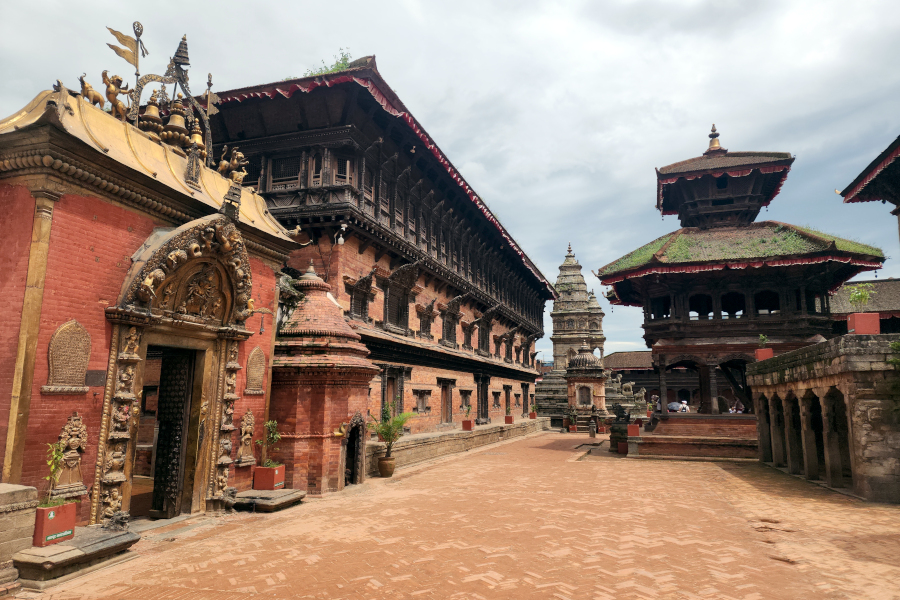
Having spent a few days playing tourist in Kathmandu, we were ready to take off to our next volunteer teaching gig through Workaway — to another Nepal capital of sorts, Bhaktapur, which was only about 10 miles away. Kathmandu and Bhaktapur are two of three cities –the other one being Lalitpur (aka Patan)– which were made into rival capitals by rival royalty in 1482. Before that schism, Bhaktapur had been THE capital for centuries. After that schism, the kingdom was split into three independent city states, which is how things stood until the formation of the modern nation of Nepal in the 19th Century.


After our taxi (booked through InDrive, a low cost booking app) dropped us at our homestay in Bhaktapur, our first order of business was to pay admission to the town. Or at least to the central part of it. We’d had to do the same thing in Kathmandu to enter Durbar Square, the historic sector of the city. Well, in Bhaktapur, the historic part of town takes up nearly the whole town. So at an office just down the street, we shelled out 1000 rupees (about $6.50) each for the keys to the ancient kingdom. And as we’d soon find out, any time we entered a historic area, which was quite often, someone would ask to see our tickets. These passes were good for one week, but we could extend them for the length of our stay, at no additional cost.


With proper authorization thus in hand, we set out to place our footprints all over the stones paving the narrow, winding streets in this eye-popping ancient municipality. We did watch our step, though, because the stone and brick streets can be tricky to negotiate, especially when they get wet and slippery. Plus, Nepalis seem to be championship spitters, and in Bhaktapur in particular, people are constantly expectorating wherever they are.
Everywhere we look, we see signs of the traditional lifestyle on display. And that includes Nepali numerals on license plates (Nepal is the only country we’ve been in that does not use Arabic numerals.) And the Nepali calendar — according to which it’s the fifth month of the year 2083.
Instead of staring at their phones, the locals are mingling on the streets, having conversations just as they would have centuries ago. This area features a high concentration of an ethnicity called the Newar, who have a distinctive language and culture — and their brightly colored traditional clothing is much in evidence.
One conspicuous aspect of Newar life is the hundreds of porch-like structures throughout the city called falcha. These raised brick and stone platforms with tiled roofs are traditional spots for gathering and socializing. Men in particular mingle there and play cards or board games. Women also gather there at times, though you’re just as likely to see them sitting on stoops knitting.


Our ramblings take us to Pottery Square, which is a square where pottery is made. And sold. Pottery has been a staple of this region, particularly among the Prajapati caste of the Newar tribe, for a millennium or longer. Here in Pottery Square, you can watch the clay being shaped on wooden wheels, see the finished product being dried or displayed in the sun, and if you are so minded, take home a vessel for a souvenir or gift. You can even have a go at making your own.
Naturally, we also spent some time being wowed by the historical architecture of Durbar Square. There is a Durbar Square in each of the three capitals; “durbar” means something like royal palace. So these were the centers of palaces and major temples, dating back to the 14th Century. All three Durbar Squares, as well as other sites in these cities, are UNESCO World Heritage Sites.


Some of the these structures have been heavily damaged by earthquakes over the centuries — most recently in 2015. And the damaged buildings have not always been rebuilt; as a result, most of them have been lost forever. Of 99 royal courtyards that once stood in the Bhaktapur area, only 15 are still extant. Considering how awe-inspiring the complex is now, it must have been beyond belief in its day. If you squint a little walking through these neighborhoods, you’d swear you’d been transported back in time. At least until you’re accosted by one of countless hustlers at the entrance to the Square offering you a tour or a taxi ride to somewhere or other. The 1993 film Little Buddha, starring Keanu Reaves as Siddhartha (Buddha before he became Buddha) was filmed at these historical sites in Bhaktapur, Kathmandu and Lalitpur.


The big things in Bhaktapur — the architectural marvels — are quite stunning, but the little details are also impressive. In front of many houses, we kept spotting little rounded stones covered with flowers, rice, incense, or some other commodity. These are chaityas or pati-stones — small sacred shrines or protective threshold markers tied to Newar Hindu-Buddhist tradition. They serve as household or community altars, where daily offerings of flowers, rice, and incense are made to honor deities and protect the home.
Many of the doors on houses and other buildings are heavy antique portals with intricately carved details. It’s also very common to have brass doorknobs sculpted in the form of some deity or folkloric emblem. (An elephant head is a frequent choice.) In the house where we were staying, even a padlock on the door was a work of art.
On our first day in this homestay, our host (who was also our liaison for the volunteer position) informed us that the clouds in the distance were unusually cleared away, and he invited us to go up on the roof to get a view of the Himalayas, an opportunity rare at this time of year. So we did, and sure enough there they were, those inimitable craggy, towering, ivory rocksicles on the horizon seeming to reach halfway to the moon.


The host family was warm and friendly toward us, and overall it was not a bad place to stay. Our one objection (well, aside from having no hot water in the shower and having to traipse up or down stairs to the bathroom in the middle of the night) was the meal situation. We had come with the understanding that we would be able to cook our own meals, which is what we always prefer; we’re rather finicky eaters, and usually have meals earlier than most people, we gather — though we like to be able to just eat when we’re hungry rather than sticking to a schedule.
But upon arrival we were told that the kitchen was off limits, and we were expected to have meals with the family (and apparently even cough up some moola to cover the expense). Well, we tried this for a couple of days, and we’re glad we did. We do enjoy an opportunity to sample the local board (including, in this case, a kind of bagel-shaped bread for breakfast that is only served on a specific holiday, which it happened to be — specifically the Nepali version of Fathers Day), and it gave us a chance to chat and get acquainted with the family, which we thoroughly enjoyed. But it soon became apparent that this arrangement just was not going to work for us.
So what we settled upon instead was making ourselves a breakfast of fruit and/ or oatmeal — we at least were allowed to access the electric kettle at the entrance to the kitchen, so we could make tea and oatmeal. Lunch would be served to us at the school on days we were volunteering. And for dinner, we’d alternate between preparing a salad in our room or eating at one of the nearby restaurants, all of which had very reasonable prices.
The first restaurant we tried out was Baiga Vutoo, a quaint and tiny eatery that has been in existence “since 2080”, according to the sign out front. It’s very folksy in design, decor, cuisine, and operation — it even offers cooking classes in Newari cuisine. The cooks preparing the food are entirely visible, behind a rustic counter and grill, a tableau that looks like a painting of traditional Newari village life. (We later discovered a restaurant that we liked better, but we’ll get to that.)


Arriving on Friday, we expected to go to work teaching on Monday. But on Sunday we informed that the school had decided at the last minute to take a holiday the next day. This sort of thing apparently happens in Nepal more than infrequently (as we’d also seen it happen in India). So when Monday rolled around we were feeling a bit of the blues because of having a few rugs pulled from under our feet.
Then we heard the sound of a band playing, and looked out to see a log procession rolling out of a courtyard and headed toward the Square. We followed it and found a celebration of some sort going on. We didn’t know what kind, but during the day we noticed several other bands, each in its own uniform (or at least matching T-shirts) marching through the streets, and some of the musicians played traditional Nepali instruments. People were dancing and laughing and making merry all over town, so it was really hard to be glum under the conditions.


It’s been said that even though there are 365 days in a year, Nepal has 366 holidays. Nepalis certainly seem to take advantage of any and every excuse for a festival or a spontaneous shindig. It was going to be a fascinating two weeks in Bhaktapur.
Events occurred 9/11-13/2026 (Bhadra 26-28, 2083 BS Newari calendar)

Leave a Reply