

Our first full week in Bhaktapur unfolded like a vivid tapestry of color, ritual, and discovery. As mentioned before, the school where we had been engaged to volunteer through Workaway was closed on our first Monday in town. As we understand it, that was for the occasion of Children’s Day, which was the day after Nepali Fathers’ Day; but there are so many holidays and festivals in Nepal that your head spins trying to keep tabs on them all.
This Monday also coincided with a festival called Haritalika Teej, (or just Teej), a three-day Hindu celebration in honor of the Goddess Parvati and her union with the Lord Shiva. Observed in the Nepali month of Bhadrapada (August-September), it’s a festival for women in which they get to both feast, then fast, then feast again.


On the first day, there’s a big family gathering with the guys doing the cooking. On the second day the women fast, which means abstaining from both food and water. But at least they get to dress handsomely, in red and gold. Married women pray for their husbands’ health and prosperity, and single women pray to find a husband to pray for. Then on the third day, there’s a ritual cleansing.
Monday was the second of the three days, when the ladies were on their one-day drastic diet. But they didn’t let that sap their energy or dampen their spirits. In the early evening, they gathered in the square, decked out in their red and gold, and did some exuberant dancing.


Meanwhile, while neither feasting nor fasting, we were making do with our awkward meal situation at home. On alternate nights, we’d be eating out, which is not something that we do a great deal of. On the other alternate nights, we’d be having salad assembled in our room. Which turned out to be generally both tasty and filling.
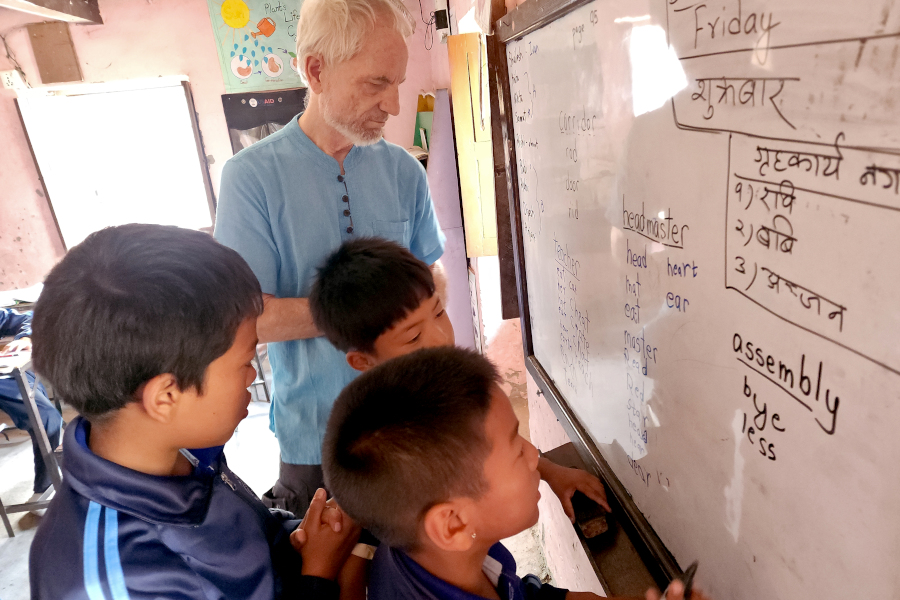
On Tuesday, we finally got to have a crack at volunteer teaching in the school, about a 10-minute walk away. We had no trouble getting up on time, because at about 6:15 we were awakened by the blaring of music in the street just below our window. Was it party goers or festival revelers getting an early start? Nope. It was the garbage truck, playing a peppy song with its speaker cranked up at full volume, and aimed almost directly at our window.
This, we would discover, would be the routine almost every day during our stay. (We’ve witnessed similar musical refuse vehicles in other cities in this part of the world — Kathmandu, Rishikesh, India and later in Jaipur, India.) Not having a knowledge of Nepali or Newari or whatever tongue the tune was trilling, we don’t know exactly what the song was saying, but presumably it was exhorting the locals to be good citizens and dutifully organize and contribute their household waste — one word we did make out was “Bhaktapur”. Well, since collecting garbage is a chore that must be done, we suppose you might as well put a cheerful spin on it. But does it really have to be right outside our window? Every morning?
When we reported at the school office in the morning, we were invited to participate in a little ritual to commemorate a special occasion. (Which one? it really hard to keep track of them all.) This entailed placing a symbolic cord around our neck and partaking of some symbolically significant foods including a slice of apple and a piece of flatbread. We felt like members of the extended Nepali family. Someone asked us if we were Hindu or Christian, apparently assuming there were no other options. We always find it awkward being queried about religion; the best answer we can give is none of thee above. But sometimes we feel that the most diplomatic answer is a little bit of everything, which was the answer we gave on this occasion. Practioner of none, student of all.


After teaching classes in the morning — and we were indeed teaching, not merely assisting — we had lunch in the tiny school dining room, where one person cooked and served. The lunch on the first day was dal (lentil) soup and flattened rice — which the locals call beaten rice, but they pronounce it “bitten”, which sounds less appetizing than it is. As the name suggests, it consists of rice (roasted or parboiled) that is pounded flat, and consumed crunchy. It’s a staple in Nepal, where it’s mixed with less dry items, such as the soup, so that the whole mixture can be consumed in the traditional manner –i.e., with the fingers. But the lunch lady was kind enough to provide us with utensils to dine in the manner to which we are accustomed. She made a fuss, by the way, if we attempted to wash our own dishes, but we sometimes did so anyway. The students by the way, are all responsible for washing their own dishes after lunch.
That night we tried out a new restaurant, and are we ever glad we did. It turned out to be quite a find indeed. It’s called Mayur, and it’s located right there along the square in one of those classic old buildings. This one, dating from the 14th Century, was apparently constructed as someone’s residence, and it’s a good bet that the someone was not a peasant.


The entrance is about four feet high, so you have to stoop to get in. And once you’re inside, it looks like you’ve stepped into the magic wardrobe. Most of the dining area is in a sunken courtyard. (There’s a glass roof retrofitted so you don’t get wet if it rains). And the stone enclaves are full of objects-d’art and museum quality knickknacks. Oh, and the food is pretty dang good too. And while the menu is a bit pricier than most of the other local restaurants, the portions were generous and it’s still a steal by American standards. Mayur immediately became our go-to when eating dinner out.
By Wednesday, we’d pretty much established our schedule at school, which would begin with an assembly in front of the building (since there was not sufficient space inside), where students did some stretches, accompanied by banging on a drum (a standard practice at schools in Nepal and India) and singing a couple of songs. One of which, of course, was the national anthem. Nepal’s national anthem is the only one in the whole world that is a waltz — normally, they’re made to march to. But Nepal’s patriotism is the kind you move to gracefully and elegantly rather than stomp to. Intentionally or not, this triple meter echoes the shape of the national flag, the only one in the world that is not rectangular — it is, instead composed of two triangles,


Our schedule involved teaching four sessions each in the morning, then lunch at 1:00, and we were done for the day. Mostly we taught English, though we were sometimes called upon to teach science, math and a bit of geography. All in a day’s work. Additionally, we began working with the students on some skits to be performed for the rest of the school at the end of our gig.
The first graders (of which there were only two) learned to perform Gingerbread Man. The fourth and fifth graders (7 students combined) learned a scene from one of their textbooks about respecting parents and elders. The second grade… well, we struggled with them, trying to teach them one song and then another. Finally we decided the best choice was “I’ve Been Working On The Railroad”. And the third grade, our star thespians, started rehearsing one of our old workhorses, a Russian story we performed for many years (during our past life as touring educational performers) under the name Simple Ivan — though we generally rechristen it Silly Boy (or Girl). Our male lead for this edition was outstanding, one of the best Ivans we’ve ever had.
On Thursday we stopped on the way to school at a little photo and printing shop to have new passport photos done. Each of us had only two of them left, as we had each used up two in renewing our passes for Bhaktapur historical center. For those passes, the photos were trimmed down a bit, and since the proprietor of the shop saw a great many of these (he was right next door to the gateway) he had the notion that everyone wanted photos of the smaller size, even though we’ve never seen them used anywhere else. And thus, even though we clearly told him that we wanted the standard visa size (for most countries) of 35 by 45 mm, he printed the small ones, and we had to have them done again.


Thursday’s school lunch consisted entirely of what we would call… well, junk food. Or at least snack food. Little chips and flakes and nuts and so on. Of course, the junk food here is, like the junk food in India, more intriguing (and probably at least a tad more nutritious) than the junk food back in the States. Still, it seems like meager fare for growing kids to get them through a day of work and play.
After we’d eaten some of ours, the lunch lady also brought us and the other teachers (though not the students) a dish of yogurt that was a welcome addition. It was homemade yogurt, a craft for which Nepal is deservedly noted. Nepalese yogurt is rich and naturally sweet and thick with the fatty layer of cream on top — somewhat like the American brand Brown Cow, but even better. It might be hell on the arteries, but it’s heaven on the taste buds.
Not gonna lie, teaching at this school could get chaotic. Although there are not a lot of students, there is also not a lot of place to put them. They’re jammed into classrooms in a house that was clearly built to be a residence. The noise from adjoining classrooms bleeds over into others, so there’s often a great deal of hubbub to contend with. Still, this is a fun group of students and teachers to work with.


And despite a couple of minor drawbacks to our living arrangements, we thoroughly enjoyed spending time in Bhakatapur. We never knew what was going to pop up next. Just strolling in the historic district, we were likely to come upon… oh, for example, a long procession of young monk acolytes in their saffron robes. Or a string of colorfully clad local citizens just lounging around and shooting the breeze.


And the architectural details continued to reveal themselves, like shy animals gradually inching out of the brush. Finally, this included the Peacock Window, which we’d heard so much about. The peacock symbolizes beauty and immortality in Hindu and Buddhist traditions — we’d already seen a carving of a peacock conspicuously displayed high on a pedestal in one of the squares. The Peacock Window, however, was rumored to be really special. It was commissioned in the 15th Century by King Yasha Malla — who, according to legend, was so overwhelmed by the workmanship that he ordered the artist’s hands amputated to prevent him from duplicating or surpassing the feat, unless with his feet. Royal folk have a different style of expressing gratitude, we suppose.


We knew where the window was supposed to be, more or less, Google Maps does help some, but we were still having difficulty zeroing in on it. And then at last there it was, smaller and up higher than we might have expected, but every bit as radiant as our expectations. Carved in hardwood, the peacock spreads its tail out in a complete circle, with its feathers, individually carved, forming a lattice. If the artist really did become incapacitated after completing this project, it was a glorious way to end his career.
Even at the house where we were staying, we were exposed to customs and traditions that we might not have been aware of otherwise. During this week, the host family hosted a ceremonial gathering, and lit a series of ghee (clarified butter) lamps that are a part of the Hindu and Buddhist traditions, symbolic acts of purification and illumination. Not to mention they sometimes serve as offerings to Lakshmi, the goddess of wealth, and that couldn’t hurt.
Our time in Bhaktapur was largely devoted to assisting in the education of local youngsters. But it was shaping up to be quite an education for us as well. It was what one might call… illuminating.
Events occurred 9/14-18/2026

Leave a Reply