

As enticing as the Nepal city of Bhaktapur is, with its rich history and culture, it was hard to be so close to the Himalayas and not get a better view of them. We’d already had our appetites whetted by a fleeting glimpse of them darting between clouds on the rooftop of the house where we were staying with our host family. But we wanted more, dang it. And we had two weekends available during our volunteer assignment through Workaway.
Fortunately, there was a place not far away where we just might be able to snag such a view of the legendary mountain ranges if the weather cooperated: the village of Nagarkot, high up in the foothills. It was only about 10 miles away from Bharaktapur as the crow flies, but it takes us wingless critters about 45 minutes to get there on a very winding road via bus.
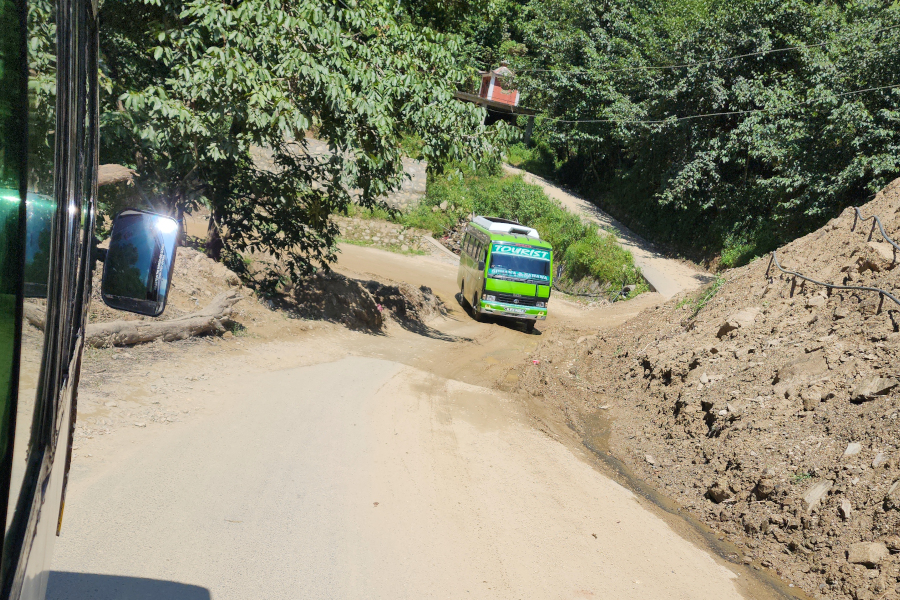
Our first weekend outing to Nagarkot was a one-day exploratory venture, to see if we thought it worth returning the following weekend for an overnighter. Early on the first Saturday morning (well, relatively early) we trekked to the bus stop and caught a bus up the hill. And taking a local bus in Nepal is quite the adventure. The bus doesn’t leave until it’s fuller than full. And then it picks up more passengers along the way. But in addition to bodies, it’s loaded with all kinds of freight. Bags and boxes of merchandise of various sorts, and sometimes trays of goods to be sold by the street vendors accompanying them.


And it’s a very curvy, tortuous route, sometimes squeezing past other vehicles (including other buses) coming from the other direction. Oh, and to make it even more interesting, there’s one place where part of the (single) lane has crumbled away, along with the shoulder, leaving a precarious drop. The bright side is that the fare is cheap: 95 rupees (about 62 cents) per person.
The bus deposited us on the edge of town, and the first order of business was… to have breakfast. Hey, we got an early morning start, so we brought it along with us. For Dennis, it was fruit and nuts. For Kimberly, it was her usual: oatmeal. But she likes to have fruit with it, and this morning there was none to add. Not to worry — the bench we parked ourselves on for our morning repast was right next to a banana seller, so for about a dime, she picked up a fresh banana to complement her rations.


With breakfast in our bellies, we began hiking on the wooded, hilly trails around town. It was colorful, especially as it was adorned with glimpses of local life, and encounters with the natives — one of whom was a girl trying to sell us refrigerator magnets. But we saw no compelling reason to return the following weekend. We did notice that, as in a mountain village we visited in India not terribly far from here, the foothills were lined with thousands of terraces dug by ancient farmers.


And then, as we were about to wrap things up, we passed by a couple of rural hotels, and decided to see if we could stop at one of them and have a cup of tea before heading home. The one that looked most enticing was called Hotel Green Valley — even though it’s on a hill, but hey, it overlooks a green valley. And it was a fortuitous choice indeed. The tea was outstanding — some of the best we’ve ever had. (It was prepared in the Nepalese/ Indian style, spiced and milky.) And the restaurant had a superb view of the mountains.


On the way out, as we were settling up the grand bill of 120 rupees (78 cents) at the front desk — because that was how they did things — we asked the desk clerk if it was ever possible to see the Himalayas from the hotel. He said it absolutely was at the right times, which mostly occurred in November and December; the rest of the time, there are usually too many clouds in the way. And he showed us some photos that confirmed there are indeed magnificent views of those ivory crags at the proper times. We also asked, mostly out of idle curiosity, about room rates, and were informed that at present it was 4000 rupees (about 25 dollars per night). This, we thought, sounded quite reasonable for the quality of the facility and its location. So we began cooking up a scheme for our imminent return in an effort at trying to beat the odds and actually get a decent view out of season.
On the way back down the hill, the bus was again packed, but it made more stops to discharge passengers. One of these was a gentleman who had mobility problems, and probably should have been in a wheelchair — as if there were any opportunity to transport one on this vehicle. Instead, several other passengers, some of whom may have known him but others probably didn’t, helped him off the bus and across the road to the front of a house he was trying to reach. It was a heartwarming display of neighborliness.


And we were the recipients of a bit of it ourselves after the bus reached its destination in Bhaktapur. Getting off and paying the fare, we walked a few blocks, heading home. When we came to the entrance to the historical district, there was, as usual, someone lurking about to ask for our passes. Kimberly showed hers, then Dennis reached for his, but… it was gone. With a touch of horror, he realized that it must have fallen out of his wallet, where he’d been keeping it, when he paid the bus fare.
So we hightailed it back to the bus stop and began looking around on the ground, finding no trace of it. A couple of guys inquired what we were doing, and we explained as best we could with a bit of a language barrier. They urged us to go back onto the bus and look, which we did. A couple of them dug around in the seat cushions and turned over the floor mats. No dice, and no pass. Meanwhile, they were spreading the word to everyone else in the vicinity. Soon it came out that a man had seen a boy pick it up off the ground. The folks had further discussion among themselves in their own language, and a woman apparently reported that she had seen the boy hand it off to a man. Finally, that man came forward, and he did indeed have it, and presented it to us. Phew. The pass didn’t cost a great deal of money, but it would have been a bit of a hassle to replace. (Although we discovered a couple of times that if the two of us were together, only one of us need display the magic ticket.)
Return to Nagarkot
The next Saturday, we took another trip up the hill. Actually, two trips. Because before docking at the hotel, we wanted to investigate a pedestrian suspension bridge that we’d spotted from the bus, and was calling our names. Trouble was, it was about halfway up the hill, so it was not practical to visit the bridge and then hike the rest of the way up unless you were in for a really strenuous workout — particularly when toting backpacks. So we just made the first day of our two-day trip a two-trip day.


This is the Bageshwori Nagarkot Suspension Bridge, otherwise known as Rani Jhula. It spans about 820 feet across a forested ravine and the Sali Nadi Rver gorge, looming some 400 feet over the valley floor. When we got off the bus early in the morning, almost nobody else was around to spoil our photos. But then we made the mistake of tarrying for breakfast again, and by the time we finished, the hordes had started storming in. And we do mean hordes: one impossibly long line of young people (high school or maybe college) started snaking up from the valley toward the bridge, and they just kept coming and coming and coming. Strangely enough, however, they didn’t seem terribly interested in the bridge, but in continuing to hike farther up the hill. Masochism is wasted on the young.


We managed to get some decent photos of the bridge, relatively uncluttered by other bodies. And then once we’d sufficiently taken in the views. we hiked down the hill to the road, to catch the bus back home at a different point from where we got off. It was a rather challenging route, down a steep path that we sometimes had to negotiate by hunkering down on our rear ends to place our feet on the next level. But we passed a couple of guys who had harvested grass/ hay/ straw bearing it in huge bundles on their backs, and a stream with stepping stones and a rustic “organic hostel”, and voila, there we were at the bus stop.


Once back at home, we had lunch, packed an overnight bag, and we were off again to go right back up the hill. But this time we hit a snag or two. To save time (we thought) and to have a more comfortable ride with our bags, we’d decided to book a car instead of taking the bus again. But that proved to be easier said than done.


First, we tried it with the most common app in Nepal (InDrive), but in tracking the driver’s progress, we saw that he stopped before coming to our homestay, and wouldn’t come any farther. So we cancelled him and tried another one. Same thing again. Then we walked a short distance to the entrance of the historical square, as we’d seen lots of tuk-tuks gathered there before. But again, the driver we booked stopped short of our destination.
Then a man standing nearby saw what we were doing and came over to tell us that on weekends, vehicles are forbidden from entering the historic district. So we walked a few blocks to the end of the street where the blockade was set up, and sent for yet another driver. This time he showed up; but he informed us that because the ride was so far and up such a hill, he’d need to charge more than what the app told us — about THREE TIMES as much. So we told him to get lost.
Then we sent for another driver. And the same thing happened again. Finally we concluded that we were just going to have to bite the bullet and pay the exorbitant fare if we didn’t want to be delayed even further by walking all the way to the other side of town to the bus stop and than riding a bus up. But we were none too thrilled — not just because the trip was more expensive than we expected, but because the fare specified on the app and the fare demanded by the drivers didn’t jibe — and in fact were not even in the same galaxy. Surely in this high-tech age somebody could get things together better than that.
Our disgruntlement quickly melted when we arrived at the hotel and checked into our comfy room with a balcony and — oh joy oh bliss — a hot shower. One of the things we didn’t like about the house where we’d been staying in Bhaktapur was that we had to take cold showers; and the weather got a bit crisp at times. But here we were in the lap of luxury, at least relatively.


We had our dinner in the lobby restaurant where we’d had the phenomenal cup of tea, and the food was also pretty impressive. One thing we ordered was the vegetarian version of a Newar specialty, which featured a fried egg in the center of the plate, surrounded by samplings of various vegetable and legume concoctions, as well as a very crunchy berry (or was it a bean) we couldn’t identify, and also a serving of the crunchy Nepal staple they call “beaten rice”, though they pronounce it “bitten rice”. Our tummies went to bed quite happy that night.
The next morning we were up before dawn in hopes of catching the sun peeping over the Himalayas. And we did, kind of sort of. The clouds and mist were not as cooperative as we would have liked (and we knew we were bucking the odds at this time of year), but we did grab a fleeting glimpse of the shy peaks showing their faces on the horizon. We can only imagine how grand it must be when the skies are clear. But all too soon, the clouds came rolling in, stealing the show.


After checking out, we stopped in the restaurant again to have another fantastic cup of tea before catching the bus back down the hill — a bus which, because it was the middle of the day, was far less crowded than previously.


So let’s see. A nice hotel room with a hot shower. A balcony glimpse of the Himalayas. A great regional meal. And a phenomenal cup of tea. All in all, it was worth what we paid, even with the inflated car fare.
Events occurred 9/13, 19-20/2026

Leave a Reply