

There are basically two ways to see Prague, or any other city. You can get up close and detailed, singling out individual points of interest to dig into. Or you can get a broad overview. In Prague, you can get an overview by literally getting an overview — i.e., a view from a hilltop, namely Petrin Hill, which looms more than 400 feet above the level of the Vltava River. And having already investigated a number of those points of interest at close range, including Charles Bridge and the Astronomical Clock, we decided that our last day in the city would be devoted to the grand panorama from this lofty vantage point.
The name Petrin comes from the Greek and Latin word petra meaning rock (as in petrified and petroleum) because… well, there are a lot of them on the hill. Supposedly. But the rocks mostly seem to be hiding from you under a mantle of lush vegetation — including a rose garden, which alas is not in bloom during our visit. Many of the rocks, however, have been abducted over the years — over the centuries, in fact — and used in construction projects. Some of them are hiding out anonymously in those buildings in the heart of the city.
To reach this elevated lookout point, you have three options, assuming you have no vehicle or bicycle or motorbike or horse. There’s a funicular, which seems like a really cool way to move up in the world. Unfortunately, we never can seem to catch it in operation. There’s a bus, which takes you nearly all the way up. And there’s the good old shoe leather express. Without the option of the first, we resort to the second two.


The bus drops us at an odd double obelisk of a tower that resembles something from 2001: A Space Odyssey. It’s actually a ventilation tower, an ultramodern take on an ancient technology used to keep buildings cools by circulating currents of air. This one is taller than most at 160 feet. It just doesn’t look that tall because, like an iceberg, most of it is brooding below the surface. It’s a style of architecture known as Brutalist, which uses exposed raw concrete and bold projectile elements, as if a building is starving to death and its bare ribs are poking out. It was considered chic during the communist era when it was constructed, but nowadays is generally considered just too brutal.
This tower doesn’t really ventilate a building as such, but a long (one and a quarter mile) tunnel that runs beneath the stadium next to it. This is the Great Strahov Stadium, which is not so great anymore because it’s hardly ever used. But at one time it was the venue of large scale synchronized gymnastics events. And we do mean large scale: its field is three times as long and three times as wide as a soccer field, which by our math gives it 9 times the total area. That, plus its capacity of a whopping 250,000 spectators make it the second largest sports venue in the history of the planet. (The largest being the Indianapolis Motor Speedway.)
The stadium was also the site of some major history, some of which was not exactly worth bragging about. It hosted a parade in honor of Hitler’s 50th birthday, and it was used as a staging area for Jews being shipped off to concentration camps. In later years, it hosted rock concerts by some major heavy hitters including The Rolling Stones, Pink Floyd, and U2. More recently, it’s just been left abandoned like a laptop without a hard drive. There have been talks about converting it into a shopping/ dining/ hotel moneytrap, but so far no go.
Meanwhile, the ventilation tower still stands, pumping cool air beneath it like a respirator keeping a brain-dead patient alive. It stands as a monument to a failed school of architecture and two failed authoritarian regimes. But mostly it just provides a cool photo op.


Technically Strahov Stadium and its ventilation tower stand, not on Petrin Hill itself, but on… well, Strahov Hill. But not to worry, Strahov is Petrin’s little sister. It’s only a very short trek from one to the other.
Walls for the Hungry: King Charles IV’s New Deal
One of the first things you notice on Petrin is an extensive wall about 15 feet high. Constructed as a line of defense between 1360 and 1362 under the order of King Charles IV, it’s commonly known as the Hunger Wall. And no, it’s not because the top of it resembles a row of teeth. But because it was built during a time of famine, providing jobs, and thus income, to the poor –and isn’t it refreshing when a ruler alleviates poverty rather than exacerbate it. There’s even a legend that His Majesty actually applied his own royal hands to the labors, but it’s unlikely that he really went that far.
There’s Brána do Královské obory Stromovka (the Gate to the Royal Game Reserve Stromovka), in the form of a miniature neo-Gothic castle that looks medieval, but — fooled you — it was actually built in the 19th Century. It commemorates a popular and massive city park that began life in the 13th Century as… well, a royal game reserve. In keeping with the spirit of the bygone age it conjures up, the faux-medieval gateway is adorned with authentic looking coats of arms.


There are also a couple of imposing churches perched up here. The larger one is the Cathedral Of Saint Lawrence, rebuilt in a Baroque style between 1739 and 1745. Its three copper-green spired domes really pop out at you from a distance. The other church, a much smaller one, is the Church Of The Archangel Michael. But it’s off limits these days, having been pretty much annihilated by a fire a few years ago.
Eiffel’s Octagonal Twin
But the piece de resistance of Petrin Hill is Petrin Tower, which was inspired (and quite obviously so) by the Eiffel Tower. But don’t you dare call it a duplicate. For one thing, being octagonal, it has twice as many sides as its Parisian cousin. Still, the design is so similar that you could be forgiven if you mistook it for a twin at first glance. It’s also, at 208 feet, only one-fifth as tall as the Eiffel, though being up on this hill, it has a bit of a head start. And guess what? The height of Petrin Hill plus the height of Petrin Tower is exactly equal to one Eiffel. It’s almost like they planned it that way. The tower opened in 1891, two years after the French structure, and — quite conveniently — the same year as the funicular that hauls visitors up to see it. When it’s actually running, that is.


Originally constructed as a lookout tower, then adapted for use as a transmission tower, it’s now converted to a tourist tower. The admission price of 250 crowns (about 12 dollars), however, may seem a bit… well, steep by local standards. There are discounts, for kids, students, seniors, and handicapped. Oh, and if climbing the 299 steps to the observation deck is beyond your skill or will, there’s an elevator available for an additional 150 crowns (7 dollars).
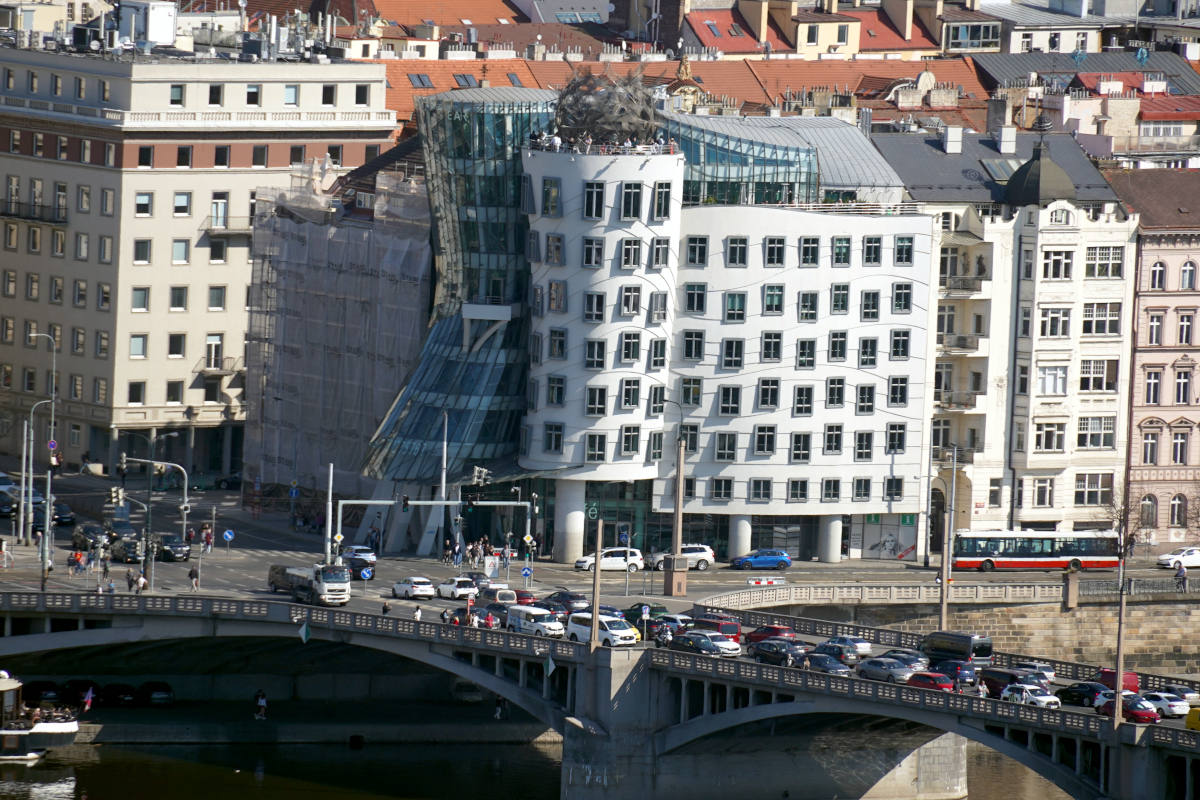
While the tower does offer the best comprehensive view of the city of Prague, the view is almost as good from the hilltop without going up in the tower — and it’s free. Either way, you can take in the sweep of of the city’s varied landmarks. You can see the medieval structures like Charles Bridge and Prague Castle, as well as more modern additions like the V-Tower (a residential complex that looks like the letter V, or is it H), and the Dancing House, which from this height looks as if it’s melting in the sun.
And that’s Prague for our first time around. We came, we saw, we explored, we experienced. From down there, and from up here.
Events occurred: 4/4/2025

Leave a Reply